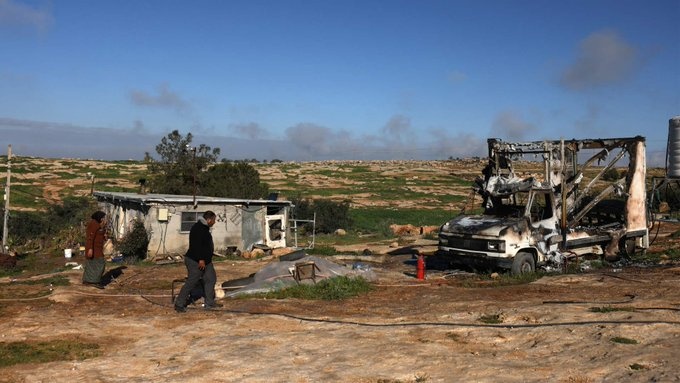

Armed Israeli settlers have driven more than 4,000 Palestinians from 59 communities across the occupied West Bank since October 7, 2023, according to Israeli human rights organisation B’Tselem, as the Israeli government funnels billions of shekels into settlement expansion and grants settlers near-total legal impunity.
The scale of displacement has accelerated sharply since Israeli Prime Minister Benjamin Netanyahu handed civilian control of the West Bank to Finance Minister Bezalel Smotrich in late 2022, creating a new administrative body — the Settlement Administration — that operates within the Defence Ministry but answers exclusively to Smotrich, himself a settlement resident.
The United Nations recorded close to 2,000 settler attacks in the West Bank in 2025, an average of approximately five per day, according to Middle East Eye.
B’Tselem also reports that the Israeli army has displaced more than 32,000 Palestinians from refugee camps in the same period, with many homes deliberately demolished. The United Nations has recorded more than 1,000 Palestinian deaths — including at least 200 children — in the West Bank since October 2023.
The settler violence is not spontaneous. It operates within a structure of state financing and legal protection that critics say makes the Israeli government directly responsible for the displacement.
Smotrich, in his capacity as finance minister, approved seven billion shekels ($2.4 billion) for a five-year settlement road construction programme, Lior Amihai, executive director of Israeli NGO Peace Now, told Middle East Eye at his Tel Aviv office. That sum works out to 1.4 billion shekels per year — approximately 30 percent of Israel’s entire national roads budget — spent on infrastructure serving roughly 300,000 settlers, who make up about three percent of Israel’s total population.
“This is daylight robbery of public funds to benefit a small group within the government’s base,” Amihai said.
Earlier this year, the Israeli cabinet approved 34 new settlements, bringing the total number approved under the Netanyahu coalition to 102, adding to the 127 settlements constructed in the almost 60 years since Israel occupied the West Bank and East Jerusalem following the 1967 Arab-Israeli war.
According to the International Crisis Group, 94 unauthorised settler outposts were established last year alone. These begin as a handful of armed individuals in mobile homes on hilltops before gaining formal recognition over time and expanding into permanent settlements. Middle East Eye correspondents travelling the Ramallah-to-Nablus route in May 2026 observed two new caravans on a hilltop that had not been there the previous week.
Itamar Ben Gvir, who leads the far-right Jewish Power party and serves as national security minister in the coalition, has given legal cover to the arming of settlers. In January, he approved personal gun licences across 18 illegal settlements to, as he described it, enhance self-defence. Settlers across the West Bank now have access to weapons ranging from M16 assault rifles to pistols and drones, according to Middle East Eye’s reporting.
All Israeli settlements in the West Bank are illegal under international law. The International Court of Justice affirmed that ruling in 2024.
Former Mossad director Tamir Pardo visited the West Bank last month and offered a stark personal assessment of what he witnessed. “My mother was a Holocaust survivor, and what I saw reminded me of the events that happened against Jews in the last century,” Pardo told Middle East Eye. He added: “What I saw today made me feel ashamed to be Jewish.”
The violence extends beyond Palestinians. Lior Amihai was physically assaulted by settlers three weeks after speaking to Middle East Eye, while leading a Jordan Valley tour for Israeli left-wing activists. Footage of the incident shows settlers striking him and pushing him against a vehicle. Human rights activist Aviv Tatarsky, of the Israeli peace organisation Ir Amim, told Middle East Eye that settlers from the ultra-orthodox Emmanuel settlement attacked him last month in Deir Istiya, a village 15 kilometres south of Nablus, after he intervened when Palestinian farmers were assaulted.
“They assaulted me, beat me with a plastic hose, hit me in the face,” Tatarsky said. He added that a police complaint was filed but that he had heard nothing back.
Foreign media have also come under attack. Settlers assaulted a German television crew last July, and CNN journalists were detained in March, according to Middle East Eye.
The Palestinian Authority, which commands approximately 70,000 security personnel, has not deployed those forces to protect Palestinians from settler violence. One senior Palestinian Authority officer, speaking to Middle East Eye, acknowledged the authority’s role plainly. “We are collaborators. We are under the orders of Israel. Anyone who denies this is a liar,” the officer said.
Background
Israel has occupied the West Bank since capturing it from Jordanian control during the 1967 Arab-Israeli war. Under international law, an occupying power must administer occupied territory through military structures and in the interests of the occupied population. Netanyahu’s creation of the civilian-run Settlement Administration in 2022 transferred that authority to Smotrich’s office, which Peace Now notes is legally bound to serve the interests of Israeli citizens — not the Palestinians living under occupation. The coalition agreement between Netanyahu, Ben Gvir’s Jewish Power party, and Smotrich’s Religious Zionist party was finalised in late 2022 after Netanyahu failed to secure a Knesset majority on his own.
What Happens Next
The Israeli cabinet’s approval of 34 new settlements this year sets the legal basis for further permanent construction across the West Bank. According to Peace Now, historical patterns show that once settler roads are built, the settler population in those areas increases sharply and Palestinian residents are displaced. Smotrich retains control of both the West Bank’s administrative apparatus and the national finance ministry, giving him the authority to continue directing public funds into settlement infrastructure. The International Crisis Group’s tracking of outpost growth suggests the rate of new outpost establishment is likely to continue at the pace recorded in 2025. No international body has announced a mechanism to enforce the ICJ’s 2024 ruling on settlement illegality.