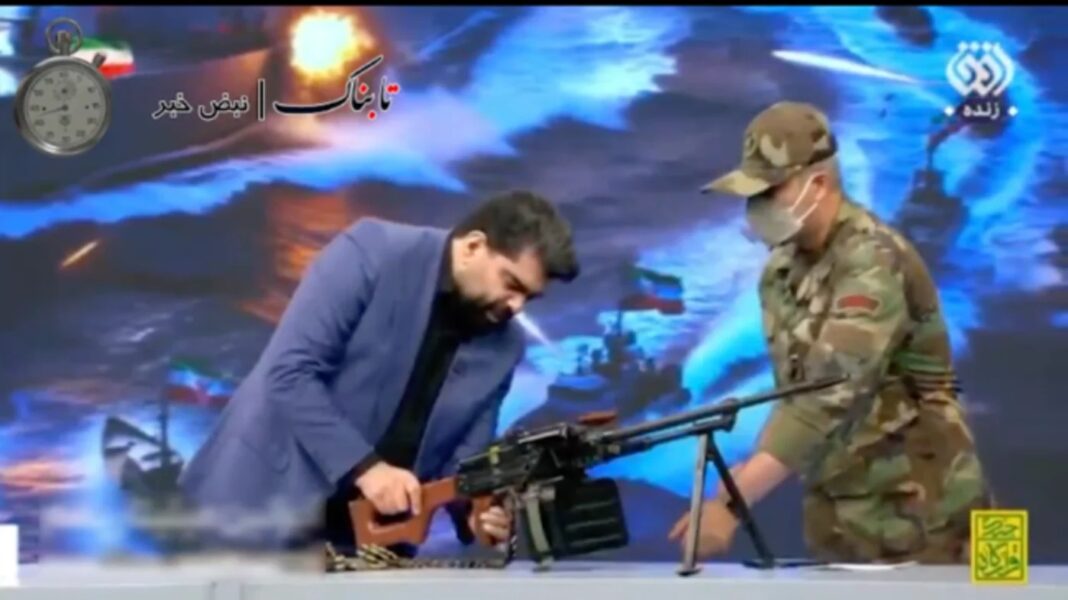

Iran’s state broadcaster has aired a series of live weapons training programmes, including demonstrations with Kalashnikov rifles and PK machine guns, since May 16, Middle East Eye reported on Thursday, May 21. The broadcasts, which appeared across multiple channels of the Islamic Republic of Iran Broadcasting (IRIB), showed presenters and uniformed Islamic Revolutionary Guard Corps officers instructing viewers on how to assemble, disassemble, and fire firearms. The content marked a departure from the network’s standard programming and drew criticism from inside Iran and abroad.
IRIB is Iran’s only television network, is controlled by hardliners, and its director is appointed by Iran’s supreme leader.
In one live broadcast on Channel 3, dedicated to Kalashnikov training, a masked man wearing an IRGC uniform demonstrated how to use the weapon. The programme’s host then prepared the rifle and asked the IRGC officer for permission to shoot at a UAE flag in the studio, which he then did on air.
The broadcast did not stop there. In another live broadcast, a television presenter joined supporters of the establishment gathered in Tehran’s main squares and fired a shot into the air in front of the camera. He then said, “This was just a shot for fun, but if necessary, each of us will take up arms and cut off the ear of those who want to invade this land.”
The display of weapons on Iranian state television was not limited to male presenters. Mobina Nasiri, a well-known pro-establishment TV presenter, also held a Kalashnikov during a live broadcast and said she had recently received the weapon and was ready to join the war against Israel and the US if necessary.
In another televised segment, an IRGC member demonstrated shooting techniques using an unloaded Kalashnikov while aiming at an image of Israeli Prime Minister Benjamin Netanyahu displayed on a studio wall. After him, the presenter pointed the weapon toward the forehead of US President Donald Trump and said: “I hope these bullets will one day hit their target.”
IRIB Defends the Content
IRIB officials moved quickly to defend the programming publicly. Mohsen Barmahani, IRIB’s deputy head, told Tasnim News Agency: “In a wartime situation, and in a country that is simultaneously engaged in a struggle against all world powers and oppressions, it is only natural for the national media to adopt a war footing.”
Barmahani also said it was important for Iranian civilians, including children, to “become acquainted with the concepts of jihad, resistance, and defense, and strengthen their sense of responsibility and readiness within the framework of religious, cultural, Iranian, and Islamic values.”
IRIB political deputy Hassan Abedini separately described the content as “symbolic.”
The broadcaster’s explanation did not satisfy critics. The conservative news website Khabar Online said media experts viewed the approach as poor judgment, while also noting that IRIB may have intended to signal to foreign enemies that “all segments of the nation are ready for battle,” or to project unity at home.
The outlet Rouydad24 wrote: “Broadcasting weapons training on television, in a country that already has an army, the IRGC, security forces, the Basij, and millions of men with mandatory military training, raises a troubling question more than it demonstrates ‘strength’: who exactly are these training programs intended for, and what situation are people being prepared for?”
Weapons Training in Public Spaces
The broadcasts were not confined to television studios. IRIB aired footage on May 18 of civilians — including women, teenagers, and children — receiving hands-on training in assembling, loading, and firing personal weapons during nightly pro-regime rallies in city squares. Khabar Online reported the same day that similar “defense preparedness” stalls had been erected in mosques and public spaces, teaching basic firearm handling to ordinary citizens.
The broadcasts showed live studio instruction on how to operate and dismantle weapons including Kalashnikov rifles, PK machine guns, the Dragunov sniper rifle, and the RPG-7. The network also broadcast footage of weapons training inside mosques in Ahvaz, Kerman, Shiraz, and Zahedan.
Former IRGC commander and member of parliament Ismail Kowsari, speaking on IRIB News on May 16, demanded universal readiness: “Woman and man… if they see any point occupied by the Zionist or American regime, they can confront it.”
Arrests and Executions Since February
The weapons broadcasts emerged alongside a worsening human rights picture documented by monitoring organisations. US-based Iranian rights activists news agency HRANA said the human rights situation in Iran has worsened since the start of the US-Israeli war, with more than 4,000 people arrested on security-related charges. According to a report by HRANA, at least 4,023 people were arrested in Iran between February 28 and April 8 on charges including espionage, threatening national security, spreading war-related information, and cooperating with hostile countries.
The report also said that 50 people were executed during the same period, including 32 linked to political and security-related charges.
The detention conditions have deteriorated, according to the same report. Conditions in prisons and detention centres have worsened significantly. Outside the prisons, authorities expanded checkpoints and increased movement restrictions. The report also said children were being deployed at checkpoints set up across Iranian cities, with some as young as 12.
Regional and Global Impact
The UAE flag shooting drew no immediate public response from Abu Dhabi, but the on-air incident added friction to already strained relations between Iran and Gulf Arab states. The broadcasts and events coincide with growing speculation about possible renewed ground operations inside Iran.
Tehran’s Stock Exchange reopened on Tuesday, May 19, after an 80-day suspension imposed as the authorities sought to contain panic and manage the political fallout from deepening economic turmoil. The reopening came as the weapons programming continued on state channels, drawing a parallel picture of a government managing internal pressure on multiple fronts.
Background
The US-Israeli war on Iran began on February 28, 2026, with strikes on Iranian nuclear facilities. A ceasefire took effect on April 8, but no formal peace agreement has been reached. IRIB has historically served as a platform aligned with Iran’s hardline establishment, with its editorial direction set by the supreme leader’s office. Iranian schools already include “defense preparedness” lessons from Grade 9 to Grade 12, covering weapon safety, basic operation, civil defense, and what authorities call “soft-war concepts.” The current weapons broadcasts represent an extension of that curriculum into prime-time national television.
What Happens Next
IRIB’s deputy head Barmahani defended the programming as having “educational, cultural and training value” beyond combat, suggesting the network intends to continue the content. HRANA said it would continue monitoring arrest figures and detention conditions as peace negotiations between Iran and the United States remain deadlocked. No Iranian government body has announced a timeline for suspending the weapons broadcasts, and no formal diplomatic complaint has been publicly filed by the UAE regarding the flag-shooting segment.