
Eurovision Winners Demand Israel’s Removal From Vienna Contest Amid Gaza Boycott
Multiple past Eurovision Song Contest champions have publicly condemned Israel’s inclusion in the 2026 edition of the competition, set to take place in Vienna next week, citing the ongoing military campaign in Gaza and what they describe as the European Broadcasting Union’s failure to separate the contest from political responsibility. These winners think the European Broadcasting Union should not mix the contest with politics.Ireland and four other national broadcasters have already withdrawn entirely, while over 1,000 artists worldwide have signed a formal petition calling for a full boycott of the event.
A Stage Turned Political Battleground
The Eurovision Song Contest has long marketed itself as apolitical. That claim has never been easy to sustain. This year, it is harder than ever.The Eurovision Song Contest has a lot of problems, with this idea.
As the 70th edition of the contest prepares to open in Vienna on Tuesday, May 13, 2026, a coalition of former winners, national broadcasters, and prominent musicians has escalated calls for Israel’s disqualification. The pressure campaign centers on Israel’s military operations in Gaza, which have resulted in more than 72,000 Palestinian deaths since October 2023, according to Middle East Eye, with thousands more reported missing or presumed dead beneath the rubble of destroyed infrastructure.
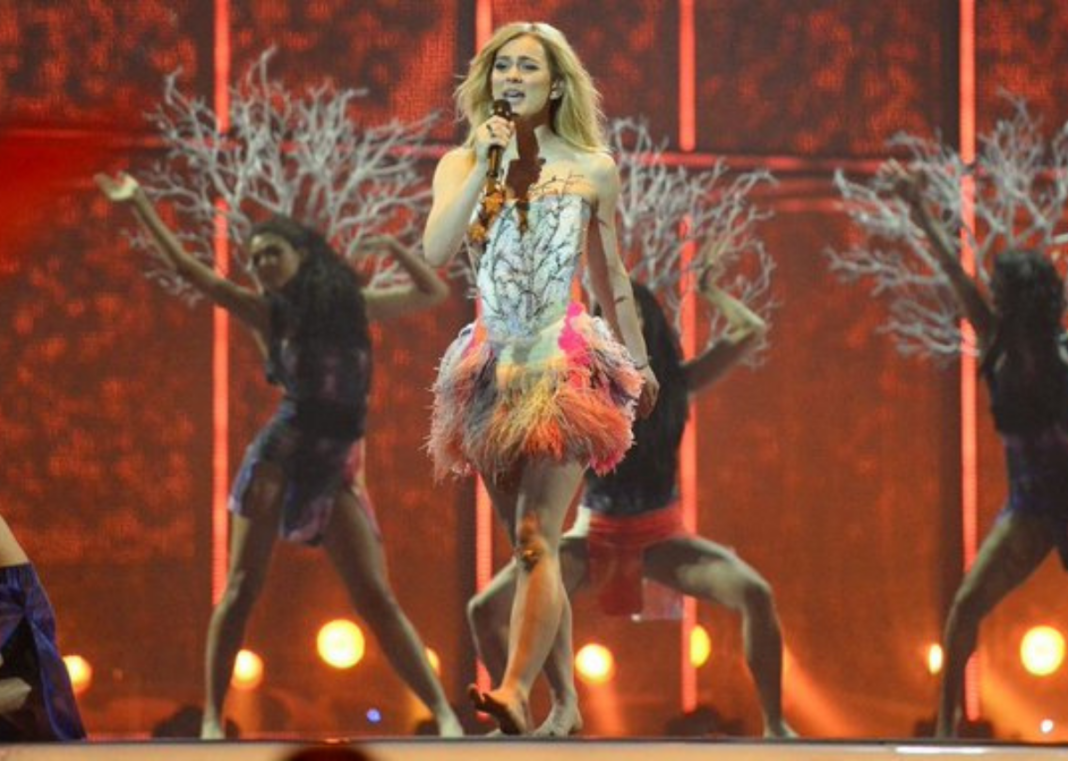
Emmelie de Forest, the Danish singer who won the 2013 Eurovision contest at age 20 with the song Only Teardrops, is among the most prominent voices opposing Israel’s participation. Speaking to Middle East Eye, de Forest framed the controversy not only as a humanitarian matter but as a question about the integrity of cultural institutions.
“For me, this is first and foremost about the devastating humanitarian catastrophe in Gaza and the enormous loss of civilian lives,” de Forest told Middle East Eye. “But it’s also about what it means when cultural institutions try to completely separate themselves from political reality. I don’t think music exists outside the world around us.”
De Forest added that her public stance had come at personal cost. She said she had strained friendships and risked financial income by speaking out — but concluded that “sometimes integrity costs something.” She also directed her sharpest criticism at the EBU itself rather than at individual artists or fans, arguing that “keeping Israel in the competition is also a political decision.”
Boycotts, Withdrawn Trophies, and Absent Broadcasters
The boycott movement has drawn support from across the music world. More than 1,000 artists signed the No Music For Genocide petition calling on the EBU to bar Israel from the competition. Signatories include Peter Gabriel, Björk, Massive Attack, Macklemore, Brian Eno, and Mogwai, alongside de Forest and Charlie McGettigan, the Irish singer who won Eurovision in 1994.
McGettigan has taken his protest a step further. Following the example set by Nemo — the Swiss performer who won the 2024 contest and subsequently announced they would return their winner’s trophy in protest — McGettigan said he had intended to do the same, until discovering he had never been issued a physical award.
“So let’s say I returned a virtual trophy!” he told Middle East Eye.
McGettigan’s native Ireland is among the five national broadcasters that have formally withdrawn from the 2026 contest. Spain, Iceland, Slovenia, and the Netherlands have also pulled out. McGettigan said he personally petitioned Ireland’s state broadcaster, RTÉ, to withdraw, alongside pro-Palestine campaigners, and that station management voted to comply.
“I’m not a member of any organisation — it’s just me personally, and thankfully, the management at RTÉ decided after a vote that they weren’t going to take part and that’s admirable, I think,” he said.
McGettigan also rejected the notion that entertainment and politics are separable, pointing to a long tradition of musicians using their platforms to challenge injustice.
“When you look back at people like Pete Seeger from the 1960s, Woody Guthrie, Bob Dylan, Joan Baez — all these artists have used their music to promote peace, to draw attention to injustice,” he said. “Some countries just see this as entertainment, and they don’t see entertainment as having any place for politics — but I do.”
The EBU’s Position and the “Big Four”
The European Broadcasting Union, the body that governs the Eurovision Song Contest, ruled in December 2025 that Israel would be permitted to participate in the 2026 edition despite mounting pressure at its General Assembly to hold a formal vote on the issue. The EBU has consistently maintained that the contest operates separately from political affairs.
That position has done little to quiet critics. Spain remains the only member of the so-called “Big Four” — the group of France, Germany, Spain, and the United Kingdom that automatically qualify for the contest each year due to their financial contributions to the EBU — to have withdrawn. The UK’s Department for Culture, Media and Sport declined to comment on the controversy when contacted by Middle East Eye in September, deferring instead to the BBC, which oversees British participation in Eurovision. The BBC also declined to comment. Representatives for the artists competing on behalf of the UK, France, and Germany had not responded to requests for comment at time of publication.
Security, Protests, and the Nakba Day Timing
The political atmosphere surrounding the Vienna contest has drawn a significant security response from Austrian authorities. At a press conference on Tuesday, police announced they expected “blockades and disruption attempts” from approximately 3,000 protesters — both pro-Palestinian and pro-Israel demonstrators — in the Austrian capital during the event. Authorities confirmed that drones would be prohibited within a 1.5-kilometer radius of contest venues. The United States Federal Bureau of Investigation is also establishing a task force in New York next week, on standby to assist Austrian authorities around the clock in addressing potential cyber threats.
The timing of the contest’s grand finale adds a further layer of symbolic weight. The eve of the final, May 15, coincides with Nakba Day — the annual commemoration observed by Palestinians marking the 1948 displacement and massacres that accompanied the founding of the State of Israel. More than 700,000 Palestinians were expelled from their homes during that period, an event Palestinians call the Nakba, meaning “catastrophe” in Arabic.
Regional and Global Implications
The Eurovision controversy reflects a broader fracturing of cultural and diplomatic consensus in Europe over Israel’s military conduct in Gaza. The withdrawal of five national broadcasters — Ireland, Spain, Iceland, Slovenia, and the Netherlands — represents an unprecedented level of coordinated institutional protest within the Eurovision framework. The contest, which reaches a television audience estimated in the hundreds of millions across Europe and beyond, has become a high-visibility arena for the debate over whether cultural platforms bear responsibility for political complicity.
For Israel, continued participation in Eurovision functions as a form of soft-power engagement with European audiences. For critics, that engagement is precisely the problem. The EBU’s refusal to exclude Israel has placed it at odds not only with individual artists but with national public broadcasters in multiple member states — an institutional tension with no clear precedent in the contest’s 70-year history.
Background: Eurovision and Politics
The Eurovision Song Contest was founded in 1956 as a vehicle to promote postwar unity in Europe through shared cultural programming. Despite its stated non-political mandate, the contest has never existed in a vacuum. Portugal’s 1974 entry served as a signal for the Carnation Revolution that ended decades of dictatorship. In 2009, Azerbaijani authorities interrogated 43 citizens for voting in favor of Armenia’s entry. Russia was expelled from the contest entirely in 2022 following its full-scale invasion of Ukraine.
Israel has participated in Eurovision since 1973 and has won the contest four times — in 1978, 1979, 1998, and 2018. The 2018 win, held in Lisbon, generated early controversy when Israeli forces shot dead 62 Palestinians in Gaza — including six children — during the Great March of Return protests, just days after Israel’s victory was announced. McGettigan cited that episode as a turning point in his own awareness of the issue.
What Happens Next
The Eurovision Song Contest 2026 opens in Vienna on Tuesday, May 13, with the grand final scheduled for Saturday, May 17. Protests are expected throughout the week, with authorities braced for disruption on multiple fronts. There will probably be protests all week long. The people, in charge are getting ready for problems to happen in different ways.
The EBU has stated it will not censor audience reactions directed at Israel’s entry, following reporting that booing Israeli performers had occurred at the 2025 contest in Basel, Switzerland. Whether additional national broadcasters announce late withdrawals in the days ahead remains an open question. The contest’s organizing body faces sustained institutional pressure, and the outcome of this year’s event is likely to determine whether its current policy on Israel remains tenable heading into future editions.
De Forest issued a pointed closing message to Eurovision’s fanbase, one that captures the tension at the heart of the debate.
“Fans have more influence than they sometimes realise, especially collectively,” she said. “I think people should continue speaking openly, asking difficult questions and refusing to simply move on as if nothing is happening.”