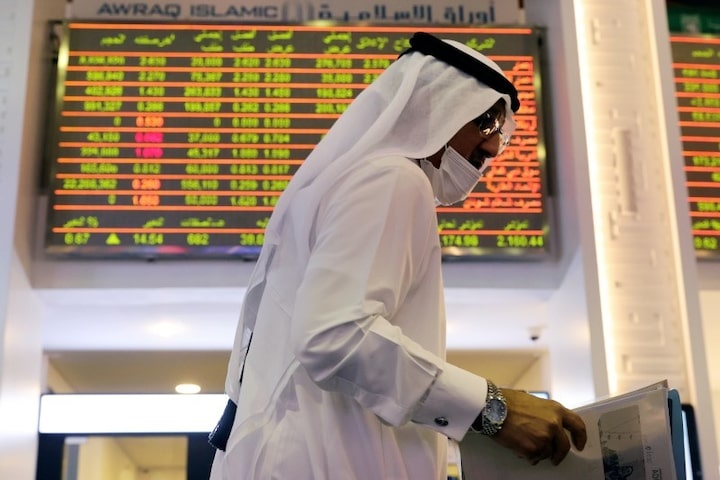

Stock markets across the Gulf and Egypt declined on Sunday, May 17, as the unresolved standoff between the United States and Iran continued to weigh on investor confidence and energy markets. Dubai’s benchmark index extended losses for a sixth straight session, falling 0.5%, with most constituents trading lower. Egypt’s bourse extended a separate losing run driven by the regional conflict’s broader economic spillover.
Blue-chip developer Emaar Properties dropped 1%, while Air Arabia tumbled 2% after the low-cost carrier reported a 22% decline in first-quarter net profit, mainly due to the impact of the ongoing conflict in the region.
In Abu Dhabi, the index eased 0.3%, weighed by losses in technology and energy stocks. Conglomerate Alpha Dhabi Holding fell 1.7%, while ADNOC Drilling declined 4.6%.
The session came two days after US-Iran diplomatic momentum stalled again. U.S. President Donald Trump said on the final day of his trip to China that his patience with Iran was running out. He said Chinese President Xi Jinping agreed that Tehran must not be allowed to develop nuclear weapons and should reopen the Strait of Hormuz.
“Stocks in the UAE continued to see some pressure amid the uncertain and cautious sentiment. Efforts to expand pipeline capacity could support the economy over the long term and secure a higher level of energy exports if tensions persist,” said Joseph Dahrieh, managing director at Tickmill.
Milad Azar, market analyst at XTB MENA, said markets were likely to remain sensitive to geopolitical headlines and developments on the ground. “Concerns about the sustainability of the current ceasefire and the resurgence of incidents could keep markets on edge,” Azar said.
Oil prices climbed more than 3% on Friday as concerns over the stalled U.S.-Iran peace talks and the Strait’s closure persisted. Brent crude was up 3.3% at $109.19 a barrel at 0925 GMT.
The broader markets picture was similarly subdued. Saudi Arabia’s benchmark index dropped 1.3% as almost all its constituents were in negative territory, including Al Rajhi Bank, which was down 0.6%, and oil giant Saudi Aramco, which fell 0.4%. Saudi Arabia reported a first-quarter fiscal deficit of 125.7 billion riyals ($33.5 billion) as the kingdom increased spending to support the economy amid disruption caused by the Iran war.
Dubai’s main share index retreated 1.7% in Thursday’s session, its biggest intraday fall since April, dragged down by losses across sectors and led by a 3% slide in Emaar Properties. The Qatari index traded 0.8% lower, with petrochemical maker Industries Qatar losing 1%.
Egypt’s EGX continued to slide. Fears have developed that the Iran conflict will spill over into Egypt through the Gaza theater or the Red Sea crisis. The conflict has also reduced traffic through the Suez Canal, costing Egypt approximately $10 billion in losses according to the World Bank Group.
The UAE took steps to reduce its vulnerability. The UAE announced it will accelerate the construction of a new oil pipeline to double its export capacity through Fujairah by 2027, a move that would significantly expand the country’s ability to bypass the Strait of Hormuz.
Regional and Global Impact
Regional equity markets, especially the UAE and Qatar, whose energy and civilian infrastructure sustained significant damage under waves of Iranian missiles and drone attacks, have taken a battering. Dubai’s benchmark DFM General Index led losses with declines of almost 19% during the first weeks of the conflict.
However, benchmarks in both Dubai and Abu Dhabi have clawed back almost half of that lost ground. The Dubai index is now about 9% lower since the beginning of the conflict, and Abu Dhabi shares are down about 5%.
Gulf Cooperation Council economies — including Bahrain, Kuwait, Oman, Qatar, Saudi Arabia, and the UAE — host some of the world’s largest sovereign wealth funds, with around a dozen sovereign funds managing significant assets. The Council on Foreign Relations warned in May 2026 that the war presents a less-appreciated risk to the United States: the supply of dollars from the Gulf, especially to capital-hungry US technology firms.
Goldman Sachs raised its Brent crude forecast to $90 a barrel by late 2026, up from $80 previously, as disruptions in the Persian Gulf proved more persistent than earlier assumed. The bank estimated that global inventories were drawing at a record pace of 11 to 12 million barrels per day in April.
Background
The United States and Iran agreed to a two-week ceasefire brokered by Pakistan beginning on April 8. The ceasefire came under strain after Iran refused to reopen the Strait of Hormuz, blaming Israeli strikes in Lebanon. Following the failure of the Islamabad Talks, Trump announced a naval blockade of Iran from April 13; there is currently a dual blockade, with the US Navy blockading Iran and Iran blockading the Persian Gulf.
On May 15, The New York Times reported that Israel and the United States were intensifying preparations for potential attacks on Iran, with operations possibly starting as soon as the following week.
Trump rejected Iran’s counterproposal to end the conflict, calling it “totally unacceptable,” while Tehran vowed to “never bow,” prolonging a standoff that has choked the Strait of Hormuz and rattled global energy markets. Iranian drone attacks on Gulf neighbors continued over the weekend preceding the May 17 session, with the UAE saying it intercepted two drones coming from Iran.
What Happens Next
Ali El Adou, head of asset management at Dubai-based Entrust Capital, said investors were already pricing in a positive outcome of negotiations from a long-term perspective. “That is why you are seeing this recovery,” he said, adding that markets look set for further gains if hostilities do not erupt again.
Hani Abuagla, senior market analyst at XTB MENA, warned that a deterioration in the geopolitical situation could generate new pressures on regional stock markets. “A prolonged disruption of the Strait of Hormuz remains a source of risk for the region and could limit gains,” Abuagla said.
The UAE’s pipeline expansion, confirmed on May 15, is scheduled for completion by 2027. Diplomatic contacts between Washington and Tehran are expected to continue, with Pakistan’s leadership actively pushing to revive formal talks, according to Reuters.