
India and UAE Sign Defence Framework, Energy Accords as Modi Visits Abu Dhabi
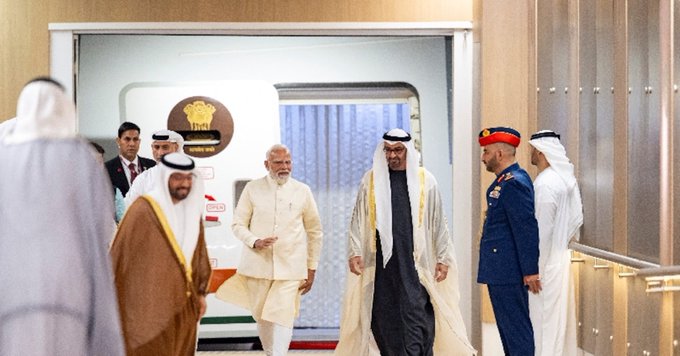
Indian Prime Minister Narendra Modi signed a strategic defence partnership agreement and two energy-focused memoranda of understanding with the United Arab Emirates on Friday, May 15, during a four-hour stop in Abu Dhabi. The visit, the first leg of a five-nation tour, also produced a $5 billion UAE investment commitment in India. Modi held talks with UAE President Sheikh Mohamed bin Zayed Al Nahyan before departing for Europe.
The two countries signed an Agreement on the Framework for the Strategic Defence Partnership, along with a Memorandum of Understanding on Strategic Petroleum Reserves and a separate agreement on long-term supplies of Liquefied Petroleum Gas. Both nations also signed an MoU to establish a ship repair cluster at Vadinar in Gujarat. The defence framework extends cooperation to the defence industry, cybersecurity, counter-terrorism, innovation, and military interoperability, according to India TV News. India TV NewsIndia TV News
UAE investment worth $5 billion was announced for Indian infrastructure, as well as for RBL Bank and Samman Capital. The announcement came as part of what officials described as a broader effort to deepen economic and strategic ties at a moment of elevated regional instability. India TV News
The regional context weighed heavily on the talks. The UAE, which hosts a prominent United States military base, has been targeted by Iranian strikes during the ongoing US-Israeli war on Iran. Modi condemned those attacks directly in his opening remarks with the UAE president. Business Standard
“We condemned the attacks on the UAE,” Modi said, according to Business Standard. “The manner in which the UAE has been targeted is not acceptable in any form. We welcome the steps taken by you to uphold national unity, security and regional integrity.” India TV News
Modi also addressed the broader conflict in the region. “The impact of war in the West Asia region is seen across the world today. India has always given importance to dialogue and diplomacy for resolving issues. It is our biggest concern that Hormuz remains free and open,” he said, adding that India stands “shoulder-to-shoulder with the UAE in every situation.” The Week
Modi also thanked the UAE leadership for protecting the Indian diaspora during the period of strikes and regional tension, saying the way the Indian community was treated “as members of one’s own family” warranted his “heartfelt gratitude.” Organiser Weekly
Energy Security at the Core
Energy security was a central theme of the discussions, with New Delhi seeking Abu Dhabi’s support on long-term supplies of cooking gas and crude oil, as well as expanded strategic petroleum reserves. The Week
The UAE was the first country to partner with India on Strategic Petroleum Reserves. In 2018, Indian Strategic Petroleum Reserves Limited and ADNOC agreed for the UAE to store over 5 million barrels of crude oil at India’s facility in Mangalore. Indian companies have also invested over $1.2 billion in the upstream oil sector in the UAE. In January 2026, BPRL confirmed an oil discovery in Abu Dhabi’s Onshore Block 1 — the first of its kind by an Indian company in the region, according to Business Standard. Business Standard
Officials said the agreements would deepen economic and strategic engagement at a time when regional instability has increased the importance of reliable energy and trade partnerships. Organiser Weekly
Regional and Global Impact
The Strait of Hormuz dimension of the talks carries direct consequences for India’s economy. Iran’s regional posture has raised fears of disruption to one of the world’s busiest shipping lanes, through which a substantial portion of India’s oil imports travel. Modi’s public call for Hormuz to remain “free and open” signals New Delhi’s calculation that its energy lifeline depends on the outcome of the current conflict, according to The Week.
The UAE is India’s third-largest trade partner and its seventh-largest source of cumulative investment over the past 25 years. The defence framework agreement moves the relationship further into security cooperation, an area that has grown steadily since the UAE president’s state visit to India in January 2026. Wionews
The UAE hosts more than 4.5 million Indians, making the Indian diaspora one of the largest expatriate communities in the Gulf region. Their welfare formed a distinct component of Friday’s bilateral talks. Organiser Weekly
Background
India’s Ministry of External Affairs described the UAE leg of the tour as focused on bilateral energy cooperation and on promoting trade and investment linkages between the two countries. India and the UAE have expanded cooperation across renewables in recent years. A consortium of Indian companies including OVL, BPRL, and IOCL took a 10 percent stake in the Lower Zakum block in the UAE in 2018, followed by a stake in Abu Dhabi Onshore Block-1 in 2019. Friday’s visit built on that upstream investment base while extending cooperation into defence and maritime sectors for the first time under a formal framework agreement. Business StandardBusiness Standard
What Happens Next
After departing Abu Dhabi, Modi travelled to the Netherlands for the second leg of his five-nation tour, which also includes Sweden, Norway and Italy, and is scheduled to run through May 20. King Willem-Alexander and Dutch Prime Minister Rob Jetten are due to receive Modi on May 16 at Huis ten Bosch Palace, where a luncheon will follow. A roundtable with Dutch and Indian CEOs is also scheduled at the prime minister’s official residence, the Catshuis. The MoUs signed in Abu Dhabi on defence and petroleum reserves will now require implementation steps by both governments, though no timetable for those steps was announced on Friday. WionewsWionew