
A coordinated offensive by two armed coalitions has thrown Mali into its deepest crisis in years, killing a senior government minister, forcing Russian mercenaries from key northern towns, and cutting supply lines into the capital, Bamako. Fighters from the Azawad Liberation Front (FLA) and Jama’at Nusrat al-Islam wal-Muslimin (JNIM) launched simultaneous attacks on military outposts across the country on 25 April, according to Middle East Eye. The assault represents the gravest threat to Mali’s ruling military junta since it came to power in 2020.
The scale of the offensive was immediate and lethal. Defence Minister Sadio Camara was killed in a suicide bombing at his residence in Kati, a key barracks town near the capital, on 26 April, Middle East Eye reported. Mali’s military leader, Colonel Assimi Goita, appointed himself defence minister three days later. By 28 April, JNIM had announced a siege of Bamako itself, with Al Jazeera reporting that fighters were filmed torching food trucks bound for the capital on 6 May.
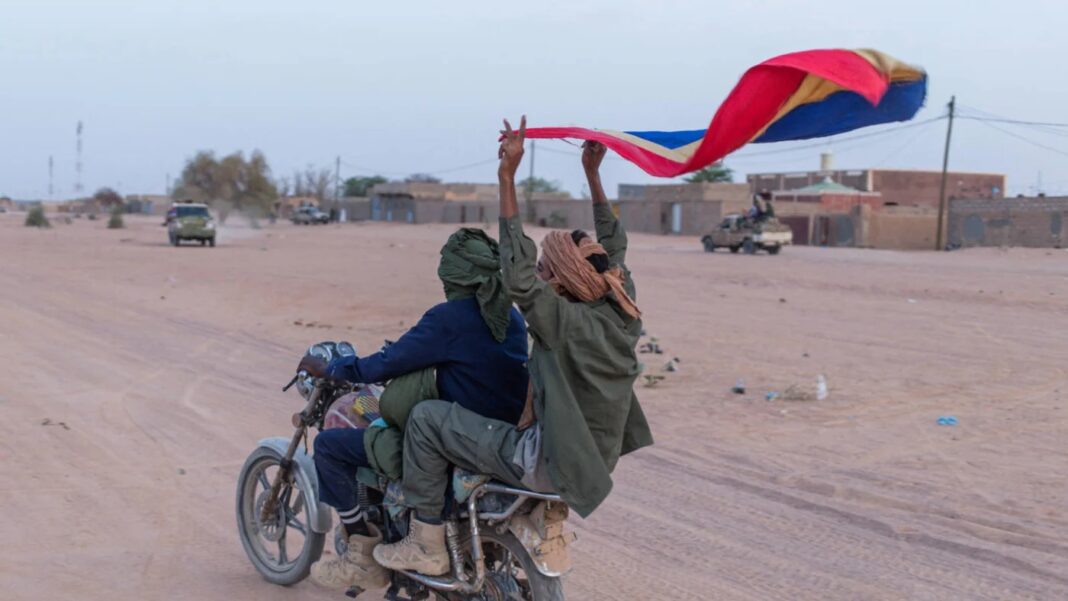
In the north, the FLA and JNIM seized the city of Kidal, forcing Africa Corps mercenaries — the Russian state paramilitary deployed to support Goita’s government — to withdraw from the town on 26 April, according to the BBC. The Malian government subsequently subjected Kidal to aerial bombardment. Elsewhere, on 6 May, JNIM fighters stormed Kenieroba Central Prison near Bamako, which holds more than 2,500 prisoners, Al Jazeera said.
Who is fighting and why?
The FLA is a militant separatist group with principally nationalist goals. It seeks independence for a region in northern Mali that its supporters call Azawad. Most of its leadership and fighters are Tuareg, a Berber ethnic group spread across multiple Saharan countries. In Mali, Tuaregs form the majority population in the Kidal and Menaka administrative regions and make up roughly 10 percent of the country’s total population, according to Middle East Eye.
The group is led by Tuareg commander and politician Alghabass Ag Intalla. It was formed in 2024 through a merger between the National Movement for the Liberation of Azawad (MNLA) — whose members previously fought for Muammar Gaddafi during the Libyan civil war — and smaller Tuareg factions, Middle East Eye reported.
JNIM is a different kind of force altogether. Formed in 2017 through the merger of four militant groups, including al-Qaeda in the Islamic Maghreb (AQIM) and Ansar Dine, it is the strongest militant group in the Sahel, with an estimated 6,000 fighters and territorial control over parts of eastern Mali, as well as sections of Niger and Burkina Faso, according to the Washington Post and Crisis Group. The UN Security Council has designated it a terrorist organisation. Its leader, former Ansar Dine emir Iyad Ag Ghali, is himself Tuareg, while his deputy, Amadou Koufa, is Fulani.
Their alliance is one of convenience, not ideology.
Jibrin Issa, a writer and political analyst specialising in Sahel affairs, told Middle East Eye that the joint offensive represents “a marriage of necessity from Azawad’s perspective, and an operational arrangement from al-Qaeda’s perspective.” He said the strategy was designed to “distract the Malian army in the north while jihadist groups push southwards to encircle the capital and open multiple pressure fronts simultaneously.”
Hamdi Jowara, a Malian journalist based in Paris, described the relationship more plainly. He told Middle East Eye that it was “a temporary alignment driven by the presence of a strong common enemy that neither side can defeat alone,” adding that coordination “is reflected more in a division of roles across fronts than in any formal organisational integration.”
The alliance has historical limits. In 2012, the MNLA and its then-partner Ansar Dine — a predecessor faction to JNIM — clashed after Ansar Dine imposed strict Sharia law across territory the two groups jointly controlled. France 24 reported that Ansar Dine pushed the MNLA out of Timbuktu in June 2012. The current partnership carries similar fault lines: the FLA seeks a secular, independent Azawad; JNIM seeks to impose religious law across the region.
Russia’s role — and its limits
Russia’s Africa Corps has operated in Mali since the Wagner Group’s transition following the death of its founder, oligarch Yevgeny Prigozhin, in 2023. Africa Corps fighters formally entered Mali in December 2024, with the force numbering an estimated 2,000 troops, according to Middle East Eye. Many of its personnel previously served with Wagner, which the BBC reported announced its departure from Mali last year.
The corps has provided direct military support to Goita’s government in operations against armed groups in the north. But the April offensive exposed its limitations: Africa Corps withdrew from Kidal as FLA forces advanced, the BBC reported. Algeria, which has longstanding ties to Moscow, reportedly helped negotiate the withdrawal with Russia, according to the Guardian.
The corps has also been accused of serious abuses. Human Rights Watch reported in July 2025 that both the Malian army and Wagner Group forces — the Africa Corps’ predecessor — had disappeared and executed Fulani civilians. Since the April offensive began, Le Monde reported that Fulani and Tuareg communities have described further forced disappearances by government forces.
Turkey, Ukraine, and the wider contest
Mali’s conflict has drawn in actors well beyond its borders.
Turkey has expanded its relationship with Goita’s government as part of what Middle East Eye described as a region-wide push across the Sahel. Ankara has supplied surveillance drones to the juntas in Mali, Burkina Faso, and Niger, and has provided personal security to Goita through the Turkish private military firm Sadat, according to Middle East Eye.
Ukraine’s involvement is less current but notable. In July 2024, Andriy Yusov, a spokesperson for Ukraine’s military intelligence agency, told the Guardian that Kyiv had provided assistance to Tuareg rebels in a battle against Africa Corps troops. Mali severed diplomatic relations with Ukraine in August 2024 in response. Whether Ukraine retains any active role in the country remains unclear, Middle East Eye said.
Meanwhile, in a joint statement on 27 April, the Alliance of Sahel States — the regional bloc formed in July 2024 by Mali, Burkina Faso, and Niger after all three withdrew from ECOWAS — condemned the FLA-JNIM attacks as “a monstrous plot backed by the enemies of the liberation of the Sahel,” according to Middle East Eye. The alliance inaugurated a 5,000-troop unified force in December 2025, intended to counter cross-border militant activity.
Background
Mali gained independence from France in 1960. A Tuareg rebellion in the north in 2012 ignited a broader civil war, during which the MNLA briefly declared an unrecognised independent state called Azawad before losing territory to rival armed groups. Peace agreements negotiated in 2013 and 2015 were largely unimplemented, and the government formally terminated the most recent deal in 2024 to resume its counteroffensive. Colonel Goita led a coup against civilian President Ibrahim Boubacar Keita in August 2020, then seized sole control in a second coup in May 2021. French troops, deployed since 2014, left in 2022; the UN peacekeeping mission departed in May 2023 after its director was expelled.
What happens next
Goita stated on 29 April that Mali’s security situation was “under control” and that the military would “neutralise” the rebel coalitions, Reuters reported. The rebel groups have rejected that framing. FLA spokesperson Mohamed Elmaouloud Ramadane told the BBC on 28 April that the FLA intends to seize Gao, a major city in eastern Mali. He added that Timbuktu — held under partial JNIM blockade since 2023 — “will be easy to take over once we fully control Gao and Kidal.” Both armed groups have stated their intention to expand territorial control. Fighting has continued beyond the initial offensive, with no ceasefire announced by any party as of 19 May 2026.