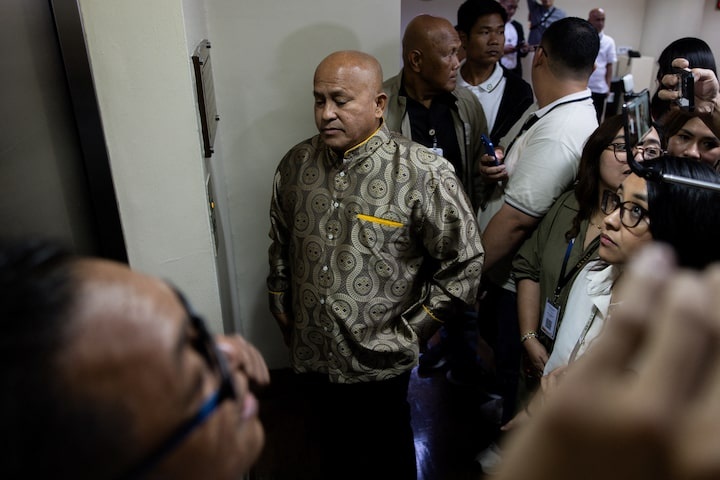

Senator Ronald “Bato” Dela Rosa, the former national police chief wanted by the International Criminal Court on charges of crimes against humanity, fled the Philippine Senate compound in the early hours of Thursday, May 14, after gunshots were fired inside the building the previous night. Dela Rosa reportedly left at around 2:30 a.m. Thursday, ending a days-long standoff that drew riot police to the Senate gates and sparked protests from families of those killed during former President Rodrigo Duterte’s drug war.
Senate President Alan Peter Cayetano confirmed on Thursday afternoon that Dela Rosa had left with Senator Robin Padilla. “The Senate sergeant-at-arms confirmed he’s no longer in the building,” Cayetano told reporters, according to Rappler.
The departure brought an abrupt end to a standoff that had gripped Manila for four days. On Monday, May 11, the ICC confirmed it had issued an arrest warrant for Dela Rosa, citing incidents in which 32 people were killed between 2016 and 2018. National Bureau of Investigation officers had attempted to serve the warrant at the Senate, only for Dela Rosa to evade them through the building’s corridors. Riot police then surrounded the compound, and the Senate voted to place him under “protective custody.”
By Wednesday night, the standoff turned volatile. Dela Rosa broadcast live on social media, claiming arrest was imminent and appealing to supporters: “I call on you. I hope you can help me. Let’s not allow another Filipino to be brought to The Hague, second to President Duterte.” Shortly after, gunfire rang out inside the Senate building. Police identified a suspect in the shooting as a driver working with the National Bureau of Investigation.
In a radio interview on DZBB that aired Thursday morning, Dela Rosa said he would “exhaust all available remedies” to block his transfer to the ICC, and after learning about the conditions Duterte was being held under, he was no longer willing to fight his case at The Hague.
His lawyer told reporters he had no prior knowledge. “As his lawyer, I asked him if you have plans to leave, he said none,” lawyer Jimmy Bondoc told reporters.
Outside the Senate on Wednesday, May 13, families of drug war victims held demonstrations demanding Dela Rosa’s immediate surrender to the ICC. Human rights groups added their voices. Ritz Lee Santos III, section director of Amnesty International Philippines, said the senator’s elected status offered no shield. “Dela Rosa held a key role in the implementation of the so-called ‘war on drugs’ under the administration of former President Duterte, responsible for command and direction over the police,” Santos said in a statement.
Deaconess Rubylin Litao, coordinator of Rise Up for Life and for Rights, called on the Senate directly: “The Senate should respect the Philippine government’s international obligations and allow the arrest of and surrender Bato dela Rosa to the ICC. Do not protect Duterte’s co-perpetrator in the commission of crimes against humanity.”
The Philippine Coalition for the International Criminal Court also “strongly” opposed the protective custody extended by the Senate, calling on authorities to arrest the former police chief and hand him over to the ICC.
The ICC Pre-Trial Chamber’s warrant, issued secretly on November 6, 2025, detailed Dela Rosa’s alleged central role in the anti-drug campaign. The Chamber found that Dela Rosa used his position as Davao City police chief to enable the operations of the so-called Davao Death Squad, a pattern of killings later replicated nationwide. As PNP chief, he allegedly enabled the continuation of the killings through his command authority, appointed key officials to carry out the campaign, and transferred police personnel from Davao to priority regions for nationwide “Tokhang” operations.
More than 6,000 people were killed in anti-drug operations after Duterte took office, according to police data. Independent monitors believe the actual number could be far higher. Both Dela Rosa and Duterte deny all charges.
The Philippine government’s legal position has become increasingly strained. The Department of Justice reiterated on Wednesday, May 13, that the Philippine government can surrender suspects to international courts, based on local law. Yet Cayetano refused to acknowledge the warrant, arguing that no local enforcement authority had presented the document to the Senate, and also argued against using the word “escape,” since Dela Rosa, in his view, was “free to go” anytime.
Dela Rosa invoked a 1987 constitutional provision stating that no lawmaker may be arrested while Congress is in session. That provision, however, explicitly covers only offences punishable by not more than six years’ imprisonment — not crimes against humanity.
Amnesty International Philippines noted that Republic Act 9851, which criminalises international crimes including genocide and crimes against humanity, requires the Philippine government to hand over those accused of such crimes to international tribunals.
The case is unfolding alongside wider domestic political turbulence. The House of Representatives had been working on the second impeachment of incumbent Vice President Sara Duterte, daughter of Rodrigo Duterte, who leads in public opinion polling to be the next Philippine President. Dela Rosa reappeared publicly on Monday, his first public appearance in months, at the Senate on the same day the House impeached the Vice President — a move that would require the Senate to convene as an impeachment court.
Former President Rodrigo Duterte was arrested at Manila’s international airport in March 2025 and flown to The Hague, where he remains in ICC custody. A start date for his trial has not yet been set.
What Happens Next
The Supreme Court did not immediately move to stop any arrest or transfer of Dela Rosa under the ICC warrant. Dela Rosa’s legal team has petitioned the Supreme Court for a temporary restraining order against the ICC arrest warrant, and that petition remains pending. The ICC’s Pre-Trial Chamber, in issuing the warrant, stated it was satisfied that Dela Rosa’s arrest was necessary to ensure his appearance before the court and to prevent him from obstructing investigations or court proceedings, citing his prior threats against the prosecution’s investigators. Human rights organisations have called on the Marcos administration to enforce the warrant and fulfil the country’s international legal obligations. His whereabouts as of Thursday afternoon had not been officially confirmed by authorities.