

Turkey Unveils First ICBM at Istanbul Defense Show, Raising Geopolitical Questions
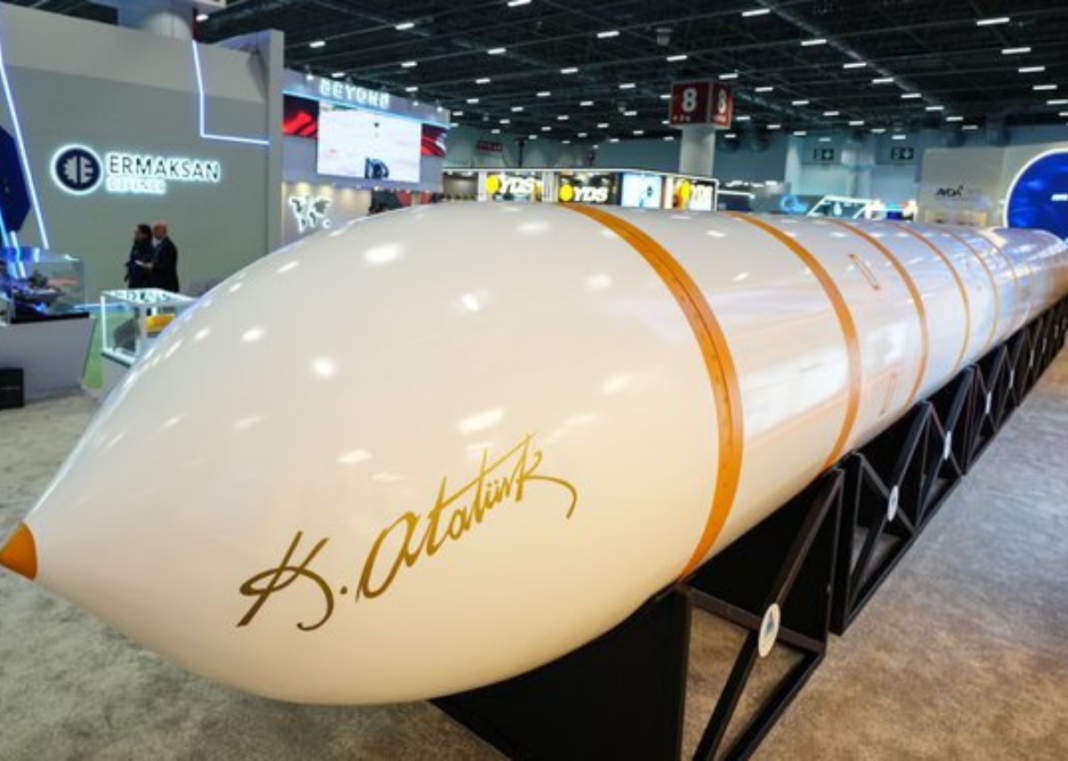
Turkey publicly revealed a full-scale model of its first intercontinental ballistic missile, the Yildirimhan, at the SAHA 2026 International Defense and Aerospace Exhibition in Istanbul on May 5, 2026. The weapon, which has been under development for approximately a decade, carries a planned range of 6,000 kilometers — enough to place it just within the ICBM class — and signals a significant escalation in Turkey’s long-range strike ambitions. The unveiling caught many observers off guard, as no prior public indication had emerged that Ankara was pursuing a weapon of this capability.
A New Class of Weapon for Ankara
The Yildirimhan — Turkish for “lightning” — represents a qualitative leap beyond anything Turkey has previously developed in the missile domain. The War Zone first reported on the missile’s characteristics following its public debut at the Istanbul Expo Center.
The weapon is designed as a conventionally armed, non-nuclear ICBM. That distinction matters. While ICBMs are almost exclusively associated with nuclear delivery, Turkey is pursuing a model that carries no nuclear payload but instead aims to project conventional striking power at intercontinental distances. The concept is novel but not unprecedented: analysts have noted that China and Russia have both explored or demonstrated conventionally armed ballistic missiles with extended ranges.
The Yildirimhan is planned to carry a warhead weighing 3,000 kilograms (approximately 6,600 pounds), making it capable of significant bunker-busting effects and able to destroy hardened area targets. The missile is liquid-fueled, using a combination of nitrogen tetroxide and hydrazine, and is powered by four rocket motors in a single-stage configuration. That single-stage design is unusual for a weapon of this range and may reflect current technological constraints, as Turkey has not previously developed missiles capable of flying this far.
The missile will be road-mobile, according to Turkey’s Ministry of National Defense, offering flexibility of deployment and reducing its vulnerability to preemptive targeting — though analysts note that its liquid-fuel requirement will slow launch preparation compared to solid-propellant alternatives.
Officials Speak: Deterrence Is the Priority
Turkish Minister of Defense Yasar Guler presented the Yildirimhan program at SAHA 2026, underscoring the government’s direct involvement in what appears to be a flagship defense initiative.
President Recep Tayyip Erdogan had previously made Ankara’s ambitions explicit. “As Turkey, we are located in a geography of high strategic importance, located in the heart of three continents, where global arm wrestling is never lacking… the first condition for survival in such a geography is deterrence,” Erdogan stated in earlier remarks, as reported by Aviation Week.
Turkish defense manufacturer Roketsan, which has been central to the country’s broader ballistic missile development effort, described the ambitions of its related Tayfun Block IV program in similar terms. “The Tayfun Block IV achieves long ranges, setting another record for the Turkish defense industry,” Roketsan said in a statement carried by Turkey’s state-run Anadolu Agency, adding that the weapon “will be capable of destroying numerous strategic targets, such as air defense systems, command and control centers, military hangars, and critical military facilities.”
Background: A Decade-Long Missile Buildup
Turkey’s emergence as a serious missile power did not happen overnight. Over the past 25 years, the country has steadily expanded its domestic defense industry, producing a growing portfolio of ballistic and cruise missiles — many of which have entered active service with the Turkish Armed Forces. Some have been exported, benefiting from the fact that Turkish products are not subject to U.S. International Traffic in Arms Regulations (ITAR), which restrict the transfer of sensitive American-origin technologies to certain buyers.
The trajectory toward longer-range systems has been deliberate. Turkey currently operates the Tayfun (formerly Bora-2) short-range ballistic missile — the only ground-launched conventional missile exceeding 300 kilometers among NATO’s European members. The Tayfun Block IV variant, believed to have a range of around 1,000 kilometers, underwent a successful test firing in the fourth quarter of 2025, according to Hurriyet Daily News.
In parallel, Turkey has been developing the Cenk, a medium-range ballistic missile (MRBM) with a planned range of 2,000 kilometers. That weapon would place most of Turkey’s potential adversaries within reach without requiring an ICBM. The Yildirimhan, therefore, represents a further and more ambitious step beyond an already aggressive development roadmap.
The program has reportedly been in development for roughly 10 years, suggesting that serious planning predates the current political climate. It is consistent with Erdogan’s repeated calls — stretching back several years — for Turkey to develop strike capabilities reaching beyond 2,000 kilometers.
Technical Constraints and Testing Challenges
The Yildirimhan faces significant engineering and logistical hurdles before it can enter service. Liquid-fueled missiles must be fueled prior to launch, reducing reaction time and making the weapon more susceptible to destruction before it can be used. The choice of propellant — nitrogen tetroxide and hydrazine — is technically demanding and potentially hazardous to handle in the field.
Testing poses an equally serious problem. Turkey’s primary missile test range sits on the Black Sea, which spans less than 1,000 kilometers from east to west. A missile with a 6,000-kilometer range cannot fly to full distance within that corridor. North Korea has addressed analogous constraints by launching missiles on steep, high-altitude trajectories that stay within a limited geographic footprint — a practice that the Yildirimhan program may need to replicate, or Ankara will need to find an alternative solution.
One option under consideration is a spaceport in Somalia. Turkey has completed feasibility design work for a launch facility there, according to Anadolu Agency, which would provide access to long ocean corridors in the Indian Ocean — suitable for both ballistic missile testing and space launch operations.
Unlike Turkey’s shorter-range Bora/Tayfun family, which operates within the atmosphere on aero-ballistic trajectories, the Yildirimhan would complete the bulk of its flight in the exo-atmospheric regime. That introduces additional design complexity, including the potential need for multiple or maneuvering warheads and electronic countermeasures to defeat missile defense systems.
Regional and Global Implications
As currently planned, the Yildirimhan’s 6,000-kilometer range would allow Turkey to strike targets as far away as Beijing. That reach extends well beyond any of Turkey’s immediate neighbors, including Greece — Ankara’s primary regional competitor — and deep into Central Asia, the Middle East, and South Asia.
Turkey is a member of the Missile Technology Control Regime (MTCR), an international arrangement that severely restricts exports of missiles capable of carrying payloads exceeding 1,100 pounds beyond 190 miles. The Yildirimhan would fall far outside those export thresholds, effectively ruling out foreign sales unless Turkey chose to withdraw from MTCR — a step that would trigger significant diplomatic consequences.
Within NATO, the missile program will invite scrutiny. Turkey remains the alliance’s only member actively developing weapons of this range class, and the Yildirimhan sits in a category typically reserved for nuclear powers. While Ankara has not indicated any intention to develop nuclear warheads — relying instead on NATO’s collective defense umbrella and U.S. nuclear guarantees since the Cold War — analysts note that an operational ICBM would provide a technical foundation for nuclear capability, should political priorities shift. The War Zone noted a parallel with South Korea, whose ballistic missile developments have prompted similar long-term questions about potential nuclear ambitions.
The emergence of a conventional ICBM from a NATO member also adds complexity to global arms control discussions, particularly as the Missile Technology Control Regime and other non-proliferation frameworks were not designed with this specific scenario in mind.
What Comes Next
No operational timeline has been announced for the Yildirimhan. Turkish media reports suggest that warhead development and fuel production are already underway, but the program appears to be in its early stages. A full-size model — not a flight-tested prototype — was displayed at SAHA 2026, indicating that significant development work remains before the weapon could be considered combat-ready.
The Cenk MRBM is likely to reach operational status first, given its shorter range and presumably more advanced development status. Together, the Cenk and Yildirimhan would give Turkey an unprecedented long-range conventional strike capability, extending its deterrent reach from the eastern Mediterranean to the far reaches of Eurasia.
Observers will be watching for flight tests — particularly given the geographic constraints Turkey faces — as well as any developments regarding the proposed Somali spaceport. Diplomatic responses from NATO partners, neighboring states, and major powers whose territory would fall within the missile’s range will provide an early measure of how the international community intends to respond to Turkey’s most ambitious weapons program to date.