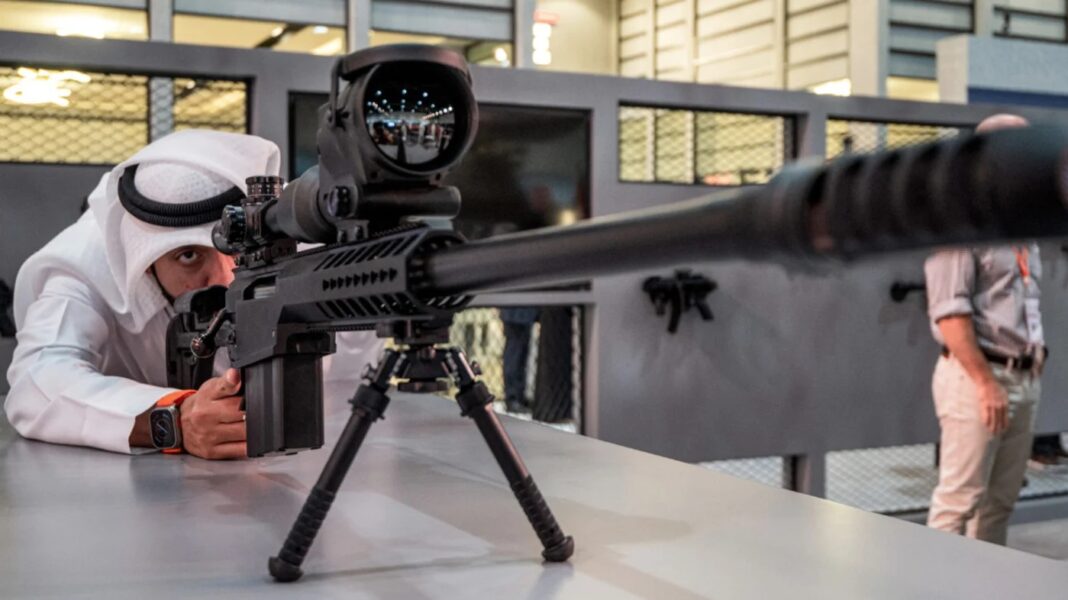

The United Arab Emirates and Israel have established a joint fund to acquire and develop new weapons systems together, according to one current and one former United States official briefed on the matter, Middle East Eye reported on May 18. The agreement was reached during a visit by Israeli Prime Minister Benjamin Netanyahu to the UAE that took place amid the ongoing US-Israeli war on Iran. The UAE and Israeli embassies in Washington did not respond to requests for comment before publication.
The current US official told Middle East Eye the two countries would pursue joint acquisitions of weapons systems as part of the new defence partnership, and that the UAE could also fund technological developments in Israeli air defence systems.
The former US official told Middle East Eye that a large amount of money has been allocated to the fund and that purchases would likely extend beyond air defence.
The two countries are specifically looking to jointly acquire and develop Counter-Unmanned Aircraft Systems, known as C-UAS, as well as other air defence technologies, the current US official said.
The agreement marks a significant deepening of security ties between Abu Dhabi and Tel Aviv that began with the Abraham Accords in 2020. Yoel Guzansky, a senior fellow at the Institute for National Security Studies, a Tel Aviv-based think tank who specialises in the Gulf, described the current state of relations to Middle East Eye as the best they have ever been. “This is the closest cooperation Israel has ever had with an Arab country,” he said.
Guzansky framed the fund as a natural convergence of complementary capabilities. “Israel will need UAE money. We have the technology, but we lack the resources. The UAE has the resources, but lacks the technology,” he told Middle East Eye.
Iran Strikes Drive the Partnership
Iran launched thousands of strikes across the Gulf in response to the US-Israeli attack in February, with the UAE bearing the heaviest toll — nearly 3,000 Iranian drones and missiles targeted the country. That bombardment has since accelerated military cooperation between Abu Dhabi and Tel Aviv at a pace that has no precedent since the two countries normalised relations.
Israel deployed Iron Dome air defence batteries and personnel to the UAE to operate them during the war, a fact confirmed by United States Ambassador to Israel Mike Huckabee in May.
On the financial architecture of the fund, Bloomberg reported in May that Abu Dhabi Crown Prince Khaled bin Mohammed al-Nahyan held discussions with Mubadala Investment Company Chief Executive Khaldoon al-Mubarak and other officials about creating a defence-focused investment vehicle.
The UAE’s defence budget is not publicly disclosed, but some governments estimate its 2026 defence spending at $27 billion, roughly five percent of GDP. Abu Dhabi alone controls nearly $2 trillion across its sovereign wealth funds and holds the majority of the country’s oil reserves.
Bernard Haykel, a professor of Near Eastern studies at Princeton University, told Middle East Eye the deal represents a continuation of existing defence agreements. “It makes sense for both sides,” he said.
Haykel pointed directly to Israel’s shifting dependence on US funding as a driver. Israel has long received substantial American military support — in addition to approximately $3 billion per year in foreign military aid, the US spent an additional $21 billion on Israel’s defence up until September 2025, according to Brown University’s Costs of War Project. Prime Minister Netanyahu has said publicly that Israel may need to phase out US aid, as support for Israel has fallen sharply among American voters across the political spectrum.
“The UAE has money,” Haykel said. “This is a time when US money is being threatened, so why not switch to the UAE? Israel needs to diversify.”
A Gulf Out of Step
The deepening UAE-Israel axis places Abu Dhabi at odds with several of its neighbours. The UAE, Saudi Arabia and Qatar all opposed the US war on Iran, but staked out different positions once the conflict began. Saudi Arabia and the UAE provided expanded basing and overflight access to the US and both launched strikes on Iran, Reuters reported.
Since then, the two Gulf powers have diverged sharply. Saudi Arabia pivoted to supporting Pakistani mediation to end the war, while the UAE reportedly tried to prevent those talks and lobbied publicly and privately for the US to continue its campaign against Iran. Reuters reported on Monday that Pakistan deployed 8,000 troops, a fighter jet squadron, and a Chinese air defence system to Saudi Arabia.
Firas Maksad, managing director for the Middle East and North Africa at the Eurasia Group, told Middle East Eye that Gulf states are alarmed the war will conclude with Tehran emboldened in the Strait of Hormuz. “The Gulf states believe they are going to be left holding the bag on any deal the Trump administration strikes with Iran, which is focused on the nuclear file and Strait of Hormuz,” he said.
Maksad drew a direct line between Abu Dhabi’s Iran anxiety and its Israeli embrace. “The Emiratis will not be part of that construct,” he told Middle East Eye, referring to the Saudi-led regional security grouping. “Their means of leverage with the Iranians is their relationship with Israel. The more adversarial the relationship is with Iran, the closer the UAE will draw to Israel and develop those security ties.”
Background
The UAE and Israel normalised diplomatic relations in 2020 under the Abraham Accords, with defence cooperation cited as one of the key benefits by supporters of the agreement. In June 2025, UAE defence firm Edge Group acquired a 30 percent stake in Israel’s Thirdeye Systems, a company that incorporates artificial intelligence technology into drones. The Netanyahu visit to the UAE during the war on Iran generated controversy — his office issued an official statement about the visit, which prompted a rare public denial from Abu Dhabi. Diplomats and defence industry sources told Middle East Eye that all Gulf states are expected to increase defence spending in response to Iran’s attacks.
What Happens Next
The former US official indicated that the joint fund’s purchases are expected to extend beyond air defence systems, though specific acquisitions have not been announced. Abu Dhabi Crown Prince Khaled bin Mohammed al-Nahyan’s reported discussions with Mubadala officials suggest the fund’s formal investment structure is still being finalised. Gulf states are expected to announce increased defence budgets in response to the Iranian strikes, according to diplomats and defence industry sources cited by Middle East Eye. The UAE and Israeli embassies in Washington had not responded to requests for comment at time of publication.