
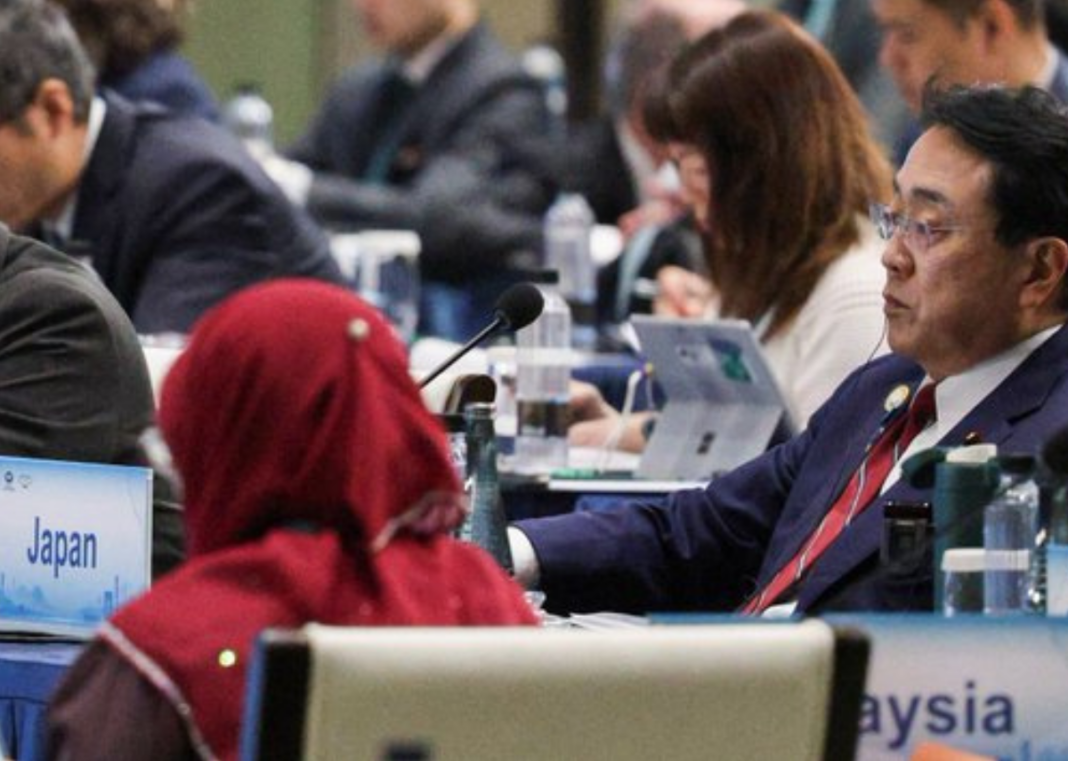

Japan Minister Meets China Counterpart at APEC in Suzhou
Japan’s Minister of Economy, Trade and Industry Ryosei Akazawa held a brief, informal exchange with Chinese Commerce Minister Wang Wentao on Friday, May 22, on the sidelines of the Asia-Pacific Economic Cooperation ministerial meetings in the eastern Chinese city of Suzhou. Akazawa described the contact as a brief conversation before a dinner, not a formal bilateral meeting, and said he could not disclose what was discussed because it was a diplomatic exchange. The encounter marked the highest-level contact between Tokyo and Beijing since a diplomatic crisis erupted between the two countries in November 2025. The Japan Times
Akazawa is the most senior Japanese official to visit China since the dispute erupted. He spoke to reporters on Saturday after attending the APEC ministerial meetings. The Japan Times
“Before the dinner began on Friday, I approached Minister Wang and had a brief conversation,” Akazawa told reporters, adding he could not disclose details because it was a diplomatic exchange. The Japan Times
Ahead of the conference, Akazawa had signalled his intent to engage, telling reporters it was “only natural to seek communication” given that Wang Wentao was serving as chair of the APEC meeting. A trade ministry official declined to comment on whether Tokyo had formally requested bilateral talks, Japan Times reported. Bloomberg
Broader APEC Context
Trade representatives from APEC members, which together account for nearly half of global trade, attended two days of meetings starting Friday in Suzhou. The gathering focused on multilateral cooperation, trade imbalances, and supply chain resilience. The Manila Times
Last year, China posted a record trade surplus of nearly $1.2 trillion. The Suzhou meeting came days after Group of Seven finance ministers agreed on the need for action to tackle trade imbalances, saying the current situation was unsustainable. US Treasury Secretary Scott Bessent, ahead of that G7 meeting, argued for more protections against a flood of cheap Chinese imports, according to Reuters. The Manila Times
The Dispute That Forced the Distance
Relations between the two Asian powers deteriorated rapidly after Japanese Prime Minister Sanae Takaichi said in parliament in November 2025 that a Chinese invasion of Taiwan would constitute “a situation threatening Japan’s survival,” potentially triggering a military response from Tokyo. Beijing demanded a full retraction. Takaichi declined to provide one. CNN
The economic consequences followed swiftly. China’s Ministry of Commerce imposed sweeping restrictions on dual-use items — goods, services, and technologies with both civilian and military applications — effective immediately. While the ministry did not specify impacted exports, a catalog of dual-use items includes rare earths, advanced electronics, aerospace and aviation components, drones, and nuclear-related technology. CNN
In January 2026, Beijing formally codified the restrictions, moving what had been apparent policy practice into explicit legal architecture. Two additional rounds of export control tightening followed in rapid succession in February 2026. Those controls specifically named major Japanese industrial conglomerates, including the shipbuilding and aero engine divisions of Mitsubishi Heavy Industries. Discovery Alert
Chinese customs data shows that exports of dysprosium, terbium, yttrium oxide, and gallium to Japan have effectively ceased since December 2025. These are not niche materials. Rare earth elements are critical to a wide range of goods, from everyday electronics and vehicles to advanced weapons systems such as F-35 fighter jets. Japan relied on China for 63% of its rare earth imports in 2024, according to a CNN calculation based on trade statistics from Japan’s finance ministry. Discovery AlertCNN
China has not provided a list of restricted items. “At this stage it is impossible to say what impact the export curbs will have,” an official at the Japan External Trade Organization told Reuters, asking not to be identified because they are not authorised to speak to the media. CNBC
Tourism and Economic Pressure
The coercion extended beyond trade in materials. In the first quarter of 2026, the number of Chinese tourists visiting Japan fell more than 60% year-on-year, creating clear headwinds for Japan’s tourism industry. At the same time, Japan’s own economic momentum remains fragile, with continued pressure on consumption and domestic demand. The Interpreter
Shin-Etsu Chemical, the world’s largest rare earth magnet producer outside China, has stopped accepting new orders for dysprosium-containing magnets — a signal of how quickly supply constraints are translating into production decisions. Discovery Alert
Japan is not without defences. Tokyo is releasing stockpiled supplies where necessary, though it does not disclose details, said an official at the Japanese industry ministry, adding that the government is aware of concerns over rising prices and tightening supplies. Japanese companies built stockpiles after a similar Chinese slowdown in rare earth exports in 2010, and have since worked to curb usage of heavy rare earths in magnets and look for alternatives. Mining WeeklyMining Weekly
Australia’s Lynas Rare Earths represents the main non-Chinese alternative, but its output is a fraction of what Japan previously imported from China. Lynas produced approximately eight tonnes of dysprosium and terbium combined in the first quarter of 2026. China had exported approximately 14 tonnes of those two minerals per month to Japan during 2024. Rare Earth Exchanges
One EU Official Leaves the Door Open
Despite the rebuff of formal talks, at least one signal from the Chinese side was cautiously constructive. One EU diplomat told the Financial Times that member states had told the European Commission not to close the door, adding: “We welcome the ambitious thinking.” City AM
On the Japanese side, Akazawa said ahead of the APEC dinner on Friday that he hoped to discuss various issues with Wang if the opportunity arose, according to Kyodo News Agency. The Japan Times
Japan’s Gradual Re-engagement
The Suzhou meeting was not Japan’s first cautious step back toward Beijing. On May 15, Hitoshi Kikawada, Japan’s minister in charge of gender equality, visited Shanghai to attend the APEC ministerial meeting on Women and the Economy — the first visit to China by a Japanese cabinet minister since relations deteriorated. On May 2, Yasutoshi Nishimura, chair of the Liberal Democratic Party’s Election Strategy Committee, visited Beijing, where he inspected advanced technology companies in areas such as robotics and autonomous driving. The InterpreterThe Interpreter
A delegation from the Japan Association for the Promotion of International Trade is also expected to visit Beijing in June, seeking meetings with senior Chinese officials. The Interpreter
Background
In November 2025, Prime Minister Takaichi stated that a potential Chinese military attack on Taiwan could legally be considered a survival-threatening situation for Japan, adding that “a Taiwan emergency is a Japanese emergency, and therefore an emergency for the Japan-US alliance.” China regards Taiwan as part of its territory and views any foreign military commitment to its defence as interference in an internal matter. Beijing suspended rare-earth supplies to Japan for two months in 2010 due to a territorial dispute, a precedent that prompted Tokyo to begin building stockpiles and diversifying supply chains. Japan relied on China for 63% of its rare earth imports in 2024. APEC, founded in 1989, groups 21 economies across the Asia-Pacific and collectively accounts for approximately half of global trade. barchart + 2
What Happens Next
A delegation from the Japan Association for the Promotion of International Trade is expected to visit Beijing in June, representing a further step in Tokyo’s incremental re-engagement with Chinese officials. The Japanese trade ministry declined to confirm whether Tokyo had formally requested bilateral talks with Beijing, leaving the status of any future structured dialogue uncertain. Industry figures briefed on the state of discussions noted that Japan’s rare earth situation has not been resolved, and Beijing has set no public timeline for lifting the export restrictions. Whether Akazawa’s brief exchange with Wang Wentao translates into a scheduled formal meeting will serve as the clearest measure of whether the two governments are moving toward substantive de-escalation. The Interpreter + 2