
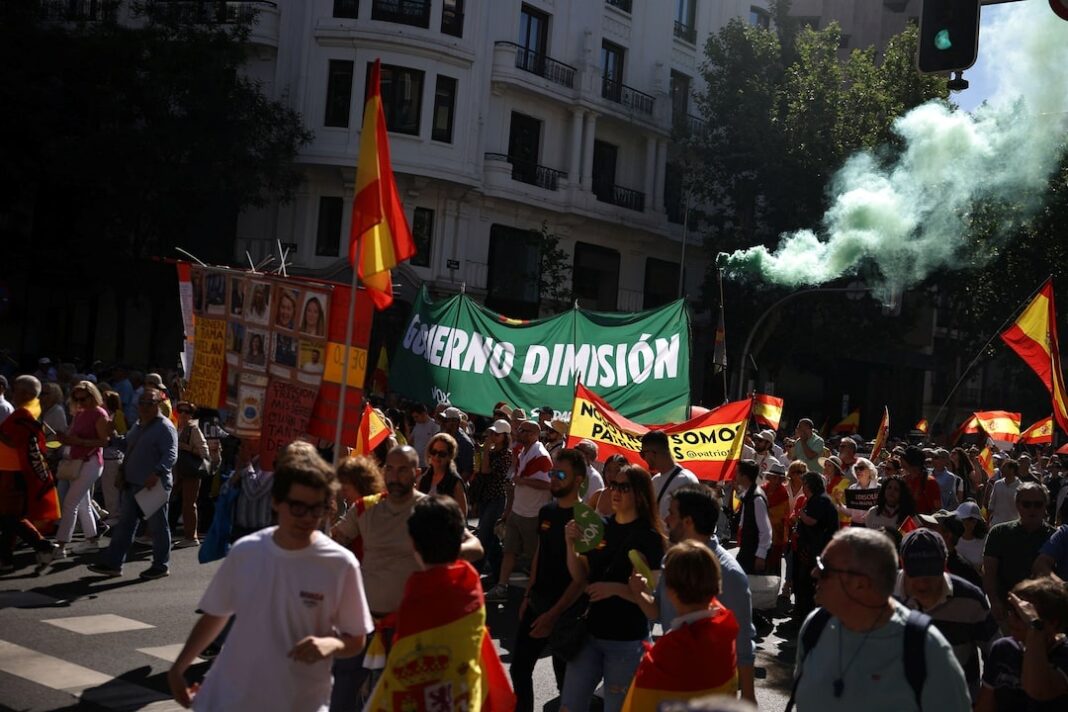

Tens of thousands of people marched through Madrid on Saturday, demanding the resignation of Prime Minister Pedro Sánchez as a cascade of corruption allegations continued to engulf his government and closest allies. At least seven police officers were injured in clashes with protesters, and three people were arrested, though officials said the demonstration was otherwise largely peaceful.
Demonstrators carried banners reading “Resignation of the socialist mafia” alongside scores of gold and red national flags in the “March for Dignity,” organised by the Spanish Civil Society association. The crowd moved through the streets of Madrid behind a large banner that read: “Corruption has a price. No more impunity. Resignation and elections now.”
Organisers said 80,000 people took part in the protest. The Spanish government representative in Madrid put the figure at approximately 40,000.
A small group of protesters attempted to break through barriers around Moncloa Palace, where Sánchez lives with his family. Police detained a group of masked individuals on the main road approaching the residence, Spanish television images showed.
“There is no-one left in Pedro Sánchez’s circle who has not been accused of very serious crimes. Spain is being held hostage by a corrupt mafia,” far-right Vox leader Santiago Abascal told reporters before the march began.
The protest was called by a coalition of more than 150 civic associations called Sociedad Civil Española and was backed by the mainstream conservative Popular Party and the far-right Vox. Leaders from both opposition parties attended the march, according to Reuters.
The demonstration came days after a fresh legal blow to the government. A Spanish court announced on Tuesday that former Socialist Prime Minister José Luis Rodríguez Zapatero was being investigated for allegedly leading an influence-peddling and money-laundering network. Zapatero, a key ally of Sánchez, denied any wrongdoing.
The Zapatero investigation is not the only legal pressure bearing down on the prime minister’s inner circle. Sánchez’s brother, David, is scheduled to stand trial for influence peddling. His wife, Begoña Gómez, is under investigation in a separate corruption case. A Spanish prosecutor last month asked the investigating judge to close the case against Gómez, which was brought by far-right groups. She denies any wrongdoing. His former right-hand man, ex-transport minister José Luis Ábalos, is awaiting a verdict in his own corruption trial, which concluded earlier this month.
Sánchez has dismissed the cases against his family as politically motivated and vowed to carry on despite the proliferation of graft allegations surrounding his government.
Saturday’s march is the latest in a series of large opposition demonstrations that have tested the durability of Sánchez’s minority government. Sánchez came to power in 2018 after using a vote of no-confidence to topple the corruption-mired conservative PP government. That history sharpens the political charge carried by the current allegations, with opposition leaders arguing the prime minister who campaigned on clean governance now leads an administration defined by graft.
The dual attendance figures — organisers’ 80,000 versus the government delegate’s 40,000 — reflect the contested political atmosphere surrounding every aspect of the protest. Both numbers, however, confirm a mobilisation on a scale that exceeds several previous anti-government demonstrations in the capital.
Spain does not hold a scheduled national election until 2027, and Sánchez’s minority government has survived prior no-confidence motions. Opposition parties have called for early elections, but they lack the parliamentary numbers to force one. The Zapatero investigation adds a new variable: if the judicial proceedings advance, they could further erode the government’s political standing among smaller coalition partners whose support Sánchez needs to govern.
Reuters reported that the march concluded near Plaza Moncloa, close to the prime minister’s official residence, with no further significant incidents after the earlier arrests.


