
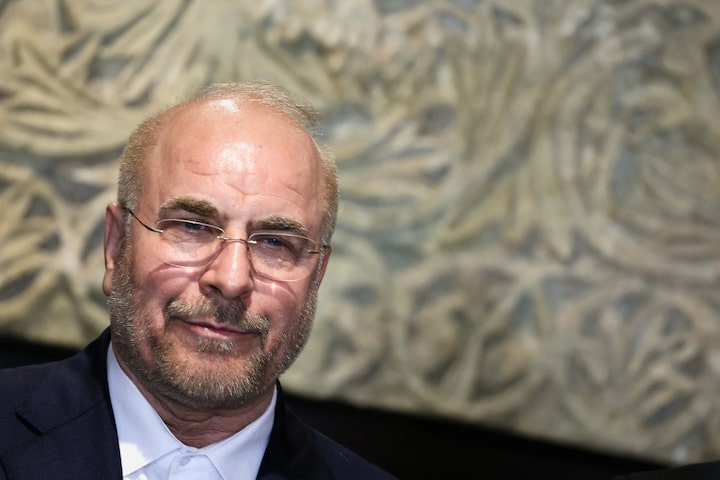

Iran’s top negotiator told Pakistan’s military chief on Saturday that Tehran will not compromise on its national rights in ongoing negotiations to end its war with the United States, as a Pakistan-led regional mediation effort struggled to bridge deep differences between the two sides. Iranian Parliament Speaker Mohammad Baqer Qalibaf made the remarks during talks with Pakistani army chief Field Marshal Asim Munir in Tehran, with Iranian state television reporting that Qalibaf declared the United States was not an honest party to the negotiations.
Qalibaf said Iran would pursue its “legitimate rights,” both on the battlefield and through diplomacy, but that it could not trust “a party that has no honesty at all” — an accusation Tehran has levelled at Washington on multiple previous occasions.
He added that Iran’s armed forces had rebuilt their capabilities during the ceasefire and warned that if the United States “foolishly restarts the war,” the consequences would be “more forceful and bitter” than at the start of the conflict.
Despite the hardline rhetoric, all three parties — Iran, the United States, and Pakistan — acknowledged some forward movement. Tehran said it was focused on finalising a memorandum of understanding, Iran’s foreign ministry said, after Qalibaf and Foreign Minister Abbas Araqchi met with Munir. The Pakistani army said negotiations over the previous 24 hours had resulted in “encouraging” progress toward a final understanding.
United States Secretary of State Marco Rubio, speaking from India, said the U.S. might have “something to say” on the issue in the coming days. “There’s been some progress done, some progress made — even as I speak to you now, there’s some work being done,” he told reporters.
On Friday, Rubio had told reporters after a NATO ministers’ meeting in Helsingborg, Sweden, “There’s been some progress. I wouldn’t exaggerate it. I wouldn’t diminish it. There’s more work to be done. We’re not there yet. I hope we get there.”
The discussions in Tehran centred on a 14-point document proposed by Iran, which Tehran considers the primary framework for the negotiations, as well as messages exchanged between the two governments. According to Al Jazeera, Iran’s 14-point proposal includes demands for Iranian control of the Strait of Hormuz, reparations for war damage, the lifting of sanctions, the release of frozen assets, and the withdrawal of U.S. troops.
Rubio repeated the Trump administration’s core demands: “Iran can never have a nuclear weapon. The straits need to be open without tolls. They need to turn over their enriched uranium.”
Munir also met Iranian President Masoud Pezeshkian, with Foreign Minister Araqchi present. Munir then departed Tehran, Iranian state media reported. Qatar separately dispatched a negotiating team to Tehran, operating in coordination with the United States, to attempt to resolve the main sticking points.
Regional and Global Impact
The Strait of Hormuz has remained closed to most international shipping since the start of the war, despite a fragile ceasefire, with the waterway’s continued blockade upending global energy markets. The strait handles roughly one-fifth of the world’s oil supply. Negotiations over reopening the waterway have largely stalled, with Washington and Tehran rejecting each other’s proposals. U.S. President Donald Trump told reporters he had “total control” of the waterway and said: “We want it open. We want it free. We don’t want tolls. It’s international. It’s an international waterway.”
The U.S. and Iran remain at odds over Iran’s enriched uranium stockpile and Tehran’s ambitions to impose a tolling system on Strait of Hormuz traffic. Rubio said any deal would be “unfeasible” if Iran pursued measures to permanently control shipping through the strait.
Iran’s foreign ministry spokesman said the U.S. blockade on Iran’s shipping was an important issue, but that Tehran’s priority was ending the threat of fresh U.S. attacks and halting the conflict in Lebanon, where Iran-allied Hezbollah fighters are engaged with Israeli forces in the south of the country.
Background
The United States and Iran agreed on April 8 to a two-week ceasefire mediated by Pakistan, after Iran rejected an earlier 45-day two-phased framework and put forward its own peace conditions. The ceasefire has since been extended but has been violated by both sides, according to reports. Six weeks into the fragile ceasefire, some gaps between the two governments have been narrowed, but enriched uranium and Strait of Hormuz control remain unresolved. Iran’s submission of a revised proposal this week, based on its original 14-point plan, shifted diplomatic focus back to the Strait of Hormuz rather than the nuclear programme, according to Scott Lucas, professor of U.S. and international politics at University College Dublin’s Clinton Institute, who told Al Jazeera that the momentum was on Iran’s side.
What Happens Next
President Trump told CBS News on Saturday that negotiators were “getting a lot closer” to an agreement, with the latest proposal including a process to reopen the Strait of Hormuz, the unfreezing of some Iranian assets held in foreign banks, and a continuation of negotiations. Rubio said the president hoped the war would end “through the diplomatic route” and indicated there might be further announcements later in the day. Iran’s semi-official Tasnim news agency, citing a source close to the negotiations, said progress had been made on some issues but that no agreement would be reached until all disputed matters were resolved. Trump was also scheduled to hold a conference call on Saturday with leaders of Gulf countries and other nations, three sources told CBS News.

