
Iranian state television confirmed on Friday, June 12, 2026, the existence of a draft agreement with the United States that would see Tehran reopen the Strait of Hormuz and pledge not to develop nuclear weapons in exchange for the lifting of oil-related sanctions, the release of frozen assets, and the end of a U.S. naval blockade. The 14-point document was reported by Iran’s Mehr news agency and represents the most detailed public account of the terms under negotiation since the war between the two countries began in late February.
President Donald Trump announced hours before the disclosure that the United States had “ended the war” with Iran, describing an agreement in principle as a “strong” memorandum of understanding (MOU) that was conceptually in place. He attributed the breakthrough to sustained U.S. military pressure and said the naval blockade of Iranian ports had been a decisive factor in bringing Tehran back to the table.
The draft, as reported by Mehr, sets out three preconditions that must be met before final negotiations can begin: the release of half of Iran’s frozen foreign assets, the suspension of U.S. oil export sanctions, and the termination of the U.S. naval blockade. Iran’s institutions must also formally ratify the document before any talks proceed.
Among the core provisions, the framework calls for a permanent and immediate cessation of hostilities across all fronts, including Lebanon, where the conflict has also spread. The Strait of Hormuz — through which approximately 25 percent of the world’s seaborne oil trade and 20 percent of global liquefied natural gas passes, according to CNBC — would be reopened within 30 days. Crucially, the draft stipulates that all operational arrangements in the strait would be managed solely by Iran.
The financial terms are sweeping. The document demands the release of $24 billion in Iranian frozen assets, a U.S. commitment to suspend sanctions on Iranian oil exports, a U.S.-led reconstruction plan for Iran valued at no less than $300 billion, and the withdrawal of U.S. military forces from areas surrounding the country. A monitoring mechanism to oversee implementation is included, with final ratification to be confirmed through a UN Security Council resolution.
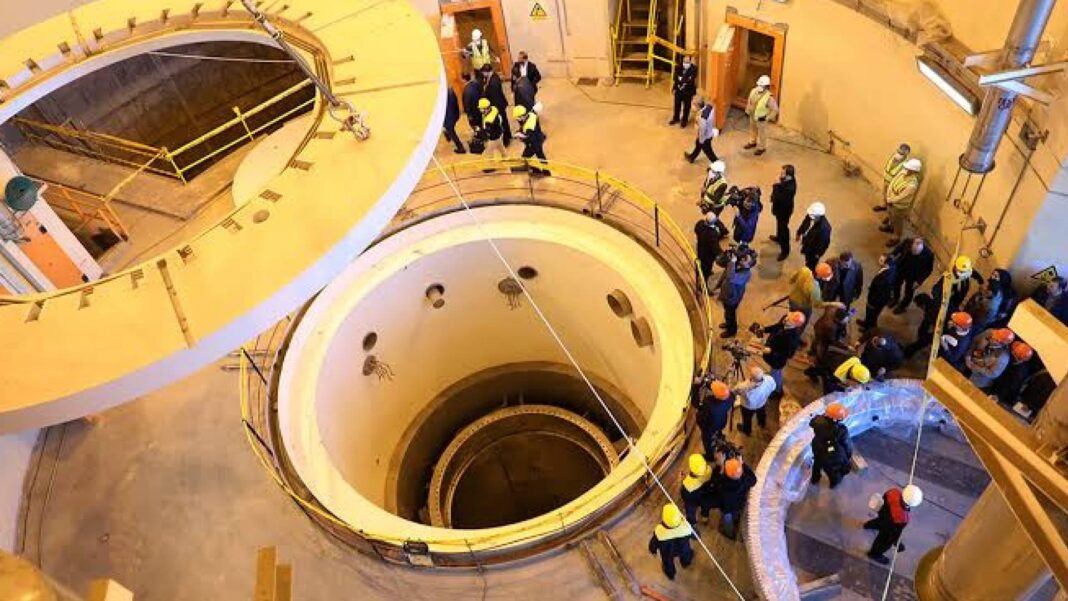
On the nuclear question, the draft includes Iran’s reaffirmed pledge not to develop nuclear weapons and sets up a 60-day negotiating period focused on Iran’s nuclear program and full sanctions relief. The U.S. would commit not to increase its military presence in the region or impose new sanctions during those talks.
One provision that drew immediate attention: discussions on Iran’s ballistic missile program and its support for regional armed groups have been formally removed from the agenda, according to the Athens Times.
Iran’s position on its nuclear program has been firmly established throughout the negotiations. Al Jazeera’s correspondent Almigdad Alruhaid reported from Tehran that Iran has set “a very firm red line” on the nuclear file, adding: “The nuclear enrichment programme is non-negotiable.”
A second Iranian source cited by Al Jazeera said Tehran’s sequencing is deliberate. “Iranians are saying that, at this stage, they’re not negotiating their nuclear programme; it’s only about ending the war on all fronts,” said analyst Atas. He added that Tehran wants direct guarantees from the UN Security Council, a lifting of sanctions, and the reopening of the Strait of Hormuz. “If that is achieved, in a second phase, they’re ready to discuss their nuclear programme,” he said.
The U.S. position has evolved repeatedly throughout the talks. A U.S. official familiar with the negotiations told Axios that the draft MOU includes commitments from Iran to never pursue nuclear weapons and to negotiate over a suspension of uranium enrichment and the removal of its stockpile of highly enriched uranium. Iran holds 440.9 kilograms of uranium enriched to 60 percent purity — a short technical step from weapons-grade levels of 90 percent, according to the International Atomic Energy Agency, as reported by PBS News.
However, Iran pushed back on characterizations of the deal by the Trump administration. Iranian sources cited by CBS News said Trump’s edits to the MOU contained “distortions,” including the claim that Iran would be required to reopen the Strait of Hormuz “without receiving tolls, while there is no such clause in the text of the agreement.” The same sources disputed Trump’s assertion that Iran would remove or destroy its nuclear material, saying “not only is there no such thing in the Memorandum of Understanding, but that the claim is fundamentally unfounded.”
Vice President JD Vance, speaking to reporters on Thursday, offered a cautious assessment. “We’re not there yet, but we’re very close, and we’re going to keep on working at it,” he said, according to CBS News.
The economic stakes of an agreement are significant. Bloomberg reported on Friday that the deal could be signed as soon as Sunday in Switzerland, ahead of the G7 summit beginning Monday. Global stock markets surged on the news: the Dow Jones Industrial Average rose 0.5 percent to 50,902.56 points in early trading on Friday, the S&P 500 climbed 0.4 percent to 7,594.10, and the Nasdaq Composite gained 0.5 percent to 27,062.47, according to CBS News. Oil prices fell simultaneously, as traders priced in the possibility of Iranian supply returning to global markets.
The Soufan Center, writing on June 1, 2026, identified the central sticking point: “President Trump and his team are concerned that front-loading financial concessions will reduce their ability to negotiate restrictions that ensure Iran can never develop a nuclear weapon. Iran is demanding that the U.S. immediately unfreeze Iran’s assets held abroad, but U.S. officials insist on tying sanctions relief to Iranian compliance with all requirements of a permanent agreement.”
Even as the draft emerged, the U.S. Treasury Department imposed additional sanctions on the Iranian military’s oil sales arm, a move first reported by the Associated Press. The new penalties extended the Trump administration’s economic pressure campaign despite the concurrent diplomatic progress.
Background
The current conflict began on February 28, 2026, when Israel and the United States launched a series of strikes against Iran targeting its nuclear and ballistic missile infrastructure, according to the UK House of Commons Library. Iran’s Supreme Leader Ali Khamenei was killed in the strikes; his son was appointed as his successor. Iran responded with counter-strikes against Israel, U.S. military bases in the region, and targets in Arab states, and closed the Strait of Hormuz. A two-week ceasefire was brokered by Pakistan on April 8, 2026. That ceasefire was extended indefinitely by Trump on April 21 after both sides had violated it. The indirect negotiations have been mediated by Pakistan, with Trump’s envoys Steve Witkoff and Jared Kushner leading the U.S. side, according to Axios. Secretary of State Marco Rubio was scheduled to meet Pakistani Foreign Minister Muhammad Ishaq Dar on Friday to advance the talks.
What Happens Next
Bloomberg reported on June 12 that a formal signing of the MOU could take place as soon as Sunday in Switzerland, ahead of the G7 summit. Under the current draft, a 60-day negotiating period on Iran’s nuclear program and full sanctions relief would follow the signing, with talks to be held either in Islamabad or Geneva, according to Axios. The draft requires ratification by Iran’s relevant institutions before negotiations formally begin. Israel, which confirmed Prime Minister Benjamin Netanyahu spoke with Trump on Thursday about the MOU, said it is not party to the negotiations but stated it expects any final agreement to include restrictions on Iran’s nuclear capabilities. The U.S. official cited by Axios cautioned that the deal could collapse before 60 days if Washington concludes Iran is not serious about the nuclear negotiations.