
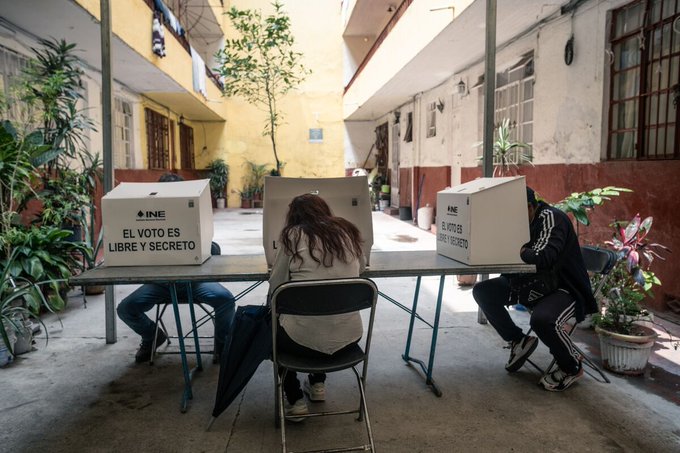

Mexico’s Congress has passed a package of electoral reforms over the past three months that cuts funding to the country’s independent election authority, restructures political party financing, and adds foreign interference as a ground for nullifying election results — changes that critics warn could weaken the integrity of the country’s 2027 midterm elections. President Claudia Sheinbaum’s government framed the legislation as a cost-saving and democratising measure, but electoral experts, opposition lawmakers, and civil society organisations said the cumulative effect concentrates institutional power in Morena’s hands.
The overhaul unfolded in two stages. In April 2026, Congress passed what the government called “Plan B” — a secondary legislative reform that amended Articles 115, 116, and 134 of the Constitution. It passed the Chamber of Deputies with 343 votes in favour and 124 against, backed by Morena and its allies the Green Party and Citizen Movement. Then, on May 29, Congress approved a separate constitutional amendment to Article 41, establishing foreign electoral interference as a new ground for annulling election results. The Senate voted 85 to 42 in favour before forwarding the measure to state legislatures.
What Plan B Contains — and What Experts Fear
Plan B caps state legislature budgets at 0.7 percent of each state’s total budget, reduces Senate spending by 15 percent, limits municipal councils to 15 members with mandatory gender parity, and imposes salary limits on party leaders and officials at the National Electoral Institute (INE) and the Electoral Tribunal, according to Mexico Business News.
The INE is Mexico’s independent electoral management body, created in 1996 as the institutional foundation of the country’s transition to multi-party democracy. It organises elections, certifies results, oversees campaign financing, and is widely regarded as one of the most technically capable electoral authorities in Latin America. The 11 INE commissioners issued a joint statement ahead of the Senate vote expressing concern about the reform’s implications, warning of the impacts on Mexico’s ability to carry out free and fair elections.
Senate President Laura Itzel Castillo, in announcing the constitutional validity of Plan B, said the reform aimed to “end privileges,” echoing the government’s framing that the existing electoral system benefited political elites rather than ordinary voters, according to Mexico Business News.
Estefanía Ortiz, a member of the INE’s National Electoral Professional Service and a district organisation officer, told Infobae México that the proposed structural and budgetary cuts would force the institute to perform the same tasks with fewer resources. She warned that merging the Electoral Training and Electoral Organisation divisions could create work overload. Ortiz also drew a direct comparison to Mexico’s June 2025 judicial elections — the first in the country’s history — which recorded only 13 percent voter turnout, cautioning that a similarly restructured electoral process for 2027 could produce equivalent results.
The Baker Institute for Public Policy at Rice University, in an April 2026 analysis, said the reforms were occurring at a critical moment. “Mexico is currently undergoing an erosion of democratic norms that has intensified since Sheinbaum took office in 2024,” the analysis said. “More specifically, its electoral rules and authorities are among the remaining institutional checks and balances on centralised executive power in the country.”
The Foreign Interference Amendment
The May 29 amendment to Article 41 defines foreign interference to include illicit financing, propaganda, the systematic dissemination of disinformation, digital manipulation, and the intervention of foreign governments or agencies. It also covers acts of political, economic, diplomatic, or media pressure intended to influence public opinion, according to Al Jazeera.
Morena Deputy Ricardo Monreal, who introduced the proposals in an extraordinary legislative session, said current law left a gap. “Currently there is no sanction for anyone who seeks to invade our country or interfere in electoral processes,” he said during the legislative debate, as quoted by UPI.
Sheinbaum acknowledged the rationale publicly. “There could be a risk of foreign interference in Mexico’s elections,” she said at her daily news conference following the Chamber of Deputies vote.
José Elías Lixa, coordinator of the opposition National Action Party (PAN), pushed back against the framing that opposing the reform was tantamount to endorsing foreign meddling. “We do not accept that kind of argument,” he told lawmakers, according to Al Jazeera.
Critics raised a separate concern about the secondary legislation accompanying the amendment. Monreal himself withdrew that secondary package before it could be voted on, saying there was insufficient time to implement it before the legal deadline tied to the 2027 election cycle. Electoral reforms must be enacted at least 90 days before the start of the election process to take effect. The withdrawal of the secondary legislation means the foreign interference nullity clause will not be operational until 2030 at the earliest, according to Mexico Business News. But critics warned that the breadth of the amendment’s definition — which could encompass media commentary, NGO statements, or foreign government criticism of Mexican electoral outcomes — creates potential for misuse if implementing rules are written broadly.
Critics also said the secondary legislation, before it was withdrawn, had drawn objections on press freedom grounds. The Inter-American Dialogue, a Washington-based policy forum, noted in a March 2026 analysis that the most consequential element of the broader legislative package was its potential to combine procedural changes with provisions that implied censorship of media outlets, columnists, and journalists.
A Pattern With a Long History
The current reforms did not emerge in isolation. They are the latest chapter in a years-long campaign by Mexico’s ruling left-wing coalition to restructure the country’s electoral institutions. Former President Andrés Manuel López Obrador repeatedly targeted the INE during his 2018–2024 term, arguing it was too costly and too protective of establishment parties. His original “Plan A” constitutional reform failed to clear the two-thirds supermajority threshold in Congress in late 2022. A revised version, known at the time as “Plan B,” passed Congress in early 2023 but was struck down by the Supreme Court in June 2023 on the grounds that it violated legislative procedure by denying lawmakers adequate time to review over 510 articles of changes. A further package, “Plan C,” was blocked by the Supreme Court in 2024.
Sheinbaum submitted a new constitutional reform on March 4, 2026, which was again defeated on March 10 when her Green Party and Labor Party allies withheld their support, leaving it 71 votes short of the required supermajority. She then pivoted to the secondary legislation route — the current Plan B — which required only a simple majority and could be passed with Morena’s core coalition intact.
Yussef Farid, of the risk consultancy EMPRA, told the Americas Society/Council of the Americas that the reform’s public appeal rested on its accessible promises. “On paper, it sounds like it enhances democracy,” he said. But the legislation’s critics argued it concentrated power in Sheinbaum’s ruling Morena and would bring Mexico closer to single-party rule. A February 2026 Enkoll poll showed that measures to slash party funds and expand direct elections of legislators carried over 80 percent public approval — giving Sheinbaum political cover even after her initial constitutional reform failed.
Regional and Global Impact
The electoral overhaul lands at a sensitive moment in US-Mexico relations. The Trump administration has repeatedly made statements characterised by Mexican officials as interference in domestic Mexican politics, including on migration, trade, and cartel designations — the very categories that could potentially be invoked under the new foreign interference nullity clause.
For investors and businesses with exposure to Mexico, electoral experts noted that structural changes to the INE carry governance risk. Mexico is scheduled to hold midterm elections in June 2027, renewing all seats in the Chamber of Deputies and 17 governorships. Any reduction in the INE’s territorial presence, budget, or operational capacity will directly affect the administration of that vote.
The Inter-American Dialogue noted the broader Latin American context: Chile, Brazil, and Colombia have all debated foreign influence in domestic elections in recent years, and Mexico’s reform joins a regional trend of governments seeking to codify electoral sovereignty protections. Whether those protections are applied narrowly — to provable cases of illicit foreign financing — or broadly, to include foreign criticism of government policy, is likely to be the defining fault line in legal and political debates over the amendment’s implementation.
Background
The National Electoral Institute was established in its current form in 1996, capping a decade-long democratic transition from single-party PRI rule. It replaced the Federal Electoral Institute and was given broader autonomous powers, including control over voter registration, polling station operations, campaign finance oversight, and the certification of results. Mexico holds federal elections every three years for the Chamber of Deputies and every six years for the presidency and Senate. The June 2027 midterms will be the first nationwide electoral test for Sheinbaum, who took office in October 2024 after defeating the opposition in a landslide in June 2024. Morena and its allies currently hold a legislative supermajority.
What Happens Next
The foreign interference constitutional amendment has been forwarded to state legislatures for ratification, a standard requirement for constitutional changes in Mexico. The secondary legislation needed to make the nullity clause operational has been withdrawn by Morena, with its implementation deferred to 2030 at the earliest. The INE is expected to begin adapting to the Plan B structural and budgetary changes ahead of the 2027 electoral cycle. Electoral experts and opposition groups have indicated they will scrutinise whether the INE’s remaining operational capacity is sufficient to administer the June 2027 midterms to the same technical standard as previous elections. The Supreme Court, which has invalidated prior electoral reforms on procedural grounds, may again face challenges to elements of the current package.