

Published: May 9, 2026 | Category: Europe & Conflict
On May 8, 2026, U.S. President Donald Trump announced that Russia and Ukraine would observe a three-day ceasefire coinciding with Russia’s Victory Day events marking the 81st anniversary of the Soviet victory in World War II. The agreement, brokered through direct U.S. diplomatic engagement, includes a mutual exchange of 1,000 prisoners of war from each country and a full suspension of kinetic military activity. Both Ukrainian President Volodymyr Zelenskyy and Russian presidential aide Yuri Ushakov confirmed the deal, though it follows the rapid collapse of two separate unilateral ceasefires declared by each side in the preceding days.
Trump’s Announcement and Its Diplomatic Context
Trump posted the announcement on Truth Social on Friday evening, framing the agreement in terms that went beyond the three-day window. “I am pleased to announce that there will be a THREE DAY CEASEFIRE (May 9th, 10th, and 11th) in the War between Russia and Ukraine,” Trump wrote. “The Celebration in Russia is for Victory Day but, likewise, in Ukraine, because they were also a big part and factor of World War II. This Ceasefire will include a suspension of all kinetic activity, and also a prison swap of 1,000 prisoners from each Country.”
Trump added that he made the request directly to both presidents. “I asked and, President Putin agreed. President Zelenskyy agreed — both readily,” he told reporters as he departed the White House. He described the agreement as potentially transformative, saying: “Hopefully, it is the beginning of the end of a very long, deadly, and hard fought War.”
Zelenskyy, confirming the arrangement on X, stated that Ukraine expects Washington to enforce compliance from Moscow. “We are counting on the United States to ensure that the Russian side fulfills its commitments,” the Ukrainian president said, adding that he had instructed his team to prepare for the prisoner exchange without delay.
Ushakov, speaking to reporters in Moscow, confirmed the ceasefire had been reached through telephone contacts between U.S. and Russian officials following a recent call between Trump and Putin. He was careful to limit expectations about what comes next. “Negotiations will probably resume, but it is still unclear when,” Ushakov said, adding: “It is understandable that the American side is in a hurry.”
The Ceasefire’s Shaky Start
The three-day agreement did not take hold cleanly. Prior to Trump’s announcement, Russia had declared a unilateral ceasefire for May 8 and 9 to cover Victory Day. That truce collapsed within hours, with both sides accusing the other of continued attacks. Kyiv had separately proposed an open-ended ceasefire beginning on May 6, which Moscow declined to adopt.
According to Al Jazeera, by early morning on May 9, Ukrainian officials reported that Russia had carried out more than 140 attacks on front-line positions, along with 10 ground assaults and more than 850 drone strikes. Zelenskyy said his forces would respond in kind. Ukraine also struck a Russian oil facility in Yaroslavl, deep inside Russian territory, describing the strike as retaliation for Russian attacks on Ukrainian cities.
Russia’s Defense Ministry, for its part, reported intercepting 264 Ukrainian drones in the hours before the bilateral ceasefire took effect, claiming that Kyiv violated the earlier Moscow-declared truce more than 1,600 times by noon on May 8. Both sides’ mutual allegations of bad faith set a complicated backdrop for the Trump-brokered pause.
Kremlin spokesman Dmitry Peskov acknowledged the complexity of broader negotiations. “It is understandable that the American side is in a hurry,” he told state television. “But the issue of a Ukrainian settlement is far too complex, and reaching a peace agreement is a very long way with complex details.”
Rubio’s Stark Assessment
The announcement by Donald Trump carried additional diplomatic weight following a series of crucial talks that took place earlier in the day. Secretary of State Marco Rubio, speaking to reporters at the end of a visit to Rome and the Vatican on May 8, delivered a markedly pessimistic assessment of U.S. mediation efforts.
“While we’re prepared to play whatever role we can to bring it to a peaceful diplomatic resolution, unfortunately right now, those efforts have stagnated,” Rubio said, according to NPR. “We don’t want to waste our time and invest time and energy into an effort that’s not moving forward. But we always stand ready if those circumstances change.”
Rubio described the ongoing war as a “tragedy” in which both sides are paying a heavy human price. His comments, delivered while Trump was still at the White House preparing his ceasefire announcement, illustrated the degree to which Washington’s diplomatic track and Trump’s personal dealmaking operate on separate timelines — and at times in direct tension.
Speaking separately, the Kyiv Post reported that Kremlin spokesman Peskov stated Putin is “ready for talks with everyone” but will not be the first to restart diplomatic contacts with European capitals, underscoring the frozen state of broader peace architecture.
Victory Day Parade: Scaled Back, Symbolically Charged
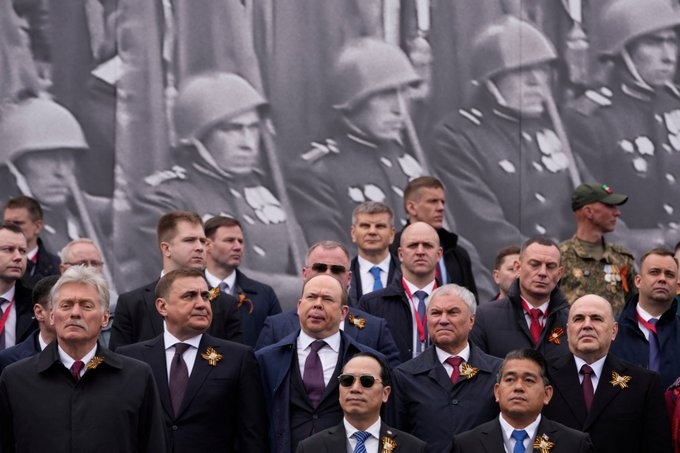
Russia’s Victory Day parade on Red Square on May 9, 2026, proceeded under the ceasefire framework but looked strikingly different from prior years. CNN reported that no military hardware appeared in the procession — the first time in nearly two decades that tanks, missile systems, and armored vehicles were absent. Fighter planes flew over the Kremlin, and more than 1,000 soldiers who had served in what Moscow calls the “special military operation” in Ukraine participated, according to Russian state media RIA Novosti. Four parade units from allied nations, including one from North Korea, also marched on Red Square.
Putin used the occasion to draw an explicit parallel between Russia’s war in Ukraine and the Soviet Union’s losses in World War II — a framing he has deployed consistently since February 2022. Seated to his left was Leonid Ryzhov, a soldier awarded the “Hero of Russia” title in 2022 for service in Ukraine. To Putin’s right sat Svet Turunov, a World War II veteran, according to Russian state media.
Zelenskyy issued a formal presidential decree “authorizing” Russia to hold the parade and declaring Red Square off-limits for Ukrainian strikes during the event — a framing designed to assert Ukraine’s claimed long-range targeting capability over the Russian capital while publicly demonstrating restraint. Peskov dismissed the decree as a “silly joke,” saying: “We don’t need anyone’s permission to be proud of our Victory Day.”
Regional and Global Implications
The three-day ceasefire, however fragile, carries significant diplomatic weight beyond its 72-hour duration. For European governments, the pause represents the first bilaterally confirmed halt to fighting since Russia’s full-scale invasion began in February 2022. European Union foreign policy chief Kaja Kallas, who visited Chisinau on May 7 and announced a doubling of EU military financing for Moldova, has signaled that European partners remain alert to the spillover risks of a prolonged conflict on NATO’s eastern flank.
For Ukraine’s allies, the prisoner exchange provides a concrete, verifiable deliverable that sustains diplomatic momentum even as broader peace talks remain frozen. The “1,000 for 1,000” format echoes the framework agreed at the May 2025 Istanbul talks — the first direct Russia-Ukraine negotiations in three years — where both sides agreed in principle to the same exchange ratio. That deal was confirmed but not fully executed, making the May 2026 prisoner swap a critical test of whether previously agreed terms can be honored under active hostilities.
For Russia, the scaled-back parade and ceasefire compliance — or lack thereof — will be scrutinized internationally. Human rights organizations and Western governments have consistently argued that Moscow uses ceasefire announcements as tactical pauses rather than genuine diplomatic signals. The sequence of collapsed unilateral ceasefires before Trump’s announcement reinforces that skepticism.
Background: A War Approaching Its Fifth Year
Russia launched its full-scale invasion of Ukraine on February 24, 2022, triggering the largest land war in Europe since World War II. The conflict has killed tens of thousands of soldiers on both sides and displaced millions of Ukrainian civilians. Multiple rounds of sanctions have been imposed on Russia by Western governments, while Ukraine has received more than $100 billion in military and financial assistance from the United States and European partners.
Trump made ending the Ukraine war a centerpiece of his 2024 presidential campaign, pledging he could resolve the conflict within 24 hours of returning to office. More than 16 months into his second term, a comprehensive settlement remains elusive. The Istanbul talks of May 2025 marked the first direct face-to-face negotiations between Russian and Ukrainian delegations since April 2022, when Ukraine suspended talks following the discovery of atrocities in Bucha. Those Istanbul discussions produced a prisoner exchange framework but no ceasefire roadmap.
What Happens Next
The prisoner exchange involving 1,000 soldiers from both Russia and Ukraine is likely to be the first major test of whether the agreement will hold. Zelenskyy said his team would begin preparations without delay, and the Kremlin confirmed the exchange through Ushakov. Whether it is carried out in full during the May 9–11 window — or requires an extension — will serve as the clearest early signal of each side’s commitment.
Beyond the ceasefire itself, the diplomatic calendar remains uncertain. Ushakov stated that broader negotiations “will probably resume, but it is still unclear when.” Rubio’s warning that U.S. mediation has stagnated suggests Washington may pull back from active engagement if progress does not materialize. European governments, particularly France and Germany, have their own diplomatic channels to Moscow and Kyiv that could be activated if the U.S. track cools.
The durability of even this brief ceasefire remains in doubt. With mutual allegations of violations already on the record before the three-day window formally opened, international observers and monitoring organizations will watch closely for evidence of renewed large-scale combat after May 11. A sustained pause — even an imperfect one — could create conditions for a broader negotiating framework. A swift collapse, by contrast, would confirm what Rubio suggested in Rome: that the path to a durable settlement remains, for now, a long way off.