

Trump’s White House Ballroom Hides Six-Floor Bunker
President Donald Trump revealed on May 19 that the White House ballroom under construction on the former East Wing site extends six stories underground, incorporating a military hospital, hardened bunker facilities, and a rooftop drone and missile defense system designed to protect Washington, D.C.
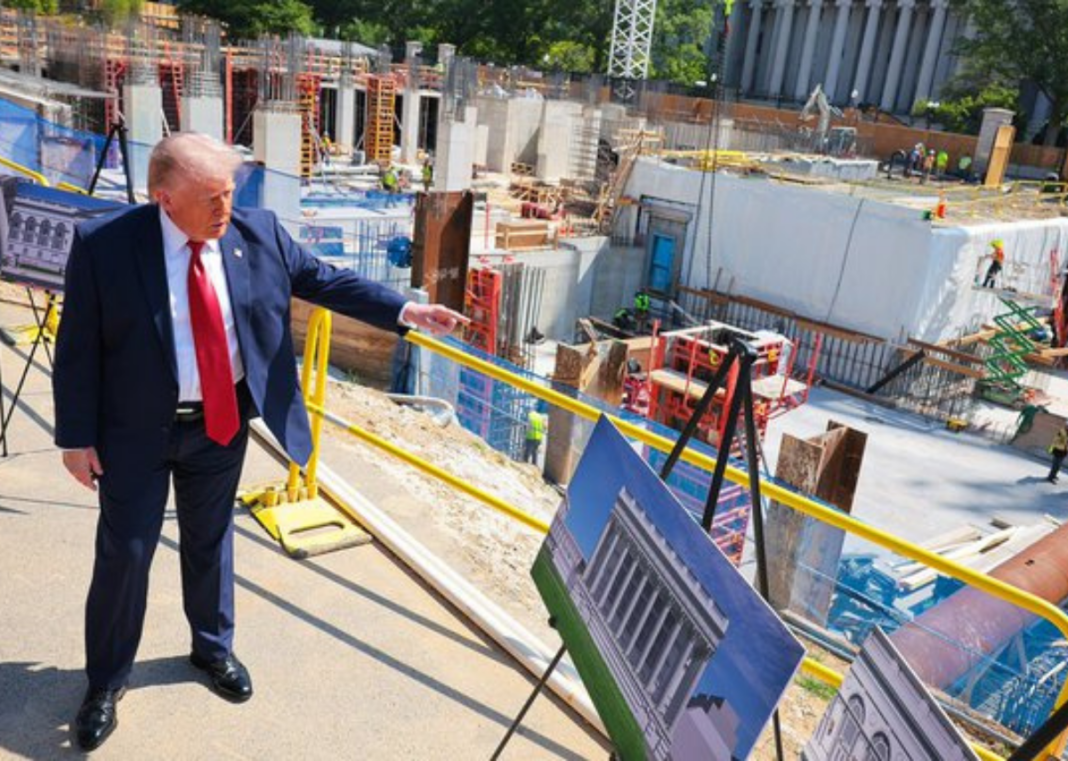
Speaking directly to reporters at the construction site, Trump described a facility whose subterranean infrastructure far exceeds its headline function as an event venue. The War Zone, which first reported on the depth and military scope of the project, noted that the building goes six floors underground and will host what Trump himself described as “the greatest drone empire you’ve ever seen that’s going to protect Washington” on its roof. twz
The disclosures came one day after a significant funding setback. The Senate parliamentarian ruled that taxpayer funds in the budget reconciliation package cannot be used for a $1 billion provision intended to fund security for the White House ballroom. The administration is now seeking alternative routes to finance the security components of the project. twz
Trump told reporters gathered at the construction site that the underground portion of the facility already includes a military hospital, research facilities of an undisclosed nature, and dedicated military meeting rooms. He described the ballroom structure above as functioning primarily as a shield. “The underneath is far more complex than the upper,” Trump said, according to The War Zone’s account of the press briefing.
Of the $1 billion in new Secret Service funding the administration sought from Congress, $220 million was earmarked for the facility itself, with the remainder allocated to broader security enhancements around the White House complex. The total cost of the ballroom project has previously been estimated at $400 million. twz
On the question of who would pay, the picture remains contested. Trump had previously said that private donors would cover construction costs — a position that drew criticism from legislators and government ethics advocates at the time. The administration has not provided updated clarity on the public-private funding split following the parliamentarian’s ruling. twz
Trump also described the rooftop in detail. He said it would feature drone-proofing, missile-proofing, and what he called “great sniper capacity.” The roof, he added, offers a 360-degree view of Washington due to its height and is being developed “for the military.” Trump said the structure would serve as a drone port capable of deploying an unlimited number of drones over the capital for area defense. “On top of the roof, we’re going to have the greatest drone empire you’ve ever seen that’s going to protect Washington,” he told reporters.
The War Zone reported that systems stored in the lower levels of the ballroom facility would be moved up to the roof for drone and missile defense capacity, though it is not confirmed whether a dedicated lift system would enable this on demand. twz
Tyler Rogoway, editor-in-chief of The War Zone, wrote that drone interceptors — drones designed to physically destroy or electronically disable other drones — are well-suited to the unique challenges of defending the White House and the National Mall, where collateral damage from traditional explosive interceptors is a serious concern. He noted that such systems have proven effective in recent conflicts, including the defense of U.S. troops against Iranian Shahed drone attacks and Ukrainian countermeasures against Russian drone waves. twz
Beyond drone defenses, the rooftop may also host surface-to-air missiles. A FIM-92 Stinger-firing Avenger missile turret has been positioned near the White House since shortly after the September 11, 2001 attacks. Washington, D.C. is the only U.S. city with a permanent surface-to-air missile network, currently built around the NASAMS medium-range defense system, with launchers positioned around the wider region. twz
The underground scale of the project places it in a separate category from the White House’s existing emergency facilities. The last major underground expansion at the White House occurred under President Barack Obama, when a large secretive project installed an underground facility reportedly five stories deep beneath the North Lawn — significantly larger than the President’s Emergency Operations Center, or PEOC, which dates in part to World War II and was made famous during the September 11 attacks. twz
The PEOC was housed below the East Wing, which was demolished to make way for the ballroom. That historic bunker is, as a result, likely gone. In its place, the new underground complex appears to occupy a substantial share of the entire floor plate of the new structure — closer in scale to a multi-story underground office building than to a traditional bomb shelter. twz
Rogoway noted that despite its hardened construction, a facility of this type would not be capable of withstanding a direct nuclear strike, as the engineering requirements for nuclear survivability far exceed what is being built beneath the ballroom. twz
Trump closed his remarks by confirming the military’s direct role in the project. “We are building it in conjunction with the United States military,” he said, adding that the facility would deliver “great military capacity.”
Regional and Global Impact
The scale of the underground installation has renewed attention on continuity-of-government infrastructure in the United States. The War Zone reported that the underground areas will include command and control, training, computing, and communications support for military operations and White House defense, with significant room for future expansion given the facility’s size. The administration has not indicated whether the new structure changes the nuclear command protocols currently in place, or how the facility will integrate with the existing NASAMS network around the capital. twz
The funding dispute adds a political dimension. With the Senate parliamentarian blocking taxpayer funding through the reconciliation package, the White House must identify another legislative or donor-based mechanism to cover the security costs — a process that is likely to face continued scrutiny from both chambers.
Background
The White House East Wing was demolished under President Trump’s second administration to make way for the ballroom project. The facility is described in official renderings as a 90,000-square-foot event and office structure. The PEOC, long the primary emergency shelter for the president, was situated beneath the East Wing and is believed to have been lost in the demolition. The Obama-era bunker beneath the North Lawn remains separate and intact. Washington’s NASAMS air defense network is the only permanent surface-to-air missile system protecting a U.S. city. Drone interceptor technology has evolved rapidly since 2022, driven by the conflicts in Ukraine and the Middle East.
What Happens Next
The White House must now find an alternative funding path for the $1 billion in security spending after the Senate parliamentarian’s ruling blocked it from the reconciliation bill. Construction on the underground levels is already underway, with Trump confirming on May 19 that the facility has reached six stories below ground. The administration is also separately evaluating the construction of a helicopter landing pad at the White House complex, which The Hill reported on May 20, after persistent issues with the new VH-92A Marine One helicopter’s existing landing zone. No date has been confirmed for the ballroom’s completion or for the installation of rooftop defense systems.