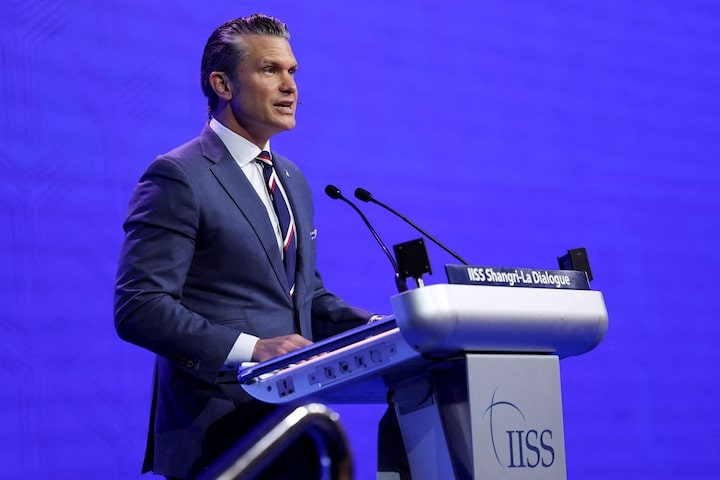

U.S. Secretary of Defense Pete Hegseth delivered a pointed public rebuke of Western European NATO allies on Saturday at the Shangri-La Dialogue security summit in Singapore, praising Asian partners for their defence commitments while warning that Europe faces hard choices ahead. European defence ministers at the same forum pushed back, insisting the alliance remains strong and its credibility intact. The exchange unfolded on May 30 at one of Asia’s most prominent annual security conferences.
Speaking at the Shangri-La Dialogue, Hegseth praised Asian partners for boosting defence spending and aligning closely with Washington as tensions with China mount. His remarks drew an immediate response from European ministers, who used the same stage to argue that the transatlantic alliance is more relevant to the Indo-Pacific than Washington’s criticism suggests.
Hegseth addressed the divide between what the U.S. expects from its allies and what it believes Europe is delivering. “When our interests align, we act together with focused resolve,” he said. “When our interests diverge, we adjust pragmatically without the drama or the moralising. I think Western Europe might take note. Europe and NATO have some big decisions to make.”
President Donald Trump’s administration has repeatedly accused European governments of underinvesting in their militaries and relying too heavily on U.S. protection, while urging both European and Asian allies to boost defence spending to 3.5% of GDP.
The speech landed as transatlantic tensions over military burden-sharing remain unresolved. Washington announced plans in May to pull 5,000 troops out of Germany, and Trump has threatened to pull out of NATO.
A senior NATO official sought to limit the political fallout from the troop withdrawal announcement. Admiral Giuseppe Cavo Dragone, chair of the NATO military committee, said the move was already planned and that the alliance’s cohesion was unaffected. “In a mature alliance, if one ally, which in this case is the principal stakeholder, needs to redirect some power somewhere else, he can do so, and the others must be able to step in,” he said.
Germany, the largest economy in Europe, signalled it would not wait for the U.S. to lead. Nils Hilmer, state secretary at Germany’s Federal Ministry of Defence, said Berlin was accelerating military investment regardless of future U.S. deployments. “What we know for sure is that there’s going to be a shift in that field,” he said. “That’s why we are about to take the security into our own hands.”
European ministers also framed their military commitments as directly relevant to the Indo-Pacific — the region at the centre of Washington’s strategic focus. French Defence Minister Catherine Vautrin told delegates: “Our credibility in Asia also depends on our robustness in Europe, defending Ukraine in the face of the Russian aggression.”
Norwegian Defence Minister Tore Sandvik argued that the European Atlantic and Indo-Pacific theatres are becoming inseparable, noting that North Korean troops are fighting in Ukraine. “The U.S. will be occupied in more theatres,” he said. Sandvik’s remarks pointed to a broader European argument: that investment in European security is not a distraction from Asia, but a condition for stability there.
The criticism from the Pentagon did not go uncontested inside the U.S. delegation itself. Several U.S. senators and members of the House of Representatives said they were seeking to reassure European and Asian allies of bipartisan support in Congress. Senator Tammy Duckworth said: “I’ve heard the same anxiety from everyone, not just in the region. I’ve actually got NATO allies worried about America’s commitment to the Indo-Pacific.”
Duckworth’s comments reflect a division within Washington over how to handle the alliance. While the Pentagon and the White House have kept pressure on European capitals, congressional figures at the summit delivered a markedly different tone.
Outside government circles, assessments of Europe’s progress remained pointed. Pavlo Klimkin, a non-resident senior fellow at the Carnegie Endowment for International Peace and a former Ukrainian minister of foreign affairs, said: “Europe has to learn how to become a player. There is no way around it. But it could be extremely beneficial for their partnership with the United States, because the States would respect such European drive.”
Regional and Global Impact
The Shangri-La Dialogue exchange illustrated how U.S.-Europe friction over defence spending is now playing out on an Asian stage — complicating Washington’s effort to consolidate a united front against China. European ministers used the forum specifically to reassure Asian partners that NATO remained credible beyond its immediate neighbourhood, a signal that Brussels and European capitals are aware the dispute has consequences beyond the Atlantic.
The withdrawal of 5,000 U.S. troops from Germany, according to Reuters, has prompted European governments to accelerate domestic defence investment. Germany’s public commitment at the summit to take security into its own hands marks a notable shift in tone from a government that spent decades minimising military outlays.
Background
The NATO alliance has set a benchmark of spending 2% of GDP on defence, a target agreed in 2014 following Russia’s annexation of Crimea. The Trump administration has pushed that target to 3.5% of GDP for all allies, a significantly higher bar that most European members have not met. The Shangri-La Dialogue, hosted annually in Singapore by the International Institute for Strategic Studies, brings together defence ministers and security officials from across the Asia-Pacific and beyond. North Korea’s military involvement in the war in Ukraine — flagged by Norway’s defence minister at the summit — has added a new dimension to the argument that European and Asian security are no longer separate concerns.
What Happens Next
NATO leaders are expected to address the spending dispute at the alliance’s upcoming summit, where the 3.5% GDP target is likely to be a central point of contention. Germany’s defence ministry has indicated Berlin will press ahead with increased military investment regardless of U.S. troop deployment decisions. The Trump administration has not set a formal deadline for European compliance but has linked continued U.S. engagement in the alliance to measurable progress on spending. Congressional delegations present in Singapore are expected to continue their parallel outreach to allied governments as a counterweight to executive branch pressure.