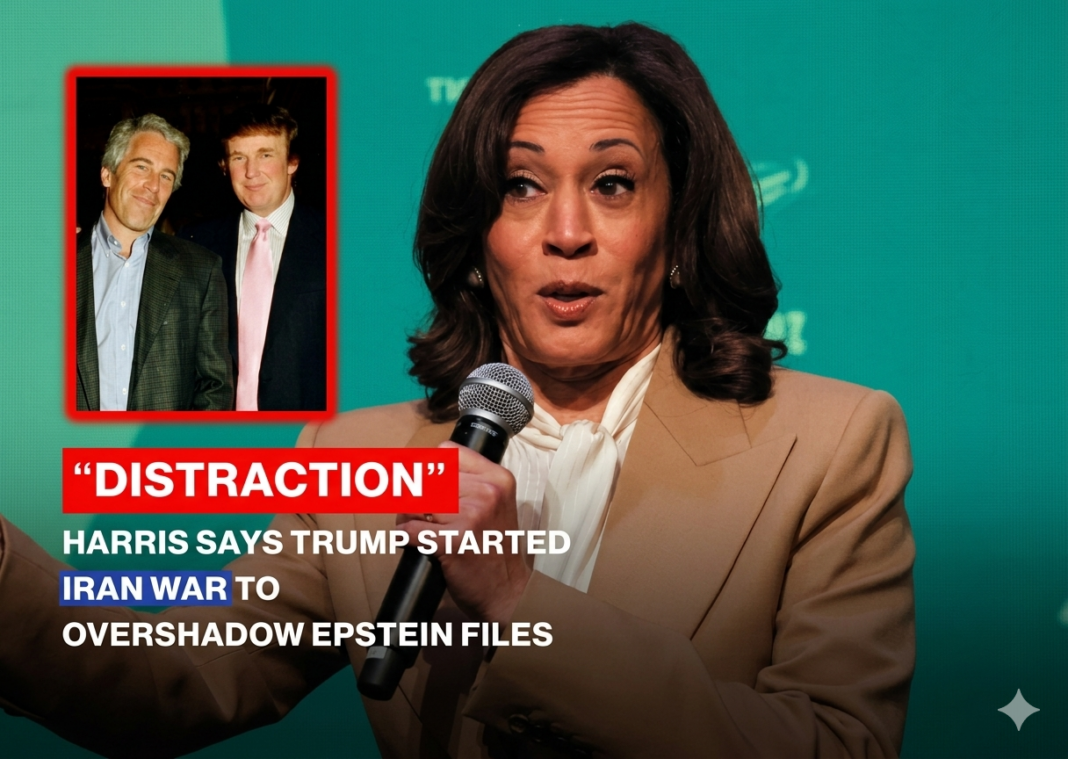

Kamala Harris stirred up some discussion at a Women’s Caucus event in Michigan. She looked at Trump’s Iran policies and made it clear—they aren’t just about foreign affairs. She believes there’s a link between what Trump does with Iran and the stuff going on here at home, especially the controversy around the Epstein files and their connection to Trump. People are angry about those Epstein files, and Harris suggests Trump’s moves on Iran might actually tie in with all that.
So, what exactly did Harris say? She did not say that Trump started a war in Iran to hide the Epstein scandal. She did think that Trumps choices on Iran were affected by his domestic problems. These problems were causing him trouble at home. The conflict, with Iran might be a way to distract people from issues. One of these issues was the Epstein scandal, which was getting attention again.
A lot of media outlets ran with her comments, making it sound like she accused Trump of launching the Iran war just to draw attention away from the Epstein mess. But if you look at her words, she focused more on the idea that political motives and diversion play a role, not on directly blaming Trump for starting a war over scandals.
Now, the “Epstein files” are a cluster of legal and investigative documents about Jeffrey Epstein, the convicted sex offender. The files have kept people guessing and speculating for years—thanks to partial releases and a lot of congressional back-and-forth—about just how deep certain powerful people’s involvement goes.
Harris picked a tense moment to speak out. By 2026, things between the U.S. and Iran have gone downhill fast. News outlets won’t stop comparing it to other nasty Middle East conflicts—missile strikes, shipping routes blocked, and constant fights over control of spots like the Strait of Hormuz. The Trump administration isn’t backing down either. They’ve ramped up military patrols and hit Iran with even more sanctions.
Some people think this is an idea and could make the whole region even more unstable. Others say it’s necessary to keep America safe. The U.S. And Iran tensions are. People are worried about what might happen next, with the U.S. And Iran.
Iran hasn’t exactly been standing down either. They’ve flexed their own military muscle, shutting down shipping routes and trying to exert more control in the region. This back-and-forth has made global markets—and especially the oil industry—pretty nervous.
Then there’s the Epstein issue, which refuses to die down in D.C. Over the past few months, more of those documents got released under pressure from Congress, but lots remain out of sight, fueling rumors and calls for real transparency. The controversy has sparked more lawsuits, more media reporting, and a wave of renewed questions about the ties between Epstein and major political or business leaders—including, repeatedly, Trump. Some allegations are still unproven and hotly disputed.
Not long ago, a judge tossed out a defamation lawsuit Trump filed against news outlets over Epstein-related stories, saying Trump failed to meet the legal threshold required for public figures, but left the door open for him to try again.
People have interpreted Harris’s comments pretty much along party lines. Her supporters say it’s obvious: politicians often let domestic problems influence their foreign policy decisions. They also use issues to distract from domestic problems. Her critics say she is making theories by linking events that seem unrelated.
Political insiders aren’t exactly surprised by this kind of accusation. Distraction tactics are a regular part of the playbook in divided times, and folks from both parties have lobbed similar claims before, hinting that leaders try to shift the conversation when scandals get too hot.
Honestly, you see the two issues—Iran and Epstein—getting mashed together more and more. Media coverage has started connecting the dots, sometimes fairly, sometimes not, but always adding fuel to the fire. That’s fed even more speculation and partisan messaging from both Republicans and Democrats.
The response to Harris’s speech exploded online and across news sites. Some painted her words as a full-blown accusation that Trump started a war to avoid embarrassment over Epstein. Others pushed back, saying she was more nuanced than that—raising questions, not making outright claims.
Meanwhile, the Epstein investigation and the Iran conflict just keep churning. Fresh headlines, courtroom battles, congressional hearings, and new reporting keep Epstein in the news, while the Iran situation still shifts by the day—one moment it’s about military strikes, the next about unpredictable diplomacy.
Put together, you get this tense, overheated scene where anything a major political figure says gets picked up, remixed, and thrown back into the spotlight almost instantly.
The main point is that Harriss comments show how complicated foreign policy and internal problems are in United States politics today. Harris never directly said that Trump caused the Iran problem just to take attention away from Epstein. However she did make people think about how things that happen in the United States can affect what happens in countries. The thing about Harriss remarks is that they make you think about the Iran conflict and how it might be connected to problems at home like the Epstein situation. Harriss comments are important because they show how foreign policy and internal scandals, like the Epstein problem are connected in United States politics now.
Right now, there’s no solid proof that Trump used the Iran situation to bury the Epstein news. It’s speculation—a talking point caught up in the larger political fight, not an established fact.
Still, the uproar around all this just shows how fast political narratives get built, twisted, and used by pretty much everyone involved—driven by media coverage, legal moves, and nonstop fights over who controls the story.