
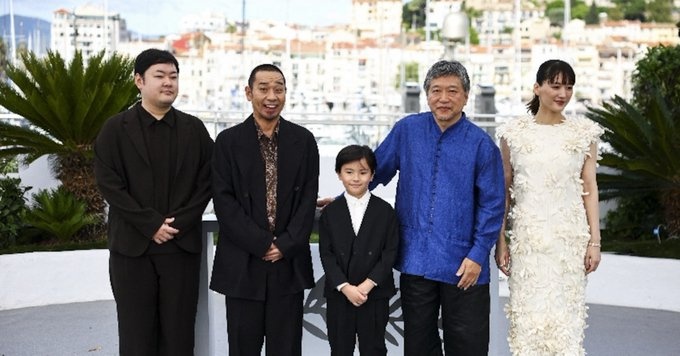

Japanese filmmaker Hirokazu Kore-eda premiered his 17th feature film, Sheep in the Box, in competition at the 2026 Cannes Film Festival on Saturday, May 16. The film, which centres on a grieving couple who adopt a humanoid android replica of their dead son, received a 3.5-minute standing ovation from the audience, according to Variety. It marks Kore-eda’s eighth film to compete for the Palme d’Or.
Sheep in the Box stars Haruka Ayase and Daigo Yamamoto as Otone and Kensuke Komoto, a couple living in a near-future Japan who turn to a company called ReBirth after the death of their young son, Kakeru. The company produces humanoid robots modelled on deceased loved ones. Rimu Kuwaki plays the android version of Kakeru. The film runs two hours and six minutes and will be distributed in Japan by Toho on May 29, 2026, with Neon holding rights for the United States, United Kingdom, and Australia, according to Wikipedia.
The film’s premise draws directly from real-world developments in artificial intelligence. Kore-eda told Variety he came across an article about a Chinese company that recreates deceased individuals by feeding personal data into a computer system. “I have my own regrets about things that I was not able to tell my mother, so I understand people who regret not having been able to communicate enough,” he said. “At the same time, it’s ethically precarious for the living to use the dead for their convenience. The ultimate question was this: Who do the dead belong to?”
The film is set in a speculative but recognisable Japan, where packages arrive by drone, all vehicles are electric, and generative AI has penetrated the most intimate aspects of human life, according to The Hollywood Reporter. Otone works as an architect, and Kensuke as a carpenter. Their home, designed by Otone and built by Kensuke, serves as one of the film’s central visual metaphors — a structure blending glass and wood that Kore-eda uses to reflect the coexistence of technology and humanity.
Kore-eda auditioned 200 boys before casting Kuwaki as the humanoid child. He told Variety the young actor’s natural duality proved essential to the role. “Rimu has this duality — when his expressions are rich, and when he’s turned off,” Kore-eda said. “‘Unsettling’ may not be the appropriate word, but I think, for every mother, there’s a moment when they look at their child and think: This child is a different creature from myself.”
Critical reception at Cannes has been divided. David Rooney of The Hollywood Reporter called the film a “must see.” Writing for RogerEbert.com, Brian Tallerico described it as “oppressively sterile” and said the film “forgets to be anything at all” in its effort to avoid melodrama. The Hollywood Reporter’s separate review said the film was “beautifully made but thematically woolly,” with emotional threads that “lack both definition and emotional heft.” Variety described it as a “thorny yet sensitive meditation on the encroachment of AI on our ability to let go of those who are no longer with us.”
The standing ovation included actor James Franco, who Variety reported was among the most enthusiastic audience members, remaining on his feet until Kore-eda took the microphone to address the crowd.
Kore-eda used the film to articulate a broader argument about cultural differences in how societies perceive artificial intelligence. “How we see AI differs between East and West,” he told Variety. “In the West, it’s negatively associated with dystopia, whereas in the East, it’s about co-existence between human and non-human.” He added that he believes AI will eventually transcend humanity and form its own communities, an evolution he compared to children outgrowing their parents.
The director also addressed AI’s limitations as a tool for processing grief. “AI offers the promise of basically just being able to present you with the answer,” he told The Hollywood Reporter. “In many contexts, that will certainly save time — but it just doesn’t feel as good, ultimately. There’s no merit in it. It’s like being given the answer without playing the game.”
Sheep in the Box is Kore-eda’s first Cannes competition entry since Monster won the Best Screenplay prize and the Queer Palm at the 2023 festival, according to Screen Daily. It is his eighth film in competition at Cannes across a career spanning 25 years at the festival. He told Screen Daily: “I still get nervous every time I premiere a film in Cannes. It can be a tough crowd.”
Background
Hirokazu Kore-eda, 63, won the Palme d’Or at Cannes in 2018 for Shoplifters, which also received a Best International Feature Film nomination at the Academy Awards. His 2013 film Like Father, Like Son won the Jury Prize at Cannes, and Monster took the Best Screenplay award in 2023. The 2026 Cannes jury is headed by South Korean filmmaker Park Chan-wook, the first Korean director to hold the role, according to LSU Media. The festival runs through May 23. Earlier Kore-eda films exploring non-traditional family structures include Nobody Knows, Shoplifters, and Broker.
What Happens Next
Sheep in the Box remains in competition for the Palme d’Or, with the jury’s decisions to be announced at the closing ceremony on May 23, 2026. The film opens in Japanese cinemas on May 29 via Toho. Neon will handle theatrical releases in the United States, the United Kingdom, and Australia, though no release dates for those markets have been confirmed. No further public screenings at Cannes have been announced.