
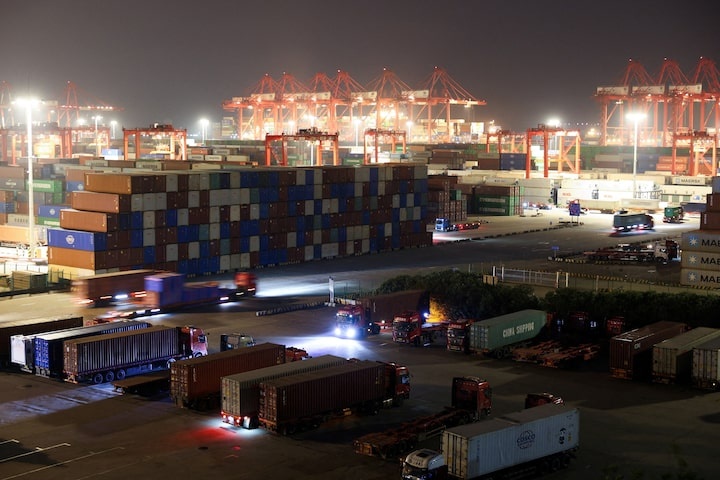

China’s exports are expected to have grown strongly in May, supported by overseas buyers placing orders early and sustained global demand for semiconductors and artificial intelligence-related products. A Reuters poll of 32 economists published on Monday forecast export growth of 15% year-on-year in dollar terms, up from 14.1% in April.
The forecast suggests that China’s export sector remained resilient despite concerns that the conflict in the Gulf region could increase energy costs and disrupt global trade flows. According to Reuters, many foreign buyers accelerated purchases to secure supplies before potential increases in shipping and production costs linked to the conflict.
Economists surveyed by Reuters projected that imports would rise by about 25% in May, close to the 25.3% increase recorded in April. China’s trade surplus is expected to reach $92.1 billion, compared with $84.8 billion in April and $51.3 billion in March.
The export sector has become one of the main drivers of growth for the world’s second-largest economy. Reuters reported that strong overseas demand helped China’s economy outperform expectations during the first quarter of 2026, although analysts continue to warn that weak domestic consumption leaves growth vulnerable to changes in external demand.
Global demand for semiconductors and AI-related components remained a major source of support for Chinese exports. According to Reuters, the worldwide expansion of artificial intelligence infrastructure has increased demand for technology products and manufacturing inputs produced in China.
South Korea’s exports, often viewed as a leading indicator of Chinese manufacturing demand, rose 80.9% in June, driven largely by semiconductor shipments and technology components. Reuters reported that the increase reflected continued strength in supply chains connected to AI and advanced electronics production.
However, several economists warned that the current export momentum may not last. Reuters said separate manufacturing data for May showed a sharp decline in new export orders compared with April, when businesses reported exceptionally strong demand as overseas buyers rushed to secure supplies.
“The Middle East conflict has yet to dent China’s exports, but it’s only a matter of time,” economists cited by Reuters said. They argued that stockpiling activity by foreign buyers could fade as inventories rise and higher costs begin to affect purchasing decisions.
Forecasts among economists varied considerably. Reuters reported that China Industrial Securities, Huachuang Securities and Zheshang Securities projected export growth of around 10%, while ING estimated growth could reach 19.5%. The Economist Intelligence Unit and JPMorgan expected exports to increase by approximately 12%.
International organizations have continued to scrutinize China’s export-led growth model. According to Reuters, the Organisation for Economic Co-operation and Development said in a report released last week that nearly 60% of Chinese companies’ market-share gains could be linked to government subsidies.
The debate over China’s trade strategy has intensified as its global trade surplus continues to expand. Reuters reported that a recent study by the U.S. Federal Reserve found China’s trade surplus exceeded 1% of global GDP, surpassing levels previously reached by Japan and Germany during their export-driven growth periods.
A meeting between U.S. President Donald Trump and Chinese President Xi Jinping last month reduced tensions between the two countries but did not produce major breakthroughs on tariffs or broader trade disputes, according to Reuters.
“The demand for semiconductors and AI-related products remains a key support for China’s exports,” Reuters reported, citing economists involved in the survey.
Regional and Global Impact
According to Reuters, strong Chinese exports continue to influence global manufacturing supply chains, particularly in technology sectors linked to semiconductors, artificial intelligence, electric vehicles and advanced electronics. Higher Chinese export volumes also affect trade balances in major economies, including the United States and members of the European Union.
The OECD’s recent findings, cited by Reuters, are likely to add to international discussions about industrial subsidies, manufacturing overcapacity and competition in global markets. Policymakers in several economies have called for stronger domestic demand in China to reduce reliance on exports as a source of growth.
Background
China recorded export growth of 14.1% in April, according to Reuters. The country has relied increasingly on overseas demand as domestic consumption remains subdued.
Exports surged 21.8% during the first two months of 2026, Reuters reported, driven by strong demand for technology products and AI-related equipment. China’s economy is valued at approximately $20 trillion and remains one of the world’s largest manufacturing centers.
The government has set a growth target of around 4.5% to 5% for 2026. Officials have pledged to encourage domestic consumption while maintaining support for strategic industries.
What Happens Next
China’s customs authorities are expected to release official May trade data in the coming days. Economists and investors will closely monitor whether export growth meets or exceeds the Reuters poll forecast of 15%.
Markets will also watch future manufacturing surveys for signs that new export orders are slowing after the recent surge in front-loaded demand. Policymakers are expected to assess whether additional measures are needed to support domestic consumption if external demand weakens.
Analysts will continue tracking developments in the Gulf conflict, energy prices and global technology demand, all of which could influence China’s trade performance during the second half of 2026.