
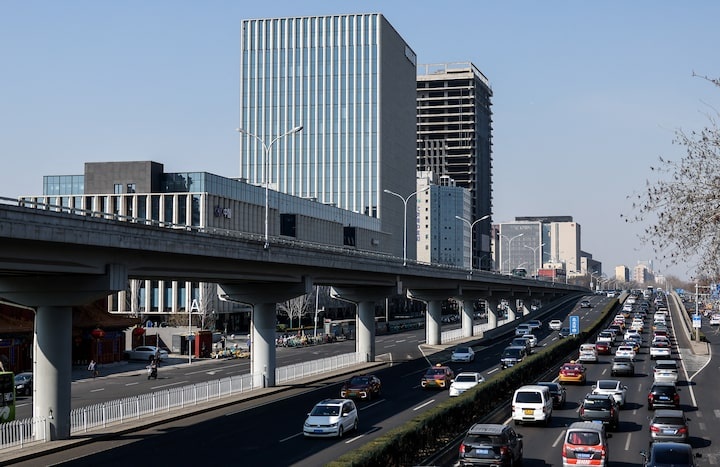

China’s domestic passenger car market recorded its eighth consecutive month of declining sales in May 2026, with volumes dropping 22.3 percent from a year earlier to 1.53 million vehicles, according to data released Monday by the China Passenger Car Association (CPCA). The association revised its full-year forecast dramatically downward, now predicting a fall of 11 percent for 2026 — far worse than the 1 percent decline it had previously estimated. The slump is straining foreign automakers, with Volkswagen among the most exposed as it scrambles to reposition around electric vehicles.
For the first five months of the year, sales were down 19.7 percent to 7.18 million vehicles, according to Reuters.
The downturn mainly reflects a hit to gasoline car sales due to oil price hikes linked to the Middle East crisis, said Cui Dongshu, the CPCA’s secretary-general, who predicts a gradual recovery in the second half to ease the year-to-date slide.
Electric vehicles and plug-in hybrids — which now account for 62.2 percent of all domestic passenger car sales — did not escape the pressure. EV and plug-in hybrid sales fell 7.5 percent from a year earlier last month, the fifth straight month of declines.
The numbers present a market in structural trouble, not merely a cyclical dip. The prolonged slump has underscored a widening gap between China’s headline economic growth and consumer demand for big-ticket items like cars. While Beijing is targeting economic growth of 4.5% to 5% this year, analysts say auto demand has been hit by weaker consumer confidence, reduced subsidies and a market that is mature after years of rapid expansion.
Exports, however, tell the opposite story. EV and plug-in hybrid electric vehicle sales abroad rose 112.6 percent in May from a year earlier, compared with a 74.7 percent increase in overall car exports. Chinese automakers have accelerated overseas expansion specifically to offset weak domestic revenue. From January to March 2026, China’s auto exports reached 2.34 million units, up 53 percent year-on-year, with Russia, Brazil, Mexico, the UK, and Belgium among the top five destination markets.
Volkswagen Faces a Critical Test
No foreign automaker is watching the data more closely than Volkswagen. The German manufacturer has spent decades building one of the world’s most profitable operations in China, but the shift to electric vehicles has eroded that position. Volkswagen has leaned more heavily on Chinese partners and suppliers, including a high-profile collaboration with Xpeng, as it seeks to close the technology gap with domestic EV brands in smart cabins, advanced driver assistance and software-defined vehicle architecture.
The strategy carries risks. The early rollout of the first Volkswagen-Xpeng model also highlights a distribution challenge facing foreign automakers as they try to build EV businesses alongside older joint ventures and combustion-engine sales networks, analysts said.
Bill Russo, chief executive of Shanghai-based advisory firm Automobility, put the dilemma plainly. “Traditional OEMs attempting to build parallel EV sales structures often face organizational fragmentation and slower market responsiveness,” Russo said. He added that separating EV retail operations from legacy dealer networks could be strategically logical but also creates execution risks around brand consistency, customer acquisition, aftersales support and retail scale.
A Mature Market With Geopolitical Pressure
Analysts have long flagged that China’s auto market was approaching saturation, but the Middle East conflict has sharpened that structural pressure into an acute one. Rising global oil prices, driven in part by the U.S.-Israeli military campaign against Iran, have depressed consumer willingness to buy gasoline-powered cars in China — while simultaneously boosting Chinese EV exports to fuel-price-sensitive markets overseas.
Eugene Hsiao, head of China equity strategy at Macquarie Capital, said: “China’s auto market is already the largest in the world at 23 million to 25 million retail sales annually and car ownership levels are relatively high, especially for an emerging market. This means the market is already at a mature stage of development.”
Hsiao said he expected China’s total retail auto market to grow at single-digit levels over the next five to ten years, though leading EV makers could continue to outpace the broader market as penetration rises.
NIO Chief Executive William Li said last month that China’s auto industry had likely moved past its “golden era” as domestic demand stagnates even though exports remain strong. With roughly 370 million vehicles already on the road, China has become a saturated market where automakers must fight harder for replacement buyers.
Background
China has been the world’s largest auto market by volume for well over a decade, selling between 23 million and 25 million passenger vehicles annually in recent years. Electric vehicles and plug-in hybrids outsold gasoline vehicles for the first time on an annual basis in 2025, but sales growth of such vehicles slowed sharply to 17.6 percent last year from 40.7 percent in 2024. Domestic demand faded in the final quarter of 2025, as many cities and provinces reduced or suspended government subsidies for auto trade-ins due to a funding shortage, intensifying competition and prompting automakers to step up overseas expansion. Chinese automakers make far more vehicles than the home market can currently absorb, which has led to a fierce price war as manufacturers compete for market share. Beijing is targeting economic growth of 4.5 to 5 percent in 2026, though consumer spending on large purchases has lagged that official trajectory.
What Happens Next
The CPCA’s Cui Dongshu has forecast a gradual recovery in domestic sales during the second half of 2026, contingent on oil price stabilisation and any renewed government stimulus. China’s overall passenger car exports could grow roughly 20 percent in 2026 from last year, according to Yichao Zhang, a partner at AlixPartners, with developing regions such as Southeast Asia identified as key expansion markets. Chinese vehicle manufacturers are likely to adapt by cutting costs and shifting toward more high-end models with bigger profit margins, said Claire Yuan, director of corporate ratings for China autos at S&P Global Ratings. Volkswagen’s first co-developed EV model with Xpeng is expected to move through initial distribution in the coming months, providing an early test of whether foreign brands can rebuild competitive relevance in China’s electric segment. The CPCA will release June sales data next month, which will be the first indicator of whether the second-half recovery Cui has forecast is materialising.