
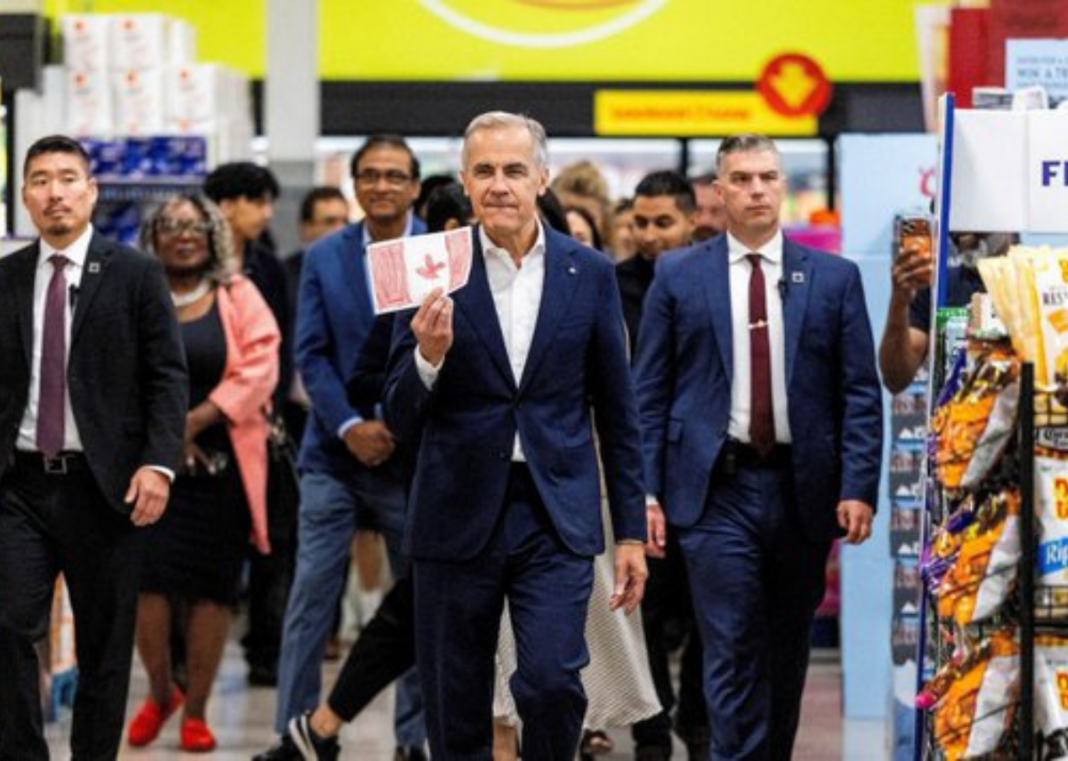

Carney Launches Canada’s First National Food Security Strategy With C$3.2 Billion in Investments
Prime Minister Mark Carney unveiled Canada’s first-ever National Food Security Strategy on Thursday, June 11, committing more than C$3.2 billion over ten years to increase domestic food production, promote competition among grocers, and reduce Canadian dependence on foreign food suppliers — framing the initiative explicitly as a matter of national sovereignty.
Canada has one of the highest food inflation rates among Group of Seven countries, and just five companies dominate 75% of its grocery market. Voters are increasingly concerned about spiking grocery prices. tradingeconomics
“A country that can’t feed itself or fuel itself or defend itself isn’t truly sovereign. It’s vulnerable to global shocks, it’s vulnerable to supply chain disruptions, vulnerable to tariffs,” Carney said while announcing the strategy at Canada’s largest food terminal in Toronto. “So to protect our sovereignty and truly take control of our future, we have to take control of our food system.” Hyundai
What the Strategy Contains
The strategy is backed by more than C$3 billion in investments over ten years and will seek to break open the market for independent retailers, boost domestic food production, and build a stronger, more independent, and more affordable food system for all Canadians. Metalwire
Its centrepiece is a new infrastructure fund. A so-called Food-Link Fund will see Ottawa provide C$1 billion over ten years to expand the Ontario Food Terminal and build new regional food hubs across the country. Those hubs will allow independent grocers and local farmers a way to bypass the five major retail chains that currently control 75% of the Canadian market. Hyundai
Ottawa has also earmarked C$750 million for greenhouses and hydroponics to expand year-round Canadian production of fruits and vegetables, including in rural and northern communities. The government also plans to speed up approvals for seeds, feed, fertilizers, and veterinary products, and to reduce backlogs that slow down the system. KED Global
The strategy also boosts funding for the federal Competition Bureau and the Competition Tribunal in an attempt to more closely monitor and enforce competition in food retailing and across its supply chains. GMK Center
On the consumer side, the new Canada Groceries and Essentials Benefit, which replaces the GST/HST credit from July 2026, will deliver C$8.6 billion in additional support over five years to more than 12 million Canadians. Quarterly payments will increase by 25% for five years. A family of four could receive up to C$1,890 in 2026, while a single person could receive up to C$950. Lexology
The government has also committed C$20 million to food banks and community food organisations through the Local Food Infrastructure Fund’s Community Support Stream, and is providing immediate expensing for new or expanded greenhouse construction as an upfront tax relief measure. Metalwire
The Competition Problem
Five supermarket chains — Loblaw, Metro, Empire (Sobeys), Walmart, and Costco — dominate 75% of Canada’s grocery market. Independent grocers, convenience stores, and regional chains account for the rest. GMK Center
Food terminals like the Ontario Food Terminal allow independent grocers to buy food at competitive prices, bypassing supply chains owned by the large retailers. They also sell fresh produce directly to hospitals, restaurants, and consumers. The strategy’s C$1 billion infrastructure commitment is designed to replicate the Ontario model nationally, giving independent operators a structural supply-chain alternative to the dominant chains. GMK Center
A government official told reporters at a Thursday morning technical briefing: “We are trying to inject some competition, some alternatives.” Hyundai
The Regulatory Dimension
The government plans to amend the Canadian Food Inspection Agency Act and the Pest Control Products Act to force regulators to consider food security and costs when making decisions, provided health and safety are not compromised. The strategy includes a controversial provision allowing for the temporary use of certain pesticides under specific conditions if they are deemed necessary for national food or economic security. Hyundai
The strategy document states: “Consumers need more affordable choices when they shop, and people in rural, remote and northern communities need better access to fresh produce at reasonable prices. We need to reduce our dependence on other countries by processing more of the food we grow and use new technologies to grow the foods we cannot currently grow at scale year-round.” KED Global
Regional and Global Impact
Canada’s food inflation problem has deepened over the past two years under a combination of structural and external pressures. Canada’s food inflation rate eased to 5.4% in February 2026, down from 7.3% previously, but remained 3.6 percentage points above overall inflation. Among the G7, Canada still posts the highest food inflation rate — ahead of Japan at 3.9%, the United Kingdom at 3.6%, the United States at 3.1%, Italy at 2.6%, France at 2.0%, and Germany at 1.5%. U.S. News & World Report
Canada’s headline inflation surged to 2.4% in March 2026, reflecting the initial impact of the Iran war on Canadian consumer prices as disruption to Persian Gulf tanker routes triggered energy shortages globally. The energy shock adds a further layer to the food cost pressure, since energy is embedded throughout the agricultural supply chain — from fertiliser production to refrigeration and transport. Thailand Business News
Dr. Sylvain Charlebois, Senior Director of the Agri-Food Analytics Lab at Dalhousie University, has said that while global factors including climate volatility, energy costs, and supply disruptions play a role, most of Canada’s food inflation is now structural — driven by regulatory drag, interprovincial trade barriers, poor logistics, and rising compliance costs that have compounded since 2008. Bloomberg
The strategy’s sovereignty framing is not incidental. It positions the food system explicitly alongside fuel and defence as pillars of national security — a formulation that reflects both the political sensitivity of grocery prices and Canada’s ongoing navigation of its relationship with the United States under a trade environment shaped by tariffs and CUSMA renegotiation.
Background
Since 2008, the food component of Canada’s Consumer Price Index has consistently grown faster than the overall CPI. The top four grocery chains control at least 72% of the national market share. A Grocery Code of Conduct became fully operational in January 2026, but its enforcement remains to be tested. Canada also stands out by posting food inflation consistently above its G7 peers, a pattern that predates the current Iran war energy shock and has been attributed by analysts to market concentration and structural inefficiencies in the domestic supply chain. Carney, who took office following his Liberal Party’s election victory in April 2026, has made affordability and economic sovereignty central pillars of his government’s domestic agenda. Wikipedia + 2
What Happens Next
Ottawa will launch an early wave of calls for proposals in June 2026 for the Food-Link Fund’s food terminal and hub infrastructure investment. The first Canada Groceries and Essentials Benefit payment will be deposited on July 3, 2026, with quarterly payments thereafter increased by 25% for five years. The Competition Bureau and Tribunal funding increases require legislative action, and the amendments to the Canadian Food Inspection Agency Act and Pest Control Products Act will be tabled in coming weeks. Whether the strategy succeeds in materially reducing food prices will depend in part on whether the Food-Link Fund’s infrastructure investment generates enough competition to erode the pricing power of the five chains that currently dominate the market. MetalwireLexology