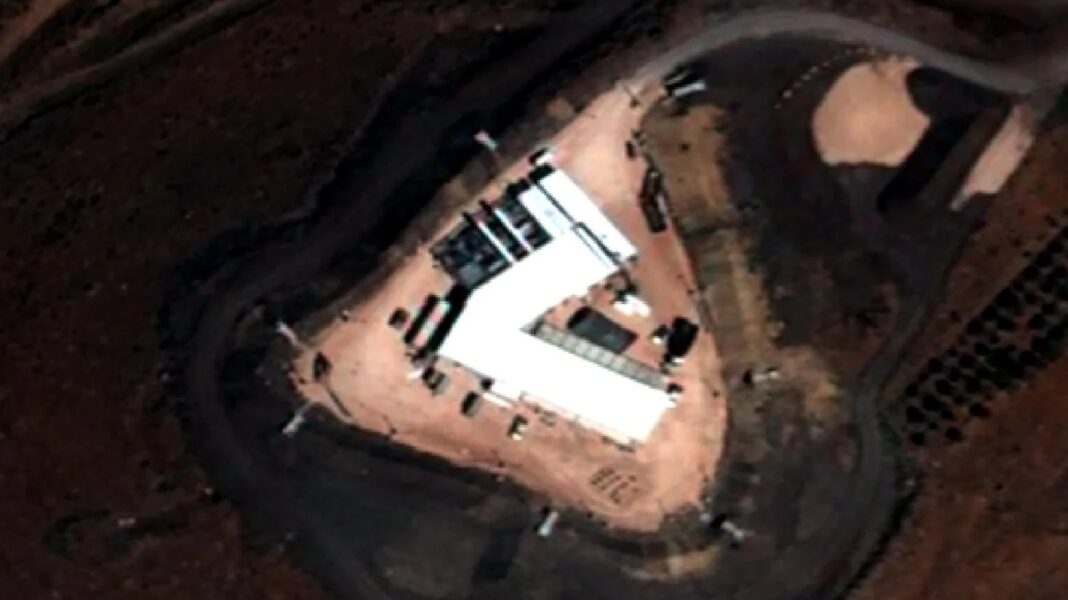

Israel has constructed a string of fortified military bases across southern Lebanon and southwestern Syria — and military sources in both countries say the infrastructure shows no sign of being temporary. Satellite imagery analysed by Middle East Eye, published on June 11, 2026, reveals a chain of bases running from the Mediterranean coast through southern Lebanon to the Yarmouk River basin in Syria, spanning territory Israel has occupied since late 2024.
The bases have been developed continuously since October 2024, with construction accelerating during ceasefire periods rather than pausing. Lebanese and Syrian military officers, along with sources close to Hezbollah, told Middle East Eye they believe Israel intends to make these positions permanent, despite repeated public statements about eventual withdrawal.
“If you are planning to withdraw, you do not carry out this much work,” a Lebanese military source told Middle East Eye.
Lebanon: Five Bases, No Exit
Israel invaded Lebanon in October 2024, after more than a year of cross-border exchanges with Hezbollah. By the time a ceasefire agreement was reached on November 27, 2024, Hezbollah’s leadership had been largely dismantled, approximately 4,000 people had been killed by Israel, and more than a million had been displaced from the south and areas of Beirut.
Under the ceasefire terms, Israel had 60 days to withdraw, with Hezbollah agreeing to pull back north of the Litani River. The deadline passed without compliance. Israel refused to leave five positions it had established in the first days of the invasion — all built on hilltop positions giving a clear line of sight over large stretches of southern Lebanon.
The five bases run along most of Lebanon’s 79-kilometre border with Israel. The towns and villages beneath them have been largely depopulated, and some have been demolished entirely.
Satellite imagery shows work beginning at the sites in October 2024. At first, nearby buildings were destroyed through air strikes, detonations, and bulldozers. Roads were then widened, earth fortifications raised, and accommodation units delivered. By the turn of 2025, Israeli military vehicles had appeared at each of the five sites.
From January to September 2025, Israel rapidly expanded the sites. Fortifications were widened, heightened and extended. Perimeters grew, watchtowers were erected, and the number of accommodation units and vehicles increased sharply by November.
Two of the bases sit within close proximity to UNIFIL, the United Nations peacekeeping force that has operated in southern Lebanon for two decades. The post at Labbouneh, Israel’s most western position, is just 150 metres from a UNIFIL base and 2 kilometres from the force’s main headquarters on the coast. At Tal Dowary near Houla, the Israeli base sits 1.5 kilometres from UNIFIL peacekeepers. UNIFIL is scheduled to wind down its operations in 2027.
“For 15 months, we watched the Israelis bring in reinforcements, conduct drilling works, and open roads around these sites — steps that suggest an intention to remain permanently,” the Lebanese military source said.
A source close to Hezbollah described the bases as operational centres “designed defensively, making it impossible to approach them, while also allowing offensive operations to be launched from them.” The source said Israel intended the bases to secure a zone five kilometres deep inside Lebanese territory.
Hostilities resumed in early March 2026, when Israel killed Iranian spiritual figurehead Ali Khamenei and Hezbollah attacked Israel in response, fearing an imminent invasion. Israeli Prime Minister Benjamin Netanyahu subsequently approved the establishment of several new outposts in Lebanese territory, according to Israeli media reports.
Israeli soldiers speaking to Haaretz said the newer positions do not look temporary. “These are permanent outposts that will be manned for a long time,” one soldier told the newspaper. “Nobody really knows where this is going.”
A new US-backed ceasefire proposal was put forward last Thursday. It contained no mention of Israeli withdrawal from the areas it currently occupies — now roughly a fifth of the whole country. Israel said it accepted the plan but continued military operations. Hezbollah Secretary-General Naim Qassem said his party rejects any agreement that does not include a full Israeli withdrawal from Lebanese territory.
Syria: A 70-Kilometre Line of Control
The Lebanese ceasefire on November 27, 2024, coincided with the launch of a Syrian rebel offensive from Idlib province that reached Damascus and toppled Bashar al-Assad within two weeks. As rebel forces under Ahmed al-Sharaa consolidated control, Israel moved troops into the UN-monitored buffer zone along the Golan Heights boundary — and beyond.
Among the first locations seized was the summit of Mount Hermon, which at 2,814 metres is the Levant’s second-highest peak. Netanyahu visited troops there in December 2024, saying Israel would not retreat for at least a year.
Middle East Eye identified at least 10 Israeli bases and observation posts established in newly occupied areas of Syria since Assad’s fall. Eight are within the neutral buffer zone, created after the 1973 Middle East war. Together, they form a line of control 70 kilometres long, running from Mount Hermon’s peak to the Yarmouk River on the Syrian-Jordanian border.
Israeli bases can now be found in three Syrian provinces: Quneitra, Daraa, and the Damascus Countryside. At Tulul al-Humr, Israeli troops are positioned just 40 kilometres from the Syrian capital.
“In western Daraa, positions were selected specifically because they provide commanding oversight over valley entrances and surrounding villages,” a source from the new Syrian government’s military told Middle East Eye.
Unlike in Lebanon, where Israel relies on pre-existing dirt tracks, in Syria it has cut new roads linking bases to each other and to the Golan Heights. Many of these have been paved, enabling rapid troop movement. The largest Israeli base in newly occupied Syria is at Jubata al-Khashab, close to the Purple Line — the boundary separating Israeli-occupied and Syrian-controlled territory — where satellite imagery shows military vehicles and storage facilities.
A Syrian military source told Middle East Eye that Israel’s ground operations “included mine-laying operations, the demolition of civilian homes, forced displacement, and the destruction of agricultural land and forested areas — methods that strongly resemble practices observed in both Gaza and the West Bank.”
According to Syrian military sources, Israel has conducted an average of 17.5 raids on villages per month over the past year, alongside arrests, occasional shelling of farmland, and forced evictions.
Ceasefires as Cover
Carmit Valensi, head of the Syrian programme at Israel’s Institute for National Security Studies (INSS), told Middle East Eye that the October 7, 2023, Hamas-led attacks “shattered” the assumption that deterrence alone would protect Israel from its enemies.
“From that point on, Israel decided to adopt what we might call the buffer zone strategy, which obviously we can see clearly in Syria and Lebanon and Gaza,” she said.
A second Syrian military source was more pointed in its assessment. “Ceasefires have increasingly functioned as diplomatic delays that provide Israel with opportunities to entrench itself militarily, exploit operational gaps, and consolidate territorial control. In practice, there is little evidence of a genuine diplomatic process,” the source said.
In January 2026, the United States established a joint coordination mechanism between Washington, Israel, and Syria aimed at de-escalation. Since then, Israeli checkpoints have appeared on several roads in western Daraa.
“Data collected between February and May indicates that Israel is not genuinely pursuing negotiations or diplomacy. Rather, it is using diplomatic processes as windows of opportunity for long-term entrenchment,” the second Syrian source said.
Valensi warned that the occupation is generating consequences Israel may not have anticipated. “We clearly see the change and the shift in the Syrian discourse towards Israel from rather more moderate, restrained stances into much more radical ones,” she said. She also described the occupation of large areas of Syria as unsustainable, given the strain two and a half years of regional warfare has placed on Israel’s military.
“In terms of the characteristics of these positions and bases, we can assume that there is a long-term intention,” Valensi told Middle East Eye.
Background
Israel first occupied Lebanon’s south from 1982 to 2000, when a guerrilla campaign by Hezbollah forced a withdrawal. The 2006 Lebanon war ended with UN Security Council Resolution 1701, which called for Israeli withdrawal and the disarmament of non-state actors south of the Litani River — terms that were never fully implemented. Israel has occupied the Syrian Golan Heights since 1967 and formally annexed the territory in 1981, a move not recognised under international law. The buffer zone in southwestern Syria was established under a 1974 disengagement agreement monitored by the UN Disengagement Observer Force (UNDOF). Assad’s government fell in December 2024 after a 13-year civil war, leaving the new Syrian administration under Ahmed al-Sharaa to navigate a country already fragmented by Israeli military expansion.
What Happens Next
Lebanon and Israel are engaged in indirect talks over a new ceasefire framework, though the US-backed proposal put forward last Thursday contains no withdrawal clause. Hezbollah has stated it will not accept any agreement that leaves Israeli forces on Lebanese soil. Syria’s government has sought US involvement to negotiate an end to Israeli attacks, but sources within Damascus say Israeli construction activity has continued uninterrupted through those discussions. UNIFIL’s mandate in southern Lebanon is set to wind down in 2027, a timeline that Lebanese officials say will leave southern communities without any international monitoring presence. Israel has not publicly committed to a withdrawal schedule from either Lebanon or Syria.