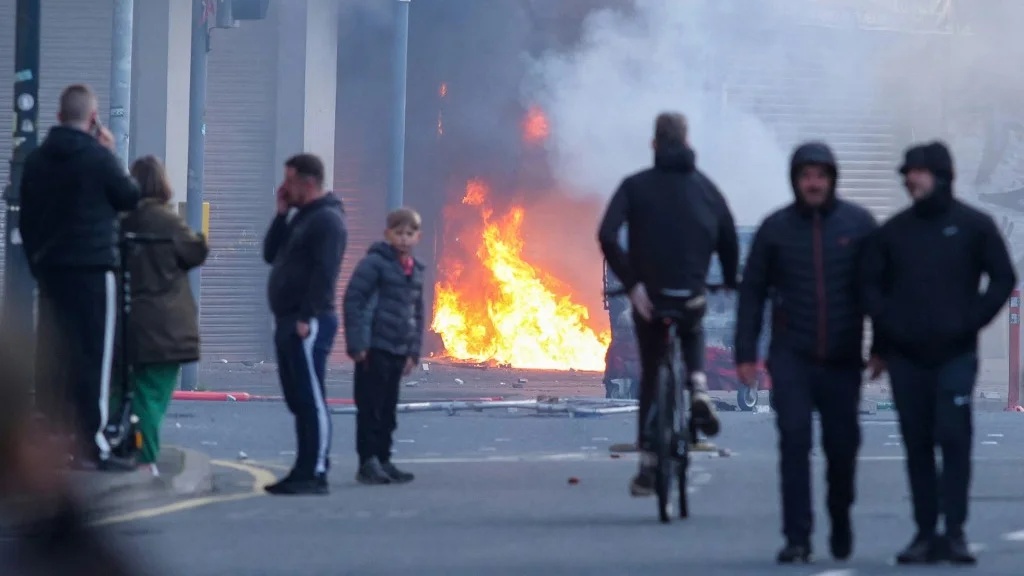

Anti-immigrant riots tore through Belfast, Northern Ireland, on the nights of June 9 and 10, 2026, after a 30-year-old Sudanese asylum seeker was charged with attempting to murder a man in his 40s in a knife attack in north Belfast on June 8. Masked mobs burned homes, torched vehicles and attacked businesses believed to belong to migrants, leaving at least 27 people homeless. Police deployed water cannons for the second consecutive night on Wednesday as violence spread to other parts of the United Kingdom.
The suspect was charged with attempted murder, possession of a knife in a public place and making threats to kill. A kitchen knife was found at the scene. Police confirmed the man flew from Paris to Dublin and entered Northern Ireland in February 2023. He claimed asylum on arrival and was permitted to remain in the UK until 2028, and had a legal right to reside in Northern Ireland. There is currently no evidence linking the attack to terrorism, police said.
Video footage of the attack spread rapidly across social media, triggering a chain of events that would engulf the city within hours.
The Violence
Riots broke out across Belfast on the evening of June 9. The fire brigade attended 62 incidents across the city. Twenty-seven people were made homeless after rioters went door-to-door targeting homes they believed to belong to immigrants. Victims included Ugandan carers, a Ukrainian family and a Romani family, whose house was set alight — the third time, according to neighbours who spoke to The Times, that family had been forced from their home.
A two-month-old baby had to be rescued during the attacks, according to the Police Service of Northern Ireland’s chief constable.
On the second night, demonstrators wearing masks tore bricks from the walls of homes and smashed pavements with sledgehammers to hurl at riot police. Officers responded with water cannons in Newtownabbey, eight miles north of Belfast city centre. At least 16 people were arrested and two were later charged. Twelve police officers were injured, some by Molotov cocktails.
Participants in the violence chanted slogans including “foreigners out” and “kill all Muslims.”
Political Reaction
Northern Ireland First Minister Michelle O’Neill condemned the violence in direct terms. “Racism, intimidation and violence are wrong wherever they occur,” she said on X, describing the riots as “nothing less than disgusting cowardice.”
British Prime Minister Keir Starmer called the original stabbing attack “horrific” and “sickening.” “I have absolutely no tolerance for abhorrent scenes of violence like this on our streets,” he said on X, adding that his thoughts were “first and foremost with the victim.”
Northern Ireland Secretary of State Hilary Benn referred on June 11 to “the truly shocking scenes we saw on Tuesday night, with people being burnt out of their homes because of the colour of their skin.”
The response from across the Atlantic introduced an additional diplomatic dimension. Key Trump administration officials, including Vice President JD Vance, seized on the attack to blame the UK’s migration policies. A spokesperson for Prime Minister Starmer warned against “trying to interfere” in the UK’s democracy.
Far-Right Amplification
Within hours of the attack becoming public, prominent figures including Reform UK leader Nigel Farage, commentator Katie Hopkins and scientist Richard Dawkins were presenting the assault as evidence of a broader threat posed by migrants. Far-right activist Tommy Robinson urged his supporters to take to the streets, according to The Guardian. Elon Musk’s platform X helped amplify those calls to millions of users.
The attack was widely framed online as an attempted “beheading,” transforming an individual act of violence into a racial narrative about a nation under siege.
The victim’s own family pushed back against that framing. In a statement issued on June 10 via MP Phillip Brett, the family said: “We have many migrants who make a deeply valuable contribution to our country, including in our healthcare system and hospitality sector, and we depend on them to make our country work. We do not want this terrible tragedy to be used to divide people or fuel hostility.” The man who intervened during the attack to stop the suspect, doing so with a hurley stick, also publicly condemned the riots that followed.
The Wider Pattern
The Belfast violence did not emerge in isolation. Northern Ireland saw more than a week of riots in June 2025 after two Romanian teenagers were charged with the attempted rape of a schoolgirl in Ballymena, northwest of Belfast. Those charges were later dropped for lack of evidence, but anti-immigrant violence had already spread to multiple towns, with dozens of houses attacked.
The UK was also struck by riots in July 2024 following the stabbing deaths of three young girls near Liverpool by a British 17-year-old whose parents were Rwandan refugees. The teenager was sentenced to life in prison with a minimum of 52 years.
Amnesty International, in a report published in November 2025, described the preceding 12 months as “a shameful year of hate” in Northern Ireland. Police services documented 2,048 racist incidents and 1,280 race hate crimes in that period — among the highest levels recorded since records began in 2004.
Dr. Amina Shareef, a researcher of anti-Muslim racism writing for Middle East Eye on June 12, placed the Belfast riots in a broader political context. She argued that for more than a decade, politicians and newspapers had “racialised asylum seekers as criminals, terrorists, welfare scroungers and opportunists,” and that migration had been “framed not as a humanitarian challenge, but as a national security issue.” Shareef wrote that the men who attacked migrant homes “did not believe they were acting against the nation — they believed they were acting for it.”
Protests also spread beyond Northern Ireland on June 9, with further unrest reported in Glasgow and Edinburgh in Scotland, and in Southampton in England.
What Happens Next
At least 16 people had been arrested as of June 11, with two formally charged. The PSNI has not indicated when further charges will follow. The suspect in the original stabbing remains in custody awaiting further legal proceedings on charges of attempted murder, possession of a bladed weapon and making threats to kill.
A smaller protest took place in east Belfast on June 11, with Translink suspending public transport services as a precaution. The UK government has not announced any formal policy response as of June 12, though Starmer’s office has publicly pushed back against foreign political commentary on the unrest, warning against interference in British domestic affairs.