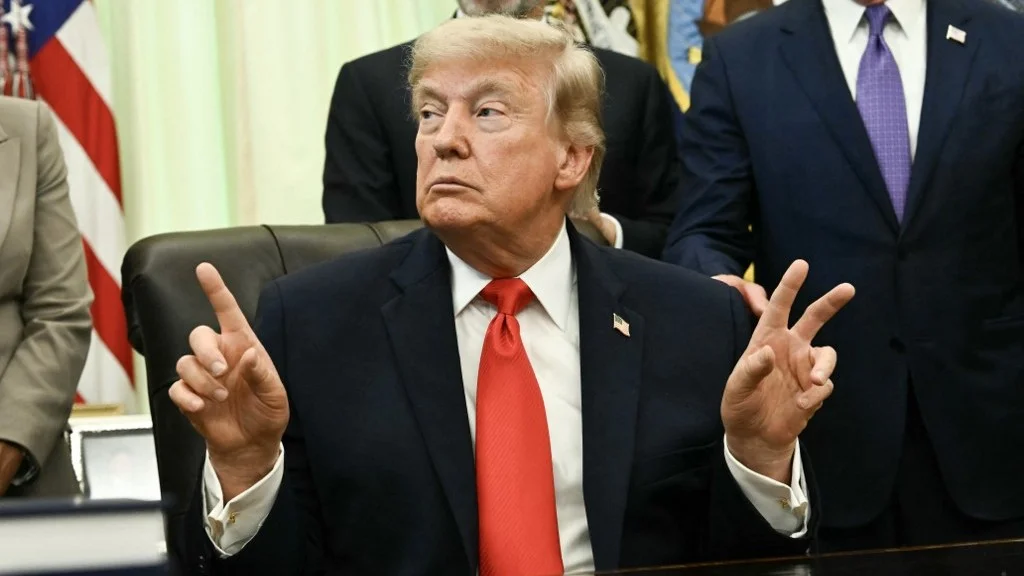

President Donald Trump said on Saturday, June 13, that a peace deal between the United States and Iran is scheduled to be signed on Sunday, June 14, and that the Strait of Hormuz will reopen immediately upon signing — even as the two sides continued to describe differing terms for the agreement, raising uncertainty about whether a final text had been fully agreed.
“The Deal is scheduled to get signed tomorrow, and immediately after it is signed, the Hormuz Strait is OPEN TO ALL,” Trump said in a post on Truth Social on Saturday. He added that he hoped the process would “all work out quickly, easily, and smoothly.”
Pakistani Prime Minister Shehbaz Sharif, who has served as a key mediator throughout the negotiations, said early Saturday that a peace deal was closer than ever before, with finalisation likely expected within 24 hours. “Pakistan is preparing for the electronic signing of the peace deal immediately after, followed by technical level talks next week,” he posted on X.
What Each Side Says
The framework under discussion is a memorandum of understanding that both sides have described as a first stage, with more complex negotiations deferred to a subsequent 60-day technical phase.
A senior Trump administration official confirmed Friday that the memorandum of understanding being negotiated states that, if signed, it would trigger a 60-day period for technical negotiations. The agreement would lead to the dismantling of Iran’s nuclear programme, including the United States obtaining Iran’s enriched material. Iran is “committing indefinitely to never procure or develop nuclear weapons,” the official said. Technical details of how to remove Iran’s stockpile of highly enriched uranium have yet to be worked out, with discussions on how to proceed to occur in the next round of technical talks.
Iranian Foreign Minister Abbas Araghchi described the emerging deal differently. He said the nuclear issue and the lifting of sanctions had been deferred entirely to the second stage of negotiations, for which a 60-day negotiation period had been envisaged. “In the second stage of the negotiations, discussions will cover the lifting of sanctions, uranium enrichment, the future status of enriched material stockpiles, and the framework for Iran’s reconstruction fund,” Araghchi said, according to the semi-official Fars news agency.
On Iran’s enriched uranium stockpile — the central point of US concern — the two sides’ positions remain publicly unreconciled. A US official said the 60-day period after both sides sign the deal would be used to work out technical details for removing Iran’s enriched uranium, though the official did not detail who the US envisions taking charge of removing the uranium, believed to be entombed under three nuclear sites battered by American strikes last year. Araghchi stated that from Iran’s perspective, the only acceptable method for dealing with the enriched material is to dilute it within Iran.
The Strait of Hormuz: Reopening Versus Control
The most publicly visible provision — the reopening of the Strait of Hormuz — also contains a source of friction. Araghchi said that Iran intends to charge a service fee for ships passing through the strait, adding that while it is not possible to levy a toll on passage, Iran would maintain control over the waterway and charge fees for services provided. He also said that Iran’s “sword will remain poised over the Strait of Hormuz indefinitely.”
Trump has previously condemned Iranian attempts to impose tolls on shipping through the strait as a violation of the ceasefire terms. The White House reiterated in April that it opposes any attempt by Iran’s military to impose charges on international shipping through the waterway.
Lebanon: A Contested Front
Iran has insisted throughout the negotiations that any deal must include a ceasefire in Lebanon, where Israel has continued a deadly offensive against Hezbollah, Iran’s proxy militia. Israeli Defence Minister Israel Katz warned Friday that Israel could still act independently toward Iran and that the country would not pull out of the zones it is occupying in Lebanon, Syria, and Gaza, nor would it withdraw from the northern refugee camps of the Israeli-occupied West Bank. Fighting continued in southern Lebanon on Saturday.
Smoke billowed from impact sites following Israeli strikes near southern Lebanon villages on June 14, as Israeli and Hezbollah forces continued to exchange fire even as American and Iranian officials described the broader deal as imminent.
British Prime Minister Keir Starmer welcomed progress on the Iran peace deal in a call with Trump on Saturday and underlined the importance of ensuring any deal delivers a durable and lasting peace, according to the prime minister’s office. Starmer expressed support for Trump’s efforts and said the UK stood ready to support the implementation of any peace agreement and to work with international partners to ensure its success.
Senator Lindsey Graham warned on X Friday that the terms described by Iranian media would be “awful” and that Trump’s red line on nuclear enrichment must hold. He welcomed reassurances from Trump, who contested parts of the deal claimed by Iran.
Nuclear Programme and Sanctions
Araghchi described the outcome of the memorandum discussions as a 14-point document, and said Iran would explain every single provision to its people once it was finalised.
US Treasury Secretary Scott Bessent reiterated on Saturday that sanctions relief would not come until Iran agreed to hand over its highly enriched uranium stockpile — a precondition Iran has not publicly accepted. Bessent said that a US-Iran deal would bring economic relief to Iran. Trump separately said that once all is calm, US forces will go in to recover what he called the nuclear material buried under the mountains targeted by B-2 bombers.
Market Response
Wall Street’s rebound continued into early Friday and oil prices sank more than 3% after Trump claimed a breakthrough in talks to end the Iran war. Futures for the S&P 500 were 0.6% higher before the opening bell, while futures for the Dow Jones Industrial Average added 0.7%. Nasdaq futures rose 0.5%.
Deutsche Bank researchers said in a June analyst note that while geopolitical developments continue to drive large oil price movements, there is some optimism that the US and Iran will reach a peace deal this month.
Regional and Global Impact
A signed memorandum of understanding — even one with key terms deferred to a 60-day technical phase — would constitute the most significant de-escalation step since the war began on February 28, 2026. The immediate reopening of the Strait of Hormuz, through which approximately 20% of the world’s traded oil passes, would have cascading effects on global energy markets, consumer inflation in G7 economies, and the foreign exchange positions of commodity-linked currencies including the Canadian dollar, Norwegian krone, and Russian rouble.
The publicly divergent descriptions of the deal’s contents — particularly on uranium disposal, Strait of Hormuz fees, and Lebanon — leave open the possibility that the Sunday signing date may slip if the 14-point text is not mutually agreed in its final form. Iran’s new supreme leader, Mojtaba Khamenei, has not been named by any US official as having personally signed off on the agreement, a point a senior Trump administration official sidestepped when asked directly on Friday.
Background
The United States and Israel launched military operations against Iran on February 28, 2026, in what US Central Command designated Operation Epic Fury, targeting military, government, and infrastructure sites. The strikes resulted in the death of Supreme Leader Ali Khamenei. A two-week ceasefire brokered by Pakistani Prime Minister Shehbaz Sharif took effect on April 8, following the effective closure of the Strait of Hormuz, which sent Brent crude above $130 per barrel in March. The ceasefire has been repeatedly strained by skirmishes in the Gulf, continued Israeli operations in Lebanon, and Iran’s imposition of transit fees on vessels passing through the strait. Negotiations have been conducted through Pakistani and Omani intermediaries, with American special envoys Steve Witkoff and Jared Kushner leading the US team, and Araghchi heading the Iranian delegation. Araghchi confirmed the memorandum structure as a two-stage process on Iranian state television.
What Happens Next
Trump set Sunday, June 14, as the date for the signing, with Hormuz reopening immediately upon execution of the agreement. Whether both governments present an identical public account of the document’s contents — particularly on uranium disposal and Strait of Hormuz fees — will be the first test of whether the memorandum holds. Technical negotiations on sanctions, enrichment, and nuclear material removal are expected to begin the following week, with a 60-day window for their conclusion. Israel’s position on Lebanon, where it has stated it will continue military operations independently of any US-Iran agreement, is the most immediate variable that could unravel the framework after signing.