
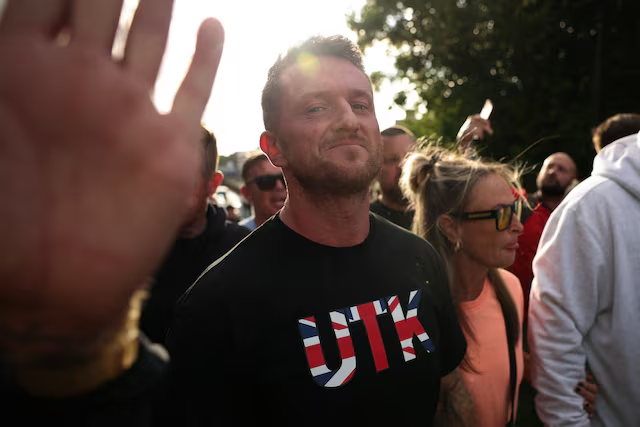

British anti-Islam activist Tommy Robinson was detained by police at Heathrow Airport on Saturday under UK counter-terrorism legislation, with his mobile phones seized, following a week in which he gained renewed prominence on social media. It was understood the activist, whose real name is Stephen Yaxley-Lennon, was stopped and had his phones seized under section 3 of the UK’s Counter-Terrorism Border Security Act 2019.
Robinson used social media to claim he was detained for almost three hours and had his iPhone and Samsung Galaxy phones taken, and to ask his supporters to donate money to fund his legal defence.
The act gives police officers at ports powers to stop, question, search and detain people suspected of travelling to plan, prepare and carry out hostile acts.
It was not known what the stop of Robinson was in relation to and the Metropolitan Police declined to comment when approached by The Guardian.
A spokesperson for Robinson framed the stop as an attempt to identify his journalistic contacts. A spokesperson for Robinson posted on X: “They likely want to see who he is talking to, and maybe find out who his sources are, sources who will expose politicians for their part in the rape of a generation of British girls. This is an attack on free speech, this is an attack on investigative journalism, nothing more nothing less.”
Saturday’s stop is not Robinson’s first encounter with Schedule 3 or its predecessor provision. Robinson was previously acquitted of a terrorism charge after refusing to give police access to his phone in July 2024, when he was stopped by officers at the Channel Tunnel in Folkestone while driving a friend’s silver Bentley to Benidorm, Spain. Robinson refused to give officers his phone’s PIN code during the stop, arguing that the device contained confidential journalistic material.
That earlier case concluded with a finding against the police’s justification for the stop. In November 2025, Judge Sam Goozee found Robinson not guilty of a terror-related offence after he refused to give police his mobile phone PIN code during the July 2024 border stop, ruling that police had detained the far-right activist based on his political beliefs rather than suspicions of a connection to terrorism. An officer had been suspicious of Robinson because of his behaviour, the expensive car he was driving — a friend’s silver Bentley Bentayga SUV — and the fact he had only bought a ticket to travel on that day, prosecutors had told Westminster Magistrates’ Court.
Regional and Global Impact
Saturday’s detention occurs against the backdrop of a wider UK debate over the use of counter-terrorism port powers against high-profile political activists, intensified by the November 2025 ruling that found Robinson’s prior stop had been politically motivated. The repeated use of Schedule 7 and Schedule 3 powers against the same individual — three encounters in under two years, by the accounts gathered here — raises questions about how police forces apply a threshold designed for counterterrorism screening to a figure whose activities, however controversial, are primarily political and journalistic rather than connected to violent extremism in any documented sense from these stops.
For civil liberties organisations and press freedom advocates, the case adds to ongoing scrutiny of how broadly counter-terrorism border powers are interpreted in practice. Robinson’s history of convictions for public order and contempt offences — including an 18-month sentence for breaching a court injunction, from which he was released early in 2025 — forms part of a long-running public controversy in the UK over his platform, his legal troubles, and the political response to both.
Background
Schedule 7 of the Terrorism Act 2000 allows police to stop anyone passing through a UK port “to determine whether they may be involved or concerned in the commission, preparation or instigation of acts of terrorism.” A person detained under Schedule 7 can be held for up to six hours, is legally obliged to answer questions, and must provide the password or PIN for electronic devices or be held to have committed a criminal offence if they refuse. Section 3 of the Counter-Terrorism and Border Security Act 2019, under which Saturday’s stop was reportedly conducted, expanded and updated these port examination powers. Robinson has numerous convictions for public order and contempt offences, and was imprisoned in October 2024 for contempt of court after admitting he had flouted an injunction preventing him from repeating false claims about a Syrian schoolboy — an injunction that came into force after he lost a libel case brought by Jamal Hijazi, the Syrian refugee he was found to have defamed. He was released from prison in Buckinghamshire four months early after the High Court cut his 18-month sentence. Advocacy group Hope Not Hate has described Robinson as “the UK’s most notorious far-right extremist.”
What Happens Next
The Metropolitan Police has not commented on the basis for Saturday’s stop or confirmed whether any further action will be taken in connection with the seized devices. Robinson has not been charged in connection with the Heathrow detention as of Sunday. His spokesperson’s call for donations to fund a legal defence suggests Robinson anticipates either a legal challenge to the stop itself or a defence against any future charge arising from it — a parallel to the successful challenge he mounted against his 2024 Channel Tunnel detention. Given the precedent set by the November 2025 ruling, which found his prior stop to have been politically motivated, any legal challenge to Saturday’s detention would likely draw on similar arguments regarding the basis on which police selected him for examination.