
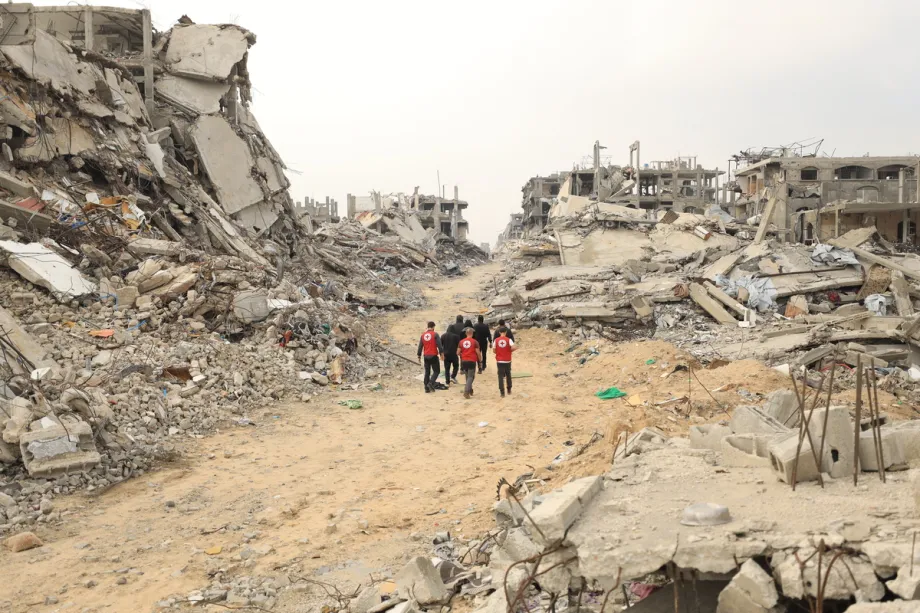

The International Committee of the Red Cross (ICRC) warned on Sunday, June 14, that thousands of Palestinians buried beneath the ruins of Gaza may never be formally identified, as slow recovery operations, blocked machinery, and deteriorating remains compound a deepening forensic crisis. The warning, first reported by The Guardian, comes more than eight months after a US-brokered ceasefire took effect in October 2025.
Pat Griffiths, the ICRC spokesperson in Jerusalem, said time was working directly against any prospect of identification. “There is no doubt that these bodies could soon become difficult to identify,” he told The Guardian. “The longer it takes for human remains to be recovered, the more difficult it can be to identify them. The longer the deceased lie beneath the rubble, the more likely they will be in advanced stages of decomposition — even skeletonised — when eventually recovered.”
The scale of what recovery teams face is vast. Gaza is buried under 61.5 million tonnes of debris, with three quarters of the territory’s buildings destroyed, according to UN data. Health officials estimate at least 10,000 people remain buried under the rubble, and at least 1,129 bodies have been recovered but could not be identified — a figure officials say likely understates the true scale of the problem.
Recovery teams have been working under severe equipment constraints. According to Middle East Monitor, rescue workers have relied almost entirely on hand tools — shovels, pickaxes, wheelbarrows, rakes, and bare hands — to retrieve remains. Only one fully functional digger remains in Gaza to clear the ruins. Repeated requests to allow the entry of excavators and heavy machinery have not received approval. Israeli officials contacted by The Guardian confirmed there was no authorisation for heavy body-recovery equipment to enter Gaza.
Griffiths said the ICRC had raised the issue directly with relevant authorities. “Search and recovery teams need access to all sites where human remains are thought to be located,” he said. “We know that much of this machinery and equipment remains almost impossible to bring into Gaza right now. And it remains our call, and part of our ongoing direct dialogue with the relevant authorities, to allow the entry of these items and equipment into Gaza.”
Beyond physical access, the identification process faces a parallel forensic collapse. There are currently no DNA analysis facilities in Gaza. Samples collected from bodies are stored under proper conditions with ICRC support, pending possible future analysis either locally or abroad. The ICRC warned, as reported by Middle East Eye, that environmental conditions — including humidity and animal activity — can erase fingerprints, dental records, and personal belongings, all of which forensic experts rely on to establish identity.
Residents also fear that Israeli military bulldozers operating in areas still controlled by Israeli forces may be displacing bodies still buried beneath the rubble, making it harder for families to locate their loved ones.
Griffiths added that the stakes were fundamentally human. “We see the scale of the task and we see what’s at stake. Thousands of families are still seeking answers in this way. That’s what’s at stake: their right to know the fate of those they love,” he said.
Gaza’s forensics chief, Mahmoud Ashour, said that without DNA kits, families are left in a state of “ambiguous loss,” often crowding around the same decomposed body in a desperate, often futile, attempt to find their loved ones.
Regional and Global Impact
The ICRC’s warning crystallises the humanitarian consequences of what the UN Environment Programme has described as one of the most severe destruction events in modern urban warfare history. The UN Environment Programme assessed that nearly two-thirds of Gaza’s rubble was generated in the first five months of the war, while destruction of buildings accelerated further in the months leading up to the October ceasefire.
Since the ceasefire took effect in October 2025, hundreds of Israeli violations have been recorded, resulting in the killing of nearly 600 people and the wounding of over 1,500 others. The ongoing instability has added to the dangers faced by recovery teams working in areas that remain contested or are subject to Israeli military operations.
The ICRC’s public statement puts direct pressure on Israeli authorities, who hold effective control over what equipment enters Gaza, to authorise heavy machinery for body recovery. International humanitarian law experts and organisations have consistently argued that identifying the dead and notifying their families constitutes a legal obligation under the laws of armed conflict — a standard the Red Cross has reiterated throughout the Gaza crisis.
Background
Hamas’s October 7, 2023, attack on southern Israel killed approximately 1,200 people and resulted in around 250 people being taken hostage into Gaza. Israel launched a military campaign in response that continued for more than two years. More than 71,800 Palestinians have been killed since October 2023, according to Gaza’s Health Ministry. A US-brokered ceasefire came into effect in October 2025, halting major combat operations but leaving large areas of Gaza in ruins and under partial Israeli military control. The ICRC-supported Deir el-Balah cemetery for unidentified bodies was opened after the start of the war and contains around 1,400 graves, of which approximately 350 remain unused. Of the 360 bodies returned through mediation during a brief ceasefire period, only 101 were identified.
What Happens Next
The ICRC said it would continue direct dialogue with Israeli authorities to push for the entry of heavy machinery and forensic equipment into Gaza. Gaza’s Civil Defence and forensic authorities are expected to continue manual recovery operations at known burial sites, with collected DNA samples held in cold storage pending the establishment of laboratory capacity. The UN Development Programme has begun an initial debris removal operation in Gaza City focused on restoring access to hospitals and schools, though the UNDP has said clearing the full estimated volume of rubble could take seven years without sustained access, fuel, and machinery.