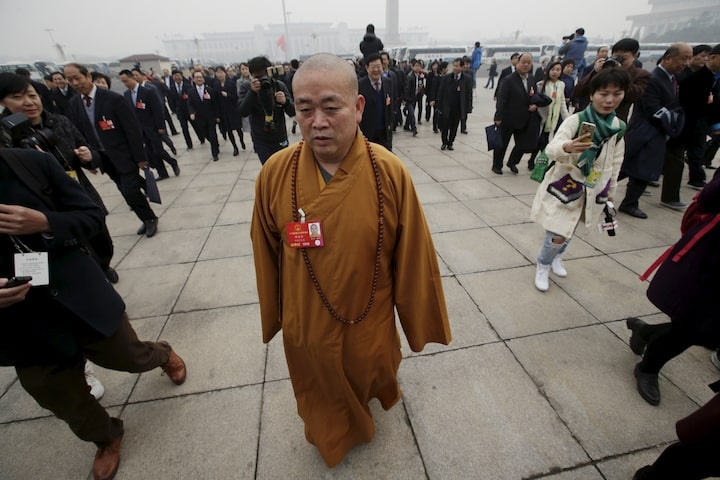

A Chinese court sentenced former Shaolin Temple abbot Shi Yongxin to 24 years in prison on Friday after finding him guilty of embezzlement, bribery, and misuse of temple funds, according to Chinese state media and Reuters. The ruling was delivered by the Intermediate People’s Court in Xinxiang, Henan province, nearly a year after authorities first placed the Buddhist monk under investigation.
Shi Yongxin, 60, who led the internationally known Shaolin Temple for decades, was also fined 3.5 million yuan, or about $517,000, according to Reuters. State broadcaster CCTV said the court determined Shi had illegally appropriated and misused funds linked to the temple and its affiliated charity foundation over nearly 30 years.
The court said Shi abused his position as abbot and charity foundation chairman to embezzle more than 131 million yuan between 2003 and 2025, according to Xinhua and the Associated Press. Prosecutors also accused him of misappropriating more than 151 million yuan in temple and foundation funds for personal use between 2012 and 2022 without repayment for extended periods.
Reuters reported that the total amount tied to the crimes, including bribery and misuse of funds, reached around 300 million yuan, or roughly $44 million. The court said Shi both accepted and offered bribes during his tenure.
“His criminal conduct lasted for a long period and involved huge sums,” CCTV said in remarks cited by the Associated Press. The court also described the bribery offences as “particularly serious,” according to the South China Morning Post.
Shi pleaded guilty during the proceedings and told the court he would not appeal the verdict, Reuters reported. Chinese state media said the sentence reflected cooperation with investigators and admissions made during the trial.
The Buddhist Association of China revoked Shi’s monastic certificate last year after the investigation became public. In a statement issued after Friday’s sentencing, the association said “he brought it on himself,” according to Reuters.
Chinese authorities first announced the investigation in July 2025. At the time, the Shaolin Temple said Shi was being investigated by multiple agencies for suspected criminal offences, including embezzlement and violations of Buddhist precepts involving relationships with several women over a long period, Reuters reported.
The temple, located in Henan province, is widely regarded as the birthplace of Chinese kung fu and one of the country’s most recognised Buddhist institutions. Under Shi’s leadership, Shaolin Temple expanded its commercial activities internationally through martial arts performances, merchandising, publishing, and cultural tourism projects.
Reuters reported that Shi earned the nickname “CEO monk” because of his efforts to turn the temple into a globally recognised cultural brand. He served as the temple’s leader from 1987 and officially became abbot in 1999.
According to Xinhua, Shi was convicted of embezzlement, misappropriation of funds, acceptance of bribes as a non-state functionary, and offering bribes. The court said he acted both independently and with associates in carrying out the crimes.
The Associated Press reported that the investigation and conviction have renewed scrutiny over the commercialisation of religious institutions in China. The Shaolin Temple has long attracted both domestic and international visitors, generating substantial tourism and business revenue.
The case also drew attention because Shi previously held political influence within China’s official structures. Reuters reported that he served for nearly two decades as a delegate to the National People’s Congress, China’s national legislature, and held leadership positions within state-backed Buddhist organisations.
Regional and Global Impact
The sentencing is one of the highest-profile corruption cases involving a religious figure in China in recent years. Chinese authorities have increasingly targeted financial misconduct across religious, charitable, and state-linked organisations as part of broader anti-corruption efforts, according to Reuters.
The case may also affect the global image of the Shaolin Temple, which has built strong international recognition through martial arts schools, cultural exchanges, and touring performances. International tourism linked to Shaolin branding has become an important source of revenue for Henan province and affiliated organisations.
Chinese officials have not announced changes to the temple’s management structure following the sentencing. However, state media said authorities would continue supervising religious institutions under existing national regulations.
Background
The Shaolin Temple was founded more than 1,500 years ago in Henan province and is internationally associated with Chan Buddhism and Chinese martial arts traditions. Shi Yongxin joined the temple as a monk in 1981 under his birth name, Liu Yingcheng.
During his decades as abbot, Shi oversaw the temple’s transformation into a global cultural and commercial brand. Reuters reported that he promoted kung fu performances, merchandise sales, publishing ventures, and tourism partnerships connected to the temple.
Allegations against Shi first emerged publicly in 2015 but were denied at the time. Chinese authorities formally opened a criminal investigation in July 2025 before prosecutors filed charges in March 2026.
What Happens Next
Chinese state media said Shi will serve his prison sentence following the court’s ruling in Henan province. Reuters reported that he waived his right to appeal after pleading guilty.
The Buddhist Association of China has already revoked his religious credentials, and no announcement has been made regarding possible reinstatement. Authorities have also not confirmed whether additional individuals connected to the case may face charges.
Chinese officials are expected to continue oversight of the Shaolin Temple’s financial and administrative operations following the sentencing. State media have not reported any immediate disruption to temple tourism or cultural activities.