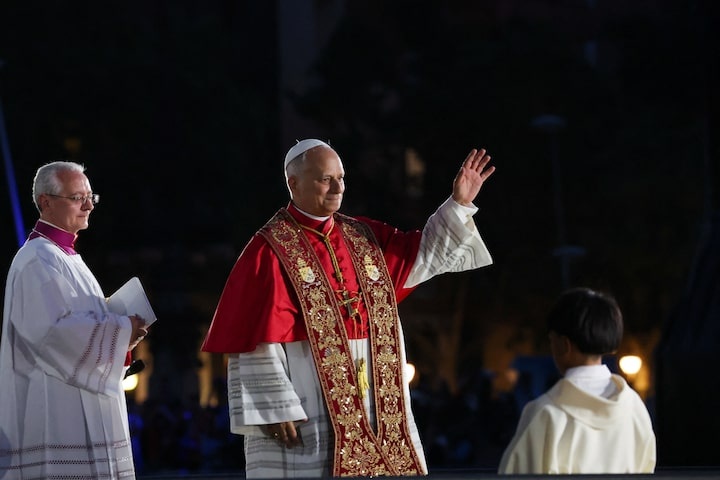

Pope Leo XIV flew from Barcelona to the Canary Islands on Thursday to meet with approximately 1,000 migrants at the Spanish archipelago’s most visible migration entry point, capping a week-long apostolic visit to Spain. The stop, the final two days of his June 6–12 tour, centers on the port of Arguineguín on Gran Canaria — known internationally as the “dock of shame” since 2020. The pope’s visit fulfils a commitment made by his predecessor, Pope Francis, who had long sought to travel to the islands but never did.
The Canary Islands sit closer to the African coast than to mainland Spain, making them a primary gateway for migrants smuggled from West Africa into Europe. Upon arriving at Gando Air Base, Leo headed to Arguineguín, where, in 2020, tens of thousands of migrants arrived in such rapid succession that many were forced to sleep in makeshift camps on the dock itself. Images of the overcrowded pier drew international condemnation and earned it the name that has since become shorthand for Europe’s failure to manage migration humanely.
Juan Carlos Lorenzo, coordinator of the Spanish Commission for Refugees in the Canary Islands, told Reuters that Leo’s meeting with around 1,000 migrants on Friday was “a significant milestone.”
The papal agenda on Gran Canaria also includes a meeting with humanitarian organisations working on the islands, a gathering with diocesan priests and pastoral workers at the Cathedral of Santa Ana in Las Palmas, and a Mass at Gran Canaria Stadium. On Friday, June 12, Leo will fly to Tenerife to meet a second group of migrants at the Las Raíces reception centre before returning to Rome.
The visit builds directly on remarks Leo made three days earlier. On June 8, he became the first pope in history to address Spain’s parliament, delivering a speech to around 700 lawmakers and guests at the Congress of Deputies in Madrid. The address drew a standing ovation lasting nearly seven minutes, with parliamentarians shouting “Long live the pope!” from the chamber floor.
In that speech, Leo framed the treatment of migrants as a test of national character. “The moral greatness of a nation is manifested, above all, in its capacity to accompany, protect and love those lives that are most fragile,” he told the Spanish parliament, according to the Associated Press.
He went further. “The situation of migrants and refugees calls for a response that focuses on people, addresses the root causes that force them to leave, and goes beyond the mere management of migration flows,” he said, according to EWTN News. He called for “safe and legal pathways, a respectful welcome and real opportunities for integration” while also defending what he described as the right of people to remain in their own countries — so that no one is forced to leave because of war, poverty, or the effects of the climate crisis.
Earlier in the week, speaking to the parliament, Leo also said that the plight of migrants “challenges the conscience of nations and the ethical foundation of the international order today,” according to the National Catholic Reporter.
The Canary Islands stop carries particular weight given the death toll recorded on the Atlantic crossing. More than 3,000 people died in 2025 attempting to reach the archipelago from the African coast, according to the non-governmental organisation Caminando Fronteras. Arrivals peaked in 2024 at nearly 47,000, according to the Associated Press, before falling sharply. Just over 3,000 people landed on the islands in the first five months of 2026, AP reported — a fraction of the prior year’s numbers.
Spain’s response to that crisis sits well to the left of most European governments. The country has introduced a program to grant legal residency to more than half a million undocumented migrants, Reuters reported. The policy has drawn sharp criticism from Spain’s far-right Vox party and from far-right leaders elsewhere on the continent. Implementation has also stalled for many applicants, with thousands still in legal limbo.
Pope Leo’s visit has not been without political controversy at home. The leading Spanish newspaper El País wrote that the tour was giving an “oxygen tank” to Prime Minister Pedro Sánchez, diverting attention from corruption scandals surrounding his Socialist Workers’ Party, according to the National Catholic Reporter. Vox leader Santiago Abascal — a Catholic who has openly criticised both the pope and the Spanish bishops’ conference’s outreach to migrants — was nonetheless seen standing in applause when Leo finished his parliamentary address.
The Canary Islands leg of the trip completes a journey Leo mapped out to combine religious ceremony with some of the most politically charged issues of his pontificate. Earlier stops included a visit to a homeless shelter in Madrid, a meeting with inmates at a Barcelona prison, and the inauguration of a new tower at the Basilica of the Sagrada Família — a landmark tied to the centenary of the death of its architect, Antoni Gaudí.
The visit also carries symbolic weight inside the Catholic Church. Francis, in September 2024 on his return from a lengthy journey through Asia and Oceania, had expressed the wish to go to the Canary Islands because of what he described as the situation with migrants arriving by sea. He never went. Vatican News reported that the General Secretariat of Pastoral Care hopes the papal stop at Arguineguín will transform the dock from a place of shame into what they have called “a place of hope” — one where migrants feel, in the secretariat’s words, “accompanied by the Holy Father.”
Regional and Global Impact
The visit places additional pressure on the European Union to address migration policy at the bloc level. In his parliamentary address, Leo acknowledged that “no nation can face a challenge of this magnitude on its own,” and called a coordinated European response “indispensable,” according to America Magazine. That framing carries weight in Brussels, where EU member states remain divided over burden-sharing for asylum seekers arriving at the bloc’s southern and western borders.
For Spain specifically, Leo’s presence reinforces the government’s positioning as a relative outlier among European nations on migration. Whether that support translates into political capital for Sánchez — whose party faces an ongoing judicial investigation — remains a matter of domestic debate.
In the United States, the visit echoes a theme Leo has pressed since before his election as pope. As an American cardinal, he was a persistent critic of the Trump administration’s immigration crackdowns and mass deportation programme. His Canary Islands stop comes roughly three weeks before he is scheduled to spend July 4 — American Independence Day — in a notably public manner, though details of those plans have not been disclosed.
Background
The Canary Islands have served as a major entry point for migrants crossing from West Africa to Europe for more than two decades. The Atlantic route is considered one of the world’s deadliest migration paths. In 2020, arrivals surged to the point where Arguineguín’s dock became overwhelmed, producing photographs of migrants crowded in open air that circulated globally. Pope Francis, who made migrant welfare a defining theme of his 13-year papacy, had planned the visit but his declining health prevented the trip. Pope Leo XIV, elected in 2025, has continued that focus, speaking at the Vatican’s annual diplomatic gathering in early 2026 about migrants’ “inalienable rights.”
What Happens Next
On June 12, Leo will travel from Gran Canaria to Tenerife to meet a second group of migrants at the Las Raíces reception centre, along with local organisations supporting new arrivals, before departing Spain. The Vatican has said further international travel is planned for 2026, with Leo expressing interest in visiting Africa — particularly Algeria — as well as Peru, Argentina, and Uruguay. No dates for those visits have been confirmed. The Spanish government’s mass residency programme for undocumented migrants remains in implementation, with thousands still awaiting legal status decisions.