
Culture ministers from all five Central Asian states met their American counterpart in Tashkent on June 5, kicking off a week of U.S. engagement across the region that will shift focus to critical minerals when delegations reconvene in Astana on June 10. The back-to-back sessions mark the C5+1 format’s most operationally active week since a leaders’ summit in Washington last November.
The Tashkent meeting brought together the culture ministers of Kazakhstan, Kyrgyzstan, Tajikistan, Turkmenistan, and Uzbekistan with Sarah Rogers, the U.S. Under Secretary of State for Public Diplomacy and Public Affairs, according to The Times of Central Asia. Participants agreed on a protocol reaffirming cultural-heritage commitments made at the November 2025 Washington summit and discussed the creation of a permanent C5+1 Working Group on Culture and a C5+1 Culture and Innovation Forum.
The session ended with concrete proposals on the table. Uzbekistan put forward the idea of joint English for Culture centers with U.S. partners inside cultural education institutions, according to coverage by the International Institute for Central Asia. Broader proposals included closer cooperation in creative industries, more places for Central Asian professionals in U.S. exchange programs, museum partnerships, digitization of heritage collections, and touring exhibitions.
Kazakhstan’s delegation linked the agenda to tourism routes and digital projects. Turkmenistan’s coverage of the meeting pointed to discussions on research centers and the U.S. Ambassador’s Fund for Cultural Preservation, which has funded restoration work across the region.
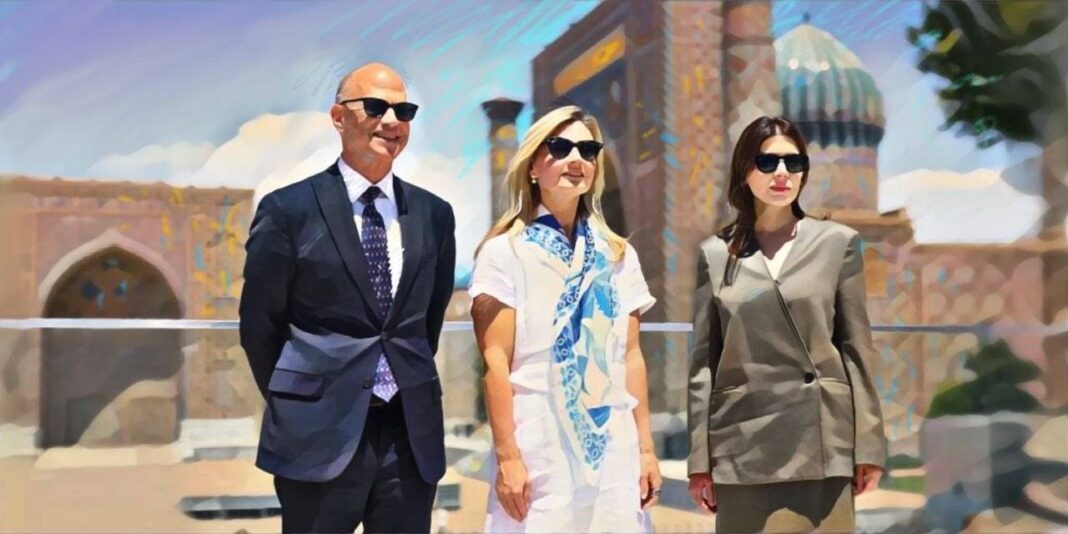
The fund’s most recent visible output is in Uzbekistan. On June 3, Rogers, U.S. Ambassador to Uzbekistan Jonathan Henick, and Gayane Umerova, chairperson of the Uzbekistan Art and Culture Development Foundation, marked the completion of the first phase of a U.S.-backed façade restoration at the Sher-Dor Madrasah in Samarkand, according to The Times of Central Asia. The same event produced a five-year cooperation roadmap between the foundation and the U.S. Embassy covering heritage preservation. The Sher-Dor Madrasah, one of the landmark structures on Samarkand’s Registan square, dates to the early seventeenth century.
Rogers is in the region as part of a May 27 to June 10 trip covering Uzbekistan and Turkmenistan, according to The Times of Central Asia. In Tashkent, she also met Uzbek Foreign Minister Bakhtiyor Saidov for separate talks on education, information exchange, and public diplomacy, according to a readout from the Uzbek embassy in Astana. That placed the C5+1 ministerial inside a larger set of bilateral meetings during the same visit.
The diplomatic calendar then moves to Kazakhstan. The current program for the Astana Mining and Metallurgy Congress 2026 lists a C5+1 Critical Minerals Dialogue session on June 10, the day before the full congress opens on June 11 and 12. Panel topics include investment conditions, taxation, transport and logistics, copper as a strategic metal, and the conversion of mineral resources into bankable projects, according to the congress program. A June 13 industrial site visit to a Qarmet enterprise is also on the schedule.
Kazakhstan’s position in global mining makes it a natural host. The International Trade Administration reported that Kazakhstan accounted for 39 percent of global uranium production and 48.8 percent of global natural uranium exports in 2024. Hard minerals and metals made up 18 percent of the country’s total exports by value that year. Refined copper exports generated $2 billion, zinc exports $788 million, and silver exports $588 million, according to the same data.
The country is also working to develop rare earth potential. In April 2025, Kazakh officials announced the discovery of the Zhana Kazakhstan deposit, with estimated resources exceeding 20 million metric tons and containing neodymium, cerium, lanthanum, and yttrium. Reuters reported at the time that no developer or production timeline had been specified.
For Washington, the minerals agenda addresses supply chain vulnerabilities that U.S. policymakers have increasingly treated as a strategic problem. Central Asian governments, for their part, want foreign capital, technology, and processing capacity that would allow them to export refined materials rather than raw ore. The C5+1 format gives all six governments a common venue for those conversations without requiring any of the Central Asian states to pivot away from other partners, including Russia and China.
The Astana congress will include participation from companies and delegations from Kazakhstan, Canada, China, Germany, Saudi Arabia, Sweden, and the United States, according to the organizers. The exhibition and business program includes B2B and B2G meetings alongside the panel sessions.
Background
The C5+1 format — the United States plus Kazakhstan, Kyrgyzstan, Tajikistan, Turkmenistan, and Uzbekistan — was launched in 2015 as a foreign-minister-level dialogue. It expanded over time to include presidential summits and expert working groups. The November 2025 Washington summit, which marked ten years of the format, shifted its direction toward deliverable agreements in specific sectors, including critical minerals, aviation, supply chains, and investment, according to The Times of Central Asia. Cultural cooperation was added to that list at the same summit. The format suits Central Asia’s multi-vector foreign policy, allowing governments to engage with the United States without formalizing an exclusive alignment.
What Happens Next
The C5+1 Critical Minerals Dialogue is scheduled for June 10 in Astana, immediately before the Astana Mining and Metallurgy Congress on June 11 and 12. The congress program includes B2B and B2G sessions alongside the panels. A June 13 industrial tour to a Qarmet facility is also confirmed. On the culture side, proposals agreed in Tashkent — including the Working Group on Culture and the English for Culture centers — will require follow-up decisions on funding, institutional hosting, and timelines before any programs become active.