
South Africa’s Top Court Revives Ramaphosa Impeachment Inquiry
Johannesburg | May 8, 2026
South Africa’s Constitutional Court ruled on Friday that Parliament acted unconstitutionally when it voted in December 2022 to block impeachment proceedings against President Cyril Ramaphosa, ordering the Section 89 independent panel’s report on the Phala Phala scandal to be referred to a formal impeachment committee. The landmark judgment, delivered at Constitutional Hill in Braamfontein, Johannesburg, marks one of the most consequential rulings against a sitting head of state in the country’s post-apartheid democratic history. The case was brought by opposition parties after lawmakers — led by Ramaphosa’s own African National Congress — used their parliamentary majority to shield the president from further scrutiny over the alleged theft and concealment of approximately $580,000 in foreign currency from his private game farm.
The Court’s Findings
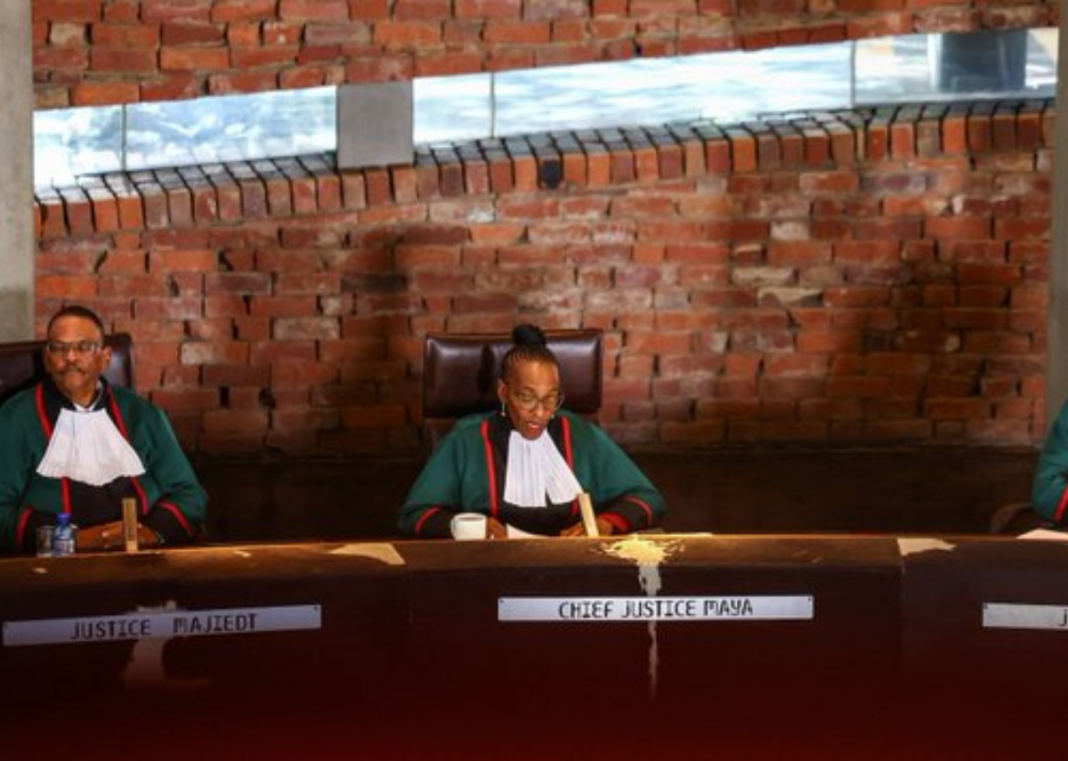
Chief Justice Mandisa Maya, who delivered the judgment on behalf of the apex court, declared that the National Assembly vote taken on December 13, 2022, was “inconsistent with the Constitution, invalid, and set aside.” The ruling targeted a specific parliamentary procedure — Rule 129(i) — which the court found had effectively blocked an impeachment process from advancing without substantive deliberation. The rule was declared unconstitutional and must now be amended.
According to reporting by The Citizen, the court issued three separate judgments on the case. Chief Justice Maya found that Rule 129I had blocked an impeachment process without meaningful parliamentary engagement on the motion, which undermined the constitutional values of accountability and transparency. As a direct consequence, Parliament is now required to refer the Section 89 panel’s report to an impeachment committee without delay.
The ruling does not constitute a finding of guilt against President Ramaphosa. It confirms, however, that the independent panel’s prima facie conclusions of potential serious misconduct cannot be procedurally buried by a parliamentary vote.
Quotes
Economic Freedom Fighters leader Julius Malema, who championed the legal challenge alongside the African Transformation Movement, celebrated the outcome outside the court in Johannesburg. “We are happy our Constitution has won,” he declared, adding that the ANC “itself has to take a decision whether it wants to be led by a president with this dark cloud hanging over him.”
Malema also framed the ruling as a rebuke of parliamentary conduct: “You cannot vote to protect criminality. You cannot vote to protect corruption because every vote must be accompanied by rationality.”
The Presidency issued a measured response. According to Times Live, Ramaphosa “respects the Constitutional Court’s judgment” and “reaffirms his commitment to the constitution, the independence of the judiciary and the rule of law.” The president maintained he had consistently provided full assistance to previous enquiries and called on all South Africans to respect the ruling.
The Democratic Alliance, the second-largest party in South Africa’s coalition government, signalled it would engage substantively with the process. “We will participate fully and constructively in the impeachment committee,” the DA said in a statement, adding that it would “be guided by the facts, by the evidence placed before the committee, and by our constitutional duty.” The party drew a sharp contrast with the ANC, accusing it of presiding over “a political culture in which accountability is delayed, diluted or avoided.”
The ATM’s parliamentary leader, Vuyo Zungula, argued the court ruling vindicated the position his party had held for years. He stressed that the independent panel’s role was only to determine whether sufficient evidence existed for a deeper inquiry. “The only rational thing to do would be to further scrutinise,” Zungula said.
Regional and Broader Impact
The ruling carries implications that extend well beyond the immediate political fortunes of Ramaphosa. It arrives at a pivotal moment for South Africa’s Government of National Unity (GNU), a 10-party coalition assembled after the ANC’s historic loss of its parliamentary majority in the May 2024 general election — its first such loss since the end of apartheid in 1994. The ANC currently holds approximately 40% of seats, forcing it into coalition with former rivals including the DA, the Inkatha Freedom Party, and smaller parties.
The political arithmetic of any impeachment committee vote is now fundamentally different from 2022. Without an ANC majority, the outcome of a committee process will depend on whether GNU partners choose to protect or scrutinise the president. The DA’s pledge to participate constructively suggests the coalition is unlikely to unanimously shield Ramaphosa. MK Party chief whip Mmabatho Mokoena-Zondi wrote to National Assembly Speaker Thoko Didiza demanding that an impeachment committee be convened “immediately,” warning that any delay would “undermine Parliament’s constitutional responsibilities” and “weaken public confidence in democratic oversight mechanisms.”
The judgment also tests the structural integrity of South Africa’s democratic institutions more broadly. Analysts noted that earlier in 2026 a declassified report from the Independent Police Investigative Directorate had found that Major General W.P. Rhoode — head of the Presidential Protection Unit — had failed to register a criminal case, instead leading an off-the-books operation to recover the stolen funds using state resources and falsified travel documentation. Rhoode remains in his position. The IPID’s national head of investigations, Thuso Keefelakae, confirmed: “Our investigation found that there were some transgressions.”
For the broader African continent, where questions of presidential accountability and the limits of executive power remain acute, the ConCourt ruling reinforces the role of independent judiciaries as a check on legislative and executive overreach.
Background
The Phala Phala scandal first surfaced publicly in 2022, when Arthur Fraser — a former director-general of the State Security Agency — filed criminal charges against Ramaphosa. Fraser alleged that in February 2020 a significant sum of undeclared foreign currency, reported at approximately $580,000, had been concealed inside furniture at the president’s Phala Phala game farm in Limpopo province. He further alleged the matter was never reported to the South African Police Service and was instead handled internally by members of the Presidential Protection Unit.
Ramaphosa has consistently maintained that the money represented proceeds from the legitimate sale of 20 buffalo to a Sudanese businessman, Mustafa Mohamed Ibrahim Hazim. However, the Section 89 panel, chaired by former Chief Justice Sandile Ngcobo and two other senior legal figures, found significant gaps in that explanation. Their report noted that the buffalo in question remained on the farm more than two years after the supposed transaction and that no official tax records existed for the sale. The panel concluded there was prima facie evidence that Ramaphosa may have committed serious violations of his constitutional duties, including those relating to transparency and the Prevention and Combating of Corrupt Activities Act.
Parliament established to consider the panel’s report in December 2022, but the ANC used its then-parliamentary majority to vote against adopting the report. The EFF and ATM challenged that decision in the courts. Ramaphosa’s own legal team sought to have the panel’s report thrown out entirely on evidentiary grounds; the Constitutional Court rejected that application. Several institutions — including the National Prosecuting Authority and the Public Protector — had previously found insufficient grounds to pursue criminal charges, though the Independent Police Investigative Directorate’s more recent report renewed questions about the conduct of the Presidential Protection Unit.
The ConCourt received arguments in 2024 but took over 500 days to deliver judgment. The delay itself became a subject of national controversy, prompting the EFF to file a formal protest with Chief Justice Maya, after which the court accelerated its timeline.
What Happens Next
Parliament must now constitute an impeachment committee as directed by the Constitutional Court’s order. Speaker Thoko Didiza has said Parliament will carefully study the judgment and its implications before announcing procedural steps. Opposition parties — including the EFF, MK Party, and ATM — are pressing for the committee to be convened without delay.
Chief Justice Maya noted in the judgment that an impeachment inquiry could take many months. The process under Section 89 of the Constitution requires the committee to examine the evidence before recommending whether the full National Assembly should vote on removing the president from office. Removal requires a two-thirds majority. Given the current composition of Parliament, such a threshold would require significant defection from GNU coalition partners, a scenario most political analysts consider unlikely in the near term. The DA has signalled it will evaluate the evidence on its merits without pre-committing to a removal vote.
Ramaphosa’s political future now depends heavily on how GNU partners navigate competing pressures: the constitutional obligation to participate in the committee process, the stability of the coalition government, and their own electoral calculations ahead of future polls. Al Jama-ah leader Ganief Hendricks stated before the ruling that GNU parties were determined to keep Ramaphosa in office, saying the president “will offer to step aside but (the) ANC will bite the bullet.” Whether the coalition holds that position through an extended impeachment inquiry remains the central question for South African politics in the months ahead.