
India and Turkey Reopen Diplomatic Dialogue a Year After Pakistan-Driven Rift
India and Turkey held their first formal bilateral consultations in four years in New Delhi on April 8, marking a significant, if cautious, step toward repairing a relationship severely damaged by Ankara’s open support for Pakistan during the India-Pakistan military confrontation of May 2025. The two sides convened the 12th round of Foreign Office Consultations at India’s Ministry of External Affairs, covering trade, energy, tourism, technology, and the shared challenge of cross-border terrorism. The meeting came nearly a year after Operation Sindoor — India’s airstrikes on nine terror sites inside Pakistan and Pakistan-administered Kashmir — triggered a diplomatic rupture that sent ripples far beyond South Asia.
The April 2026 Meeting
India’s Secretary (West) at the Ministry of External Affairs, Sibi George, and Turkey’s Deputy Foreign Minister Berris Ekinci co-chaired the April 8 consultations in New Delhi, according to IANS. The two sides reviewed the full scope of bilateral ties, agreed to convene the next round of consultations in Turkey, and discussed regional and global matters of mutual concern. The previous round of these consultations had taken place in Ankara in 2022 — meaning the two governments went nearly four years without holding this structured diplomatic exchange, a gap that itself reflects the depth of the deterioration.
India’s External Affairs Ministry confirmed the meeting in an official statement, noting that both delegations addressed bilateral cooperation in education, culture, and innovation alongside harder security topics.
Officials Speak
India’s Ministry of External Affairs stated: “Both sides reviewed the full spectrum of bilateral relations with focus on trade and investment, tourism, technology and innovation, energy, cooperation in educational and cultural fields, people to people ties and fight against cross border terrorism.”
Randhir Jaiswal, spokesman for India’s External Affairs Ministry, had set the tone for any potential reconciliation in May 2025 when he articulated New Delhi’s core demand. “We expect Turkey to strongly urge Pakistan to end its support to cross-border terrorism and take credible and verifiable actions against the terror ecosystem it has harboured for decades,” Jaiswal said at that time, adding: “Relations are built on the basis of sensitivities to each other’s concerns.” That framing — bilateral ties conditioned on mutual respect — became the benchmark against which any diplomatic reset would be measured.
Background: Operation Sindoor and the Diplomatic Rupture
The crisis that poisoned India-Turkey relations traces directly to April 22, 2025, when a terrorist attack in Pahalgam, in Indian-administered Kashmir, killed 26 people, most of them tourists. India attributed the attack to Pakistan-based militant networks and, on May 7, 2025, launched Operation Sindoor — a tri-service military operation deploying BrahMos cruise missiles and more than 100 aircraft against nine targets in Pakistan and Pakistan-administered Kashmir. It was the largest aerial engagement between the two countries since 1971. A ceasefire followed on May 10, mediated by U.S. Secretary of State Marco Rubio.
Turkey’s response to the crisis enraged New Delhi. Turkish President Recep Tayyip Erdoğan voiced solidarity with Pakistan, backed Islamabad’s call for an international investigation, and warned of the risk of an all-out war. Erdoğan subsequently met Pakistani Prime Minister Shehbaz Sharif in Istanbul. More damaging still, debris recovered from Pakistani drone strikes on Indian territory during the conflict revealed the use of the Turkish-made Songar armed drone system. India alleged that Turkey had supplied over 350 drones and two military operatives to Pakistan during the confrontation; Ankara denied the claims, but the denial did little to defuse Indian outrage.
India reacted swiftly. India’s aviation regulator suspended the security clearance of Turkish firm Çelebi Aviation Holding on May 15, a move that erased nearly $200 million in shareholder value and stripped approximately one-third of the company’s global revenue. Shares of Çelebi fell 20% over two trading sessions. India’s Jawaharlal Nehru University cancelled an academic cooperation agreement with Turkey’s Inonu University. New Delhi also postponed the credentials ceremony for Turkey’s newly appointed ambassador, citing scheduling issues — a diplomatic signal widely read as deliberate.
Public and commercial boycotts amplified the government’s moves. The Travel Agents Association of India ceased promoting Turkish travel destinations. Major booking platforms reported a 60% drop in Turkey-bound reservations and a 250% surge in cancellations. Official Turkish tourism data recorded a 24% year-on-year decline in Indian visitors in May 2025 alone, with the full impact of the boycott expected to peak in June. The All India Cine Workers Association suspended film shoots and cultural collaborations in Turkey.
Economic Stakes
The financial context matters. India-Turkey bilateral trade reached $10.43 billion in financial year 2023-24, with India exporting $6.65 billion and importing $3.78 billion from Turkey — a trade surplus that consistently favors New Delhi. Turkish exports to India fell more than 17% as tensions mounted, and the bilateral merchandise trade contracted by nearly 63% compared to 2022-23 levels. Turkey’s economic vulnerabilities — including elevated inflation running close to 30% in 2025 and a technical recession in 2024 — meant the rupture with India carried real costs for Ankara, even though Indian visitors represent less than 1% of Turkey’s total foreign tourist arrivals.
Turkey, for its part, needs India’s support on a strategic file of its own. Ankara has expressed interest in joining the BRICS grouping, and India — as a founding member — holds effective veto power over any new admission.
Regional and Global Implications
The India-Turkey falling-out, and now its partial repair, carries implications across multiple theaters. Turkey is Pakistan’s second-largest arms supplier after China, providing stealth corvettes, F-16 components, armed drones, and missiles. The formalization of a Turkey-Pakistan strategic partnership declaration in 2025 deepened that alliance. For India, the alliance between Ankara and Islamabad represents not merely a bilateral irritant but a structural challenge: Turkey is a NATO member with access to Western military technology, and its deepening ties with Pakistan complicate India’s security calculus on its western flank.
The broader triangular dynamic also touches on the India-Middle East-Europe Economic Corridor (IMEC), a connectivity initiative championed by India from which Turkey has been notably absent. Ankara’s exclusion from IMEC, and its aspiration to serve as a trade corridor in its own right, adds a layer of economic rivalry to an already complex relationship.
The Diplomat noted in May 2025 that India-Turkey relations entered a new phase of strategic tension following Operation Sindoor, and that “the space for sustained ambiguity is shrinking” in a world of increasingly interconnected conflicts. The April 2026 consultations suggest both capitals are attempting to rebuild at least a functional working relationship, even as the deeper structural tensions remain unresolved.
History of a Complicated Partnership
Diplomatic relations between India and Turkey date to 1948, when Turkey became one of the first countries to recognize an independent India. A Treaty of Friendship signed between Indian Prime Minister Jawaharlal Nehru and Turkish President Celal Bayar in 1951 laid the early foundation. The two nations shared a degree of ideological sympathy in the immediate post-colonial period — Nehru’s non-alignment resonated with the Kemalist principle of “peace at home, peace in the world.”
The relationship frayed through the Cold War as Turkey aligned with NATO and India led the Non-Aligned Movement. It entered a new low after the revocation of Jammu and Kashmir’s special constitutional status in August 2019; Erdoğan criticized India at the United Nations General Assembly, and New Delhi responded by deepening ties with Turkey’s regional rivals — Greece, Cyprus, and Armenia. The period 2019-2022 is described by analysts at The Diplomat as the lowest point in modern India-Turkey ties, marked by sustained diplomatic and media hostilities on both sides.
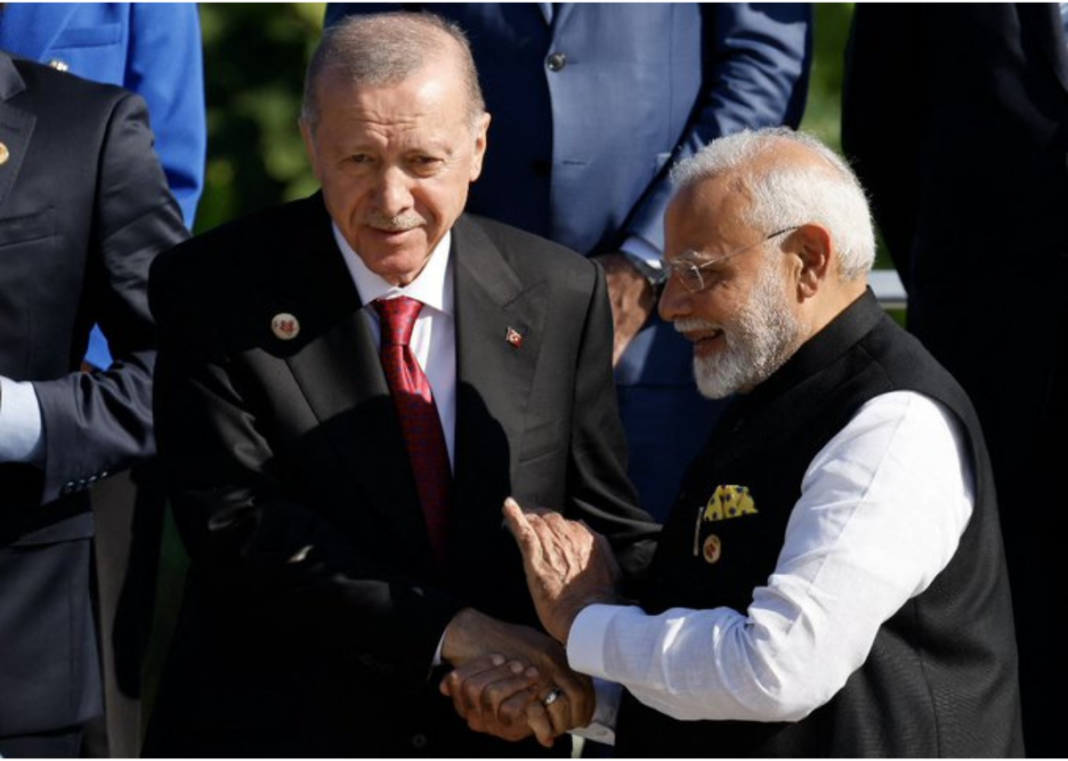
A partial reset appeared possible after 2022. Prime Minister Narendra Modi met Erdoğan on the sidelines of the Shanghai Cooperation Organization summit in Samarkand in September 2022, and again at the G20 in New Delhi and COP28 in Dubai in 2023. India’s humanitarian mission to earthquake-devastated Turkey in February 2023 — Operation Dost — deployed National Disaster Response Force teams and a mobile military field hospital, generating goodwill. Those gains were effectively erased by May 2025.
What Happens Next
The April 2026 consultations represent the opening of a diplomatic channel, not a resolution of the underlying disputes. Several fault lines remain intact. Turkey has not withdrawn its support for Pakistan’s position on Kashmir. The question of Turkish military hardware in Pakistani hands during Operation Sindoor remains a source of deep grievance in New Delhi. India declined to attend Turkish Republic Day celebrations hosted by Ankara’s embassy in New Delhi in October 2025, a continued signal of official displeasure.
Analysts will watch several indicators in the months ahead: whether the ambassador’s credentials ceremony is finally held; whether Turkey makes any public gesture distancing itself from cross-border terrorism emanating from Pakistan; and whether Indian trade and tourism flows toward Turkey show measurable recovery. Turkey’s BRICS application also provides India with quiet but substantial leverage, giving New Delhi options beyond public confrontation.
The next round of Foreign Office Consultations, agreed to take place in Turkey at mutually convenient dates, will serve as the next formal test of whether the two governments can move from a managed pause to a genuine diplomatic reset.