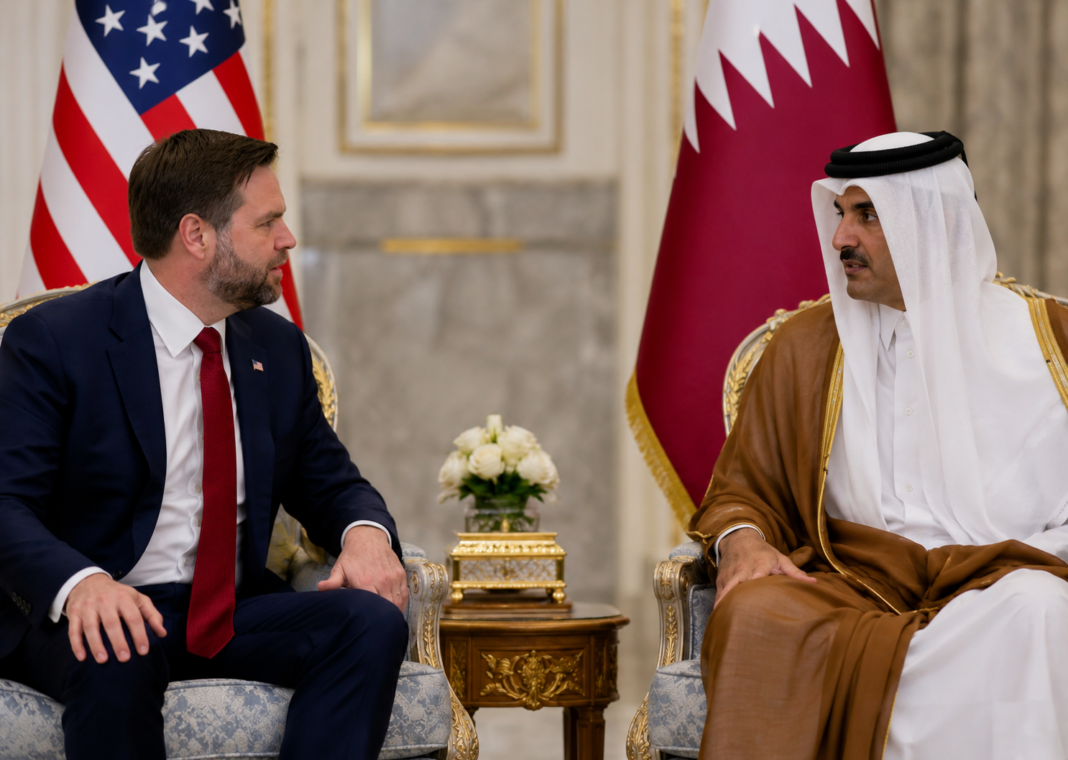

U.S. Vice President JD Vance is in the middle of some high-stakes talks with Qatar’s Prime Minister and Foreign Minister, Sheikh Mohammed bin Abdulrahman Al Thani. Their main goal? To push forward indirect negotiations that could finally end the long-running conflict involving Iran. Sources from Axios, citing a senior U.S. official, say the conversation is all about a sensitive mediation channel led by Qatar. Qatar has become a crucial go-between in these U.S.-Iran talks.
Qatar’s Role as Mediator
Qatar is a country that people can count on in the region. It is very good at helping the United States and Iran talk to each other. Qatar has a role as a neutral helper. This means Qatar can keep the conversation going between the United States and Iran even when things are not going well or when there are soldiers moving around. Qatar is good, at keeping the United States and Iran talking.
Sheikh Mohammed bin Abdulrahman Al Thani, who serves as both Prime Minister and Foreign Minister, has stayed committed to calming tensions in the region. Earlier this year, he met with Iranian officials and made it clear: peace isn’t just one country’s job—it takes everyone in the neighborhood.
Qatar doesn’t just talk to the U.S. and Iran. They’ve looped in Egypt and Turkey as well, making sure the lines stay open even when Washington and Tehran aren’t directly speaking. People who follow this stuff closely often point out that Qatar’s long-standing ties to both Western governments and Iran’s leaders put it in a unique spot to make progress.
JD Vance Steps Up
JD Vance, the U.S. Vice President, is moving into the heart of these diplomacy efforts. He started out as a skeptic of drawn-out military interventions, but these days, he’s up front in the search for a peace deal or at least a way to cool things down.
Recent reports show Vance is hands-on—he’s been part of direct and indirect talks with Iranian reps, Gulf partners, and U.S. diplomats. He’s in these rooms talking through both the nuts and bolts of de-escalation and the bigger-picture negotiations—especially how to outline an agreement addressing nuclear worries and ending the violence.
In one round of negotiations in Islamabad, Vance led the U.S. delegation through more than 20 hours of talks. It didn’t end with a breakthrough—stalemates over nuclear issues and questions of regional security kept the two sides apart. Still, U.S. officials say Vance’s involvement is a big deal, mainly because his reputation as open to diplomacy gives him credibility with Iran.
What’s on the Table Now
Right now, Vance and Sheikh Mohammed are focused on fine-tuning Qatar’s approach and figuring out if the timing is right to try another formal round of talks with Iran.
They’re working through things like:
- How a possible ceasefire or de-escalation agreement might look
- What kinds of nuclear guarantees and checks are needed
- Regional security, especially in the Gulf and nearby waters
- The fate of economic sanctions and humanitarian issues
- Building up trust between Washington and Tehran
American officials quoted by Axios say the mediation channel through Qatar might be one of the last real options left, after earlier direct talks came up empty.
Backdrop: Tensions and Missed Chances
These discussions come after another run of rising tensions and failed talks. Between military build-ups, incidents at sea, and repeated diplomatic dead ends, things haven’t exactly been calm. Earlier this year, some indirect negotiations—again, with help from regional partners—had both sides hopeful. But that round in Islamabad fell apart. Iran and the U.S. just couldn’t find middle ground on the nuclear front and other core demands.
In simple terms: Iran keeps insisting it wants sanctions relief and concrete security guarantees if it’s going to sign anything. On the flip side, the U.S. pushes for tight restrictions on Iran’s nuclear work and its military activity across the region.
Why Qatar Matters
Qatar is really good at helping people talk things out. They have done this before when countries in the area had problems with safety or disagreements about energy. The people in charge of Qatar think that talking things out is the way to solve problems even when other countries are getting ready to fight. People from Qatar have said that if things keep getting worse it could cause problems, for the whole Gulf area. Qatars leaders keep saying that talking is the answer and they will not give up on this idea. Qatar is still trying to help. They want everyone to get along.
Nobody’s promising a quick breakthrough from Vance and Sheikh Mohammed’s latest meeting, but it’s another step at keeping diplomacy alive after months of stalemate.
American officials describe the situation as “fragile but not closed.” It really comes down to whether Qatar can successfully bridge the gap between the U.S. and Iran this time. But even optimists admit there are some stubborn roadblocks—nuclear verification, military presence in the region, and years spent building mutual distrust.
In the End
The whole thing with Vance going into these negotiations and Qatar helping to mediate shows that the world still needs people to help make peace when there are big problems. The question is will these talks actually work or will they just be something people forget about. What happens in the few weeks will be important. For now the door, to talking is still open. It is not very stable. Vance and Qatar are doing this to try to make peace and the world is watching to see what will happen with these negotiations.