
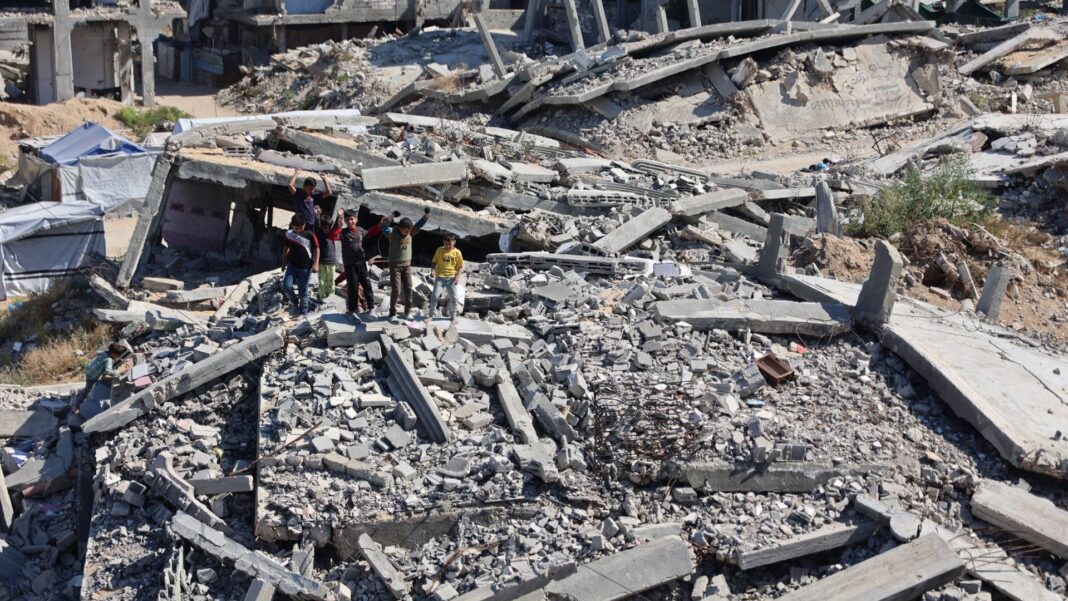

The United Nations envoy said that cleaning up the amount of rubble all over the Gaza Strip is a big job. It could take a long time maybe even the rest of our lives to finish this work. The United Nations and other helpers are still trying to see how bad the damage is from the war, between Israel and Hamas. The Gaza Strip has a lot of rubble. It will be hard to clear it all. The United Nations envoy thinks that cleaning up the Gaza Strip could take a generation of work. The remarks were reported on Wednesday following updated assessments from UN officials and aid agencies operating in Gaza.
Jorge Moreira da Silva, Executive Director of the United Nations Office for Project Services (UNOPS), said more than 60 million tons of debris now cover large parts of Gaza after months of Israeli military operations. According to UN estimates cited by Reuters and other international outlets, the territory’s infrastructure damage includes destroyed homes, hospitals, schools, roads, water systems, and electricity networks.
“I have just returned from Gaza, where the humanitarian crisis is worsening,” da Silva said after visiting the enclave. “People are exhausted, traumatized, and living in despair,” he added, according to the UN statement reported by Roya News.
Da Silva said every resident in Gaza is now surrounded by an average of 30 tons of debris. He compared the scale of destruction to the cargo capacity of nearly 3,000 container ships, according to the UNOPS assessment.
United Nations agencies warned that the cleanup effort faces additional complications from unexploded ordnance buried beneath collapsed buildings and damaged streets. Pehr Lodhammar, a senior official at the United Nations Mine Action Service, previously told reporters in Geneva that unexploded bombs and ammunition could extend the cleanup timeline to 14 years under certain conditions. Reuters reported in April 2024 that Gaza contained an estimated 37 million tons of debris at that stage of the war.
Nick Orr, an explosive ordnance disposal specialist with the humanitarian group Humanity & Inclusion, said the territory had effectively become a “horrific, unmapped minefield.” In comments reported by Reuters, Orr said surface clearance alone could take between 20 and 30 years because of the number of unexploded bombs remaining underground.
The United Nations Development Programme said in February that roughly 90 percent of Gaza’s population continued to live among dangerous rubble and damaged infrastructure. UNDP chief Alexander De Croo said the conditions in Gaza were “the worst living conditions that I have ever seen,” according to Anadolu Agency.
Aid agencies have also warned that debris removal is being slowed by shortages of fuel, construction equipment, and secure access routes. Reuters reported in April that only a small fraction of Gaza’s estimated 61 million tons of debris had been removed despite ongoing efforts by local workers and UN-supported teams.
The humanitarian impact remains severe. UN officials said damaged sanitation systems, destroyed hospitals, and limited shelter capacity continue to expose civilians to disease, displacement, and unsafe living conditions. Da Silva warned that children who have been out of school for years risk becoming “a lost generation” because of the prolonged conflict and collapse of essential services.
Regional governments and international donors are still debating how Gaza’s reconstruction will be financed and administered. Reuters reported earlier that reconstruction costs could reach tens of billions of dollars, while several international agencies estimate rebuilding could continue well into the next decade.
The scale of destruction is a problem that people are talking about when they discuss stopping the fighting and helping people in need. The scale of destruction is something that’s very important, to a lot of people who are trying to figure out how to make things better. Arab governments, the United Nations, and Western aid organizations have repeatedly called for expanded entry of heavy equipment and reconstruction materials into Gaza. Israeli authorities maintain restrictions on many imports entering the territory, citing security concerns over dual-use materials that could be diverted for military purposes.
The war began after Hamas attacked southern Israel on October 7, 2023, killing about 1,200 people and taking hostages, according to Israeli authorities. Israel responded with a large-scale military campaign across Gaza aimed at dismantling Hamas. Palestinian health officials and international organizations say tens of thousands of Palestinians have been killed during the conflict, while widespread urban destruction has displaced most of Gaza’s population.
UN agencies say debris removal cannot proceed safely without large-scale coordination between humanitarian groups, demining experts, and local authorities. Several organizations are currently conducting assessments of damaged infrastructure, unexploded ordnance, and transportation access routes before broader reconstruction work can begin.
International mediators are working hard to get a term ceasefire in place. This ceasefire is really important because it will allow people to start thinking about rebuilding. Aid officials say immediate priorities include restoring clean water supplies, reopening schools and medical facilities, and securing temporary housing for displaced civilians.