

The US House of Representatives voted 215-208 on Wednesday to restrict President Donald Trump’s authority to wage war on Iran without first seeking congressional approval, according to Middle East Eye. The following day, the same chamber voted 324-92 to reject a separate resolution that would have ended US support for Israel’s military campaign in Lebanon. Both votes took place on Capitol Hill in Washington, D.C., on June 4, 2026.
The Iran war powers resolution passed with narrow bipartisan support. Four Republicans voted alongside Democrats to pass the measure, including Kentucky Congressman Thomas Massie, who will leave the House in January after being defeated last month in the most expensive Republican primary ever, by a candidate backed by pro-Israel lobbying groups.
More than a dozen Republicans were absent from the House on Wednesday, as they were on Thursday for the Lebanon resolution, meaning they did not vote at all. Their absences may have shaped the margin in both cases.
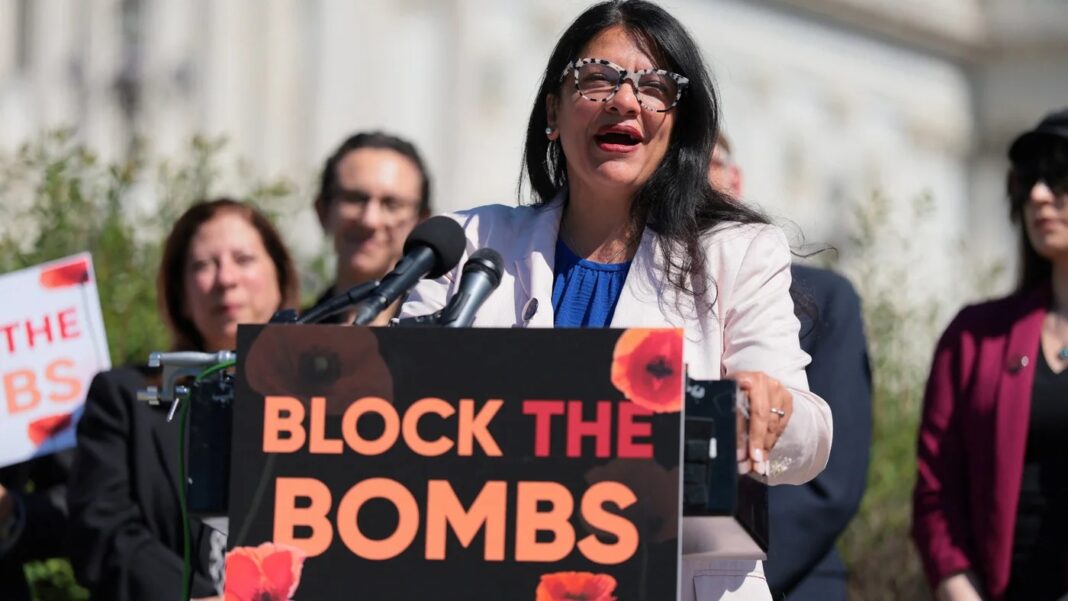
The Lebanon vote told a different story. Michigan Democratic Congresswoman Rashida Tlaib forced the vote on her war powers resolution to end US participation in what she described as “the genocidal war on Lebanon,” pointing to Washington’s logistical and intelligence support to Israel, including arms sales.
In a statement following the vote, Tlaib said: “Since early March, Israel’s military has murdered more than 3,500 people in Lebanon, including 128 paramedics and healthcare workers. The Israeli military has focused on bombing ambulances, medical facilities, and homes — forcibly displacing 20 percent of the population. These are all war crimes.”
The resolution failed overwhelmingly, with 324 lawmakers — a majority drawn from both parties — voting against it. Only 92 members supported the measure.
The Iran vote drew immediate responses from key figures. Representative Gregory Meeks, the ranking Democrat on the House Foreign Affairs Committee, said the administration had fallen short of its own objectives.
“Trump’s war has failed to accomplish the Trump administration’s stated goals with respect to Iran,” Meeks said. “If anything, it has pushed a diplomatic resolution of Iran’s nuclear program further away. The war has undermined the credibility of US negotiations and allowed Iran to demonstrate its leverage over the Strait of Hormuz. Meanwhile, Americans are paying 50 percent more at the gas pump since the war began and footing the bill for billions per week in costs for a war they overwhelmingly oppose.”
Jamal Abdi, president of the National Iranian American Council, called the vote a “clear and unmistakable” signal from a majority of lawmakers. “President Trump needs to stop dithering and bring this disastrous war to a close before more harm is done. Otherwise, more harm to the nation and more political blowback will follow,” he said.
The votes came as tensions across the region continued to escalate. Over the past week alone, the US launched three rounds of air strikes on Iran, which prompted a retaliatory response against Washington’s Gulf partners, culminating in an attack on Kuwait on Wednesday that destroyed an airport terminal, killed one Indian national, and wounded more than 60 others.
A ceasefire in Lebanon is also seen as a central condition for Iran agreeing to nuclear concessions and the full reopening of the Strait of Hormuz — two goals Trump has publicly demanded.
Meanwhile, the Republican-led House Armed Services Committee was examining next year’s US military budget, which drew scrutiny for a provision that would effectively merge US and Israeli weapons development projects, technology, and research. The think tank A New Policy, founded by two former Biden administration officials who resigned over US support of Israel’s war on Gaza, said last week it “strongly opposes” the relevant section of the budget, warning it “exposes sensitive US capabilities to counterintelligence risk, normalises technologies developed in contexts of occupation and civilian harm, disadvantages US defence companies’ ability to compete with Israeli competitors, and aims to hide continuing US military support to Israel from Congressional and public transparency.”
Regional and Global Impact
The divergent outcomes of the two votes lay bare a divide within Congress over how far legislators will go when Israel’s military operations are directly involved. The Iran resolution succeeded narrowly; the Lebanon resolution collapsed. The difference in margins — seven votes versus 232 — reflects the political weight that US-Israel military ties carry across party lines in the current Congress.
The Iran war powers resolution will now move to the Senate, where it has a reasonable chance of advancing, given the Senate had previously passed a similar measure. However, Trump is widely expected to veto the resolution if it reaches his desk, as he did in 2019 when Congress invoked the War Powers Act to challenge US participation in the Saudi-led war in Yemen. At that time, lawmakers were unable to override the veto with the required two-thirds majority.
For Iran, the House vote offers no immediate relief but adds legislative pressure at a moment when nuclear diplomacy remains stalled and the Strait of Hormuz — a chokepoint for roughly 20 percent of global oil — remains contested. For Lebanon, the lopsided rejection of Tlaib’s resolution signals that Congress is unlikely to formally challenge US weapons transfers to Israel in the near term, despite reported casualties that have exceeded 3,500 since early March, according to Tlaib’s office.
Background
The War Powers Act of 1973 allows any lawmaker to introduce a resolution to withdraw US armed forces from a conflict not authorised by Congress. The legislative branch is constitutionally designated as the body empowered to declare war, not the executive. The 1973 statute does allow the president to take up to 60 days of military action before either ending hostilities, seeking congressional authorisation, or requesting a 30-day extension.
Since the September 11, 2001 attacks in particular, the White House has expanded its unilateral military authority, carrying out air strikes in countries from Somalia to Pakistan without a formal declaration of war. On April 30, a US administration official told Reuters: “For War Powers Resolution purposes, the hostilities that began on Saturday, February 28, have terminated.” Secretary of War Pete Hegseth had also suggested at a Senate hearing that the 60-day war window is automatically frozen when a ceasefire is called — an interpretation rejected by both Democrats and some Republicans.
What Happens Next
The Iran war powers resolution now goes to the Senate, which previously advanced a comparable measure. Should the Senate pass the resolution, it will proceed to Trump’s desk, where a presidential veto is the widely anticipated outcome. Congress would then need a two-thirds majority in both chambers to override that veto — a threshold that prior votes suggest would be extremely difficult to reach. On the Lebanon front, no further war powers votes on that conflict are currently scheduled. The House Armed Services Committee continues its review of next year’s defence budget, including the contested provision on US-Israeli weapons development cooperation.