
European Airport Passenger Traffic Falls for First Time Since COVID Recovery as Iran War and EES Bites
Passenger traffic at European airports fell by 0.7 percent in April 2026 compared with the same month last year, marking the first year-on-year decline since the post-pandemic recovery started in April 2021, according to Airports Council International Europe, or ACI Europe. The trade body published the figures on Wednesday. The downturn was driven by several factors, including the conflict in the Middle East, the timing of Easter holidays shifting partly into March, and widespread industrial action in Germany. WSLS 10 NewsWSLS 10 News
The Numbers
Traffic in non-EU+ countries dropped sharply by 7.6 percent, while the EU+ market still managed modest growth of 0.6 percent. WSLS 10 News
Airports in Israel experienced the steepest decline, with passenger numbers plunging 73.4 percent, while Turkey, Georgia and Azerbaijan also recorded significant losses due to their exposure to Middle Eastern traffic. In contrast, Albania, North Macedonia and Moldova continued to post strong growth. WSLS 10 News
Among Europe’s largest aviation markets, Spain posted growth of 3.7 percent and Italy grew 2.2 percent, while Germany fell 8.5 percent, the United Kingdom fell 2.1 percent and France fell 0.9 percent. Germany’s performance was particularly affected by seven days of industrial action. WSLS 10 News
Hub Airports Hardest Hit
Large hub airports were hit hardest. Among airports handling more than 40 million passengers annually, only Barcelona–El Prat Airport, Adolfo Suárez Madrid–Barajas Airport and Amsterdam Airport Schiphol recorded growth. Airports in Munich, Frankfurt, London Gatwick and London Heathrow all saw notable declines. WSLS 10 News
The divergence between large and small airports was stark. Medium-sized and small airports outperformed larger hubs, benefiting from their stronger focus on intra-European traffic and continued capacity growth by low-cost carriers. However, small airports remain nearly 28 percent below their 2019 passenger levels, highlighting ongoing structural challenges. WSLS 10 News
For Belgium, one of the strongest performances came from Brussels South Charleroi Airport, which recorded passenger growth of 16.2 percent compared with April 2025, making it one of Europe’s fastest-growing large airports during the month. WSLS 10 News
Beyond Passengers: Freight and Movements
In addition to weaker passenger demand, European airports also reported a 5.3 percent decline in freight volumes and a 0.8 percent reduction in aircraft movements. WSLS 10 News
The freight fall adds a logistical dimension to the aviation disruption. European air cargo has been under pressure from both reduced passenger belly capacity on long-haul routes and disrupted supply chains connecting Europe to the Middle East and Asia.
The EES Problem
Alongside the Middle East war, ACI Europe flagged a second structural threat to European aviation: the Schengen Entry/Exit System, or EES.
ACI Europe warned that, beyond geopolitical uncertainty, implementation of the EES is becoming a major operational concern, with airports arguing that border-control procedures are causing significant delays and disruption for passengers. WSLS 10 News
The EES rollout was phased over six months. It started at 10 percent of ports of entry in October 2025, expanded to 35 percent by January 2026, reached 50 percent by March, and moved to 100 percent coverage on 10 April 2026. West Point
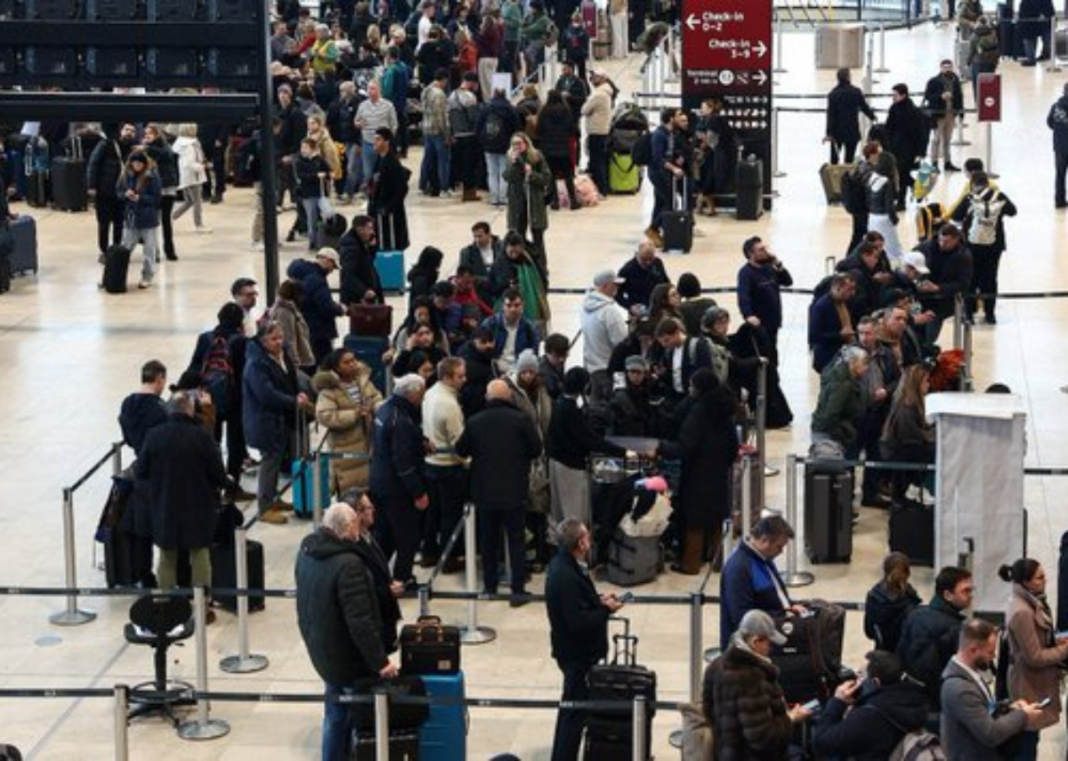
Problems surfaced throughout the phased launch. Border control processing times at airports increased by up to 70 percent, with waiting times of up to three hours at peak traffic periods. Airports in France, Germany, Greece, Iceland, Italy, Portugal and Spain were especially impacted. Business Standard
ACI Europe Director General Olivier Jankovec, Airlines for Europe Managing Director Ourania Georgoutsakou and IATA SVP External Affairs Thomas Reynaert said in a joint statement: “There is a complete disconnect between the perception of the EU institutions that EES is working well, and the reality, which is that non-EU travellers are experiencing massive delays and inconvenience.” Al Jazeera
The organisations warned that, without immediate action, severe disruptions over the peak summer months are a real prospect, with queues potentially reaching four hours or more. Al Jazeera
Jankovec said: “Border control authorities must be allowed to fully suspend the EES when waiting times become excessive. This is essential not only in the coming weeks, but throughout the peak summer travel season. Our support for the EES and its objectives is unwavering. However, strengthening border management must not come at the expense of operational efficiency or the passenger experience.” The Interpreter
Regional and Global Impact
The April data represents a significant turning point for European aviation, which had been on an unbroken recovery trajectory since the COVID-19 pandemic collapsed travel in 2020. European airport passenger traffic only exceeded pre-COVID 2019 levels for the first time in 2024, completing a recovery that took four years. A return to negative growth within months of that milestone reflects the speed and severity of the Iran war’s economic impact on the aviation sector. 2news.com
The asymmetry between markets is notable. Tourism-driven economies in southern Europe — Spain and Italy — have so far proved resilient, supported by leisure demand that is less sensitive to geopolitical shocks than business travel. Northern European hub airports, which carry heavier loads of international transit and long-haul passengers, have absorbed the brunt of the decline.
Portugal suspended the EES fully in Lisbon in December 2025, Gran Canaria experienced system crashes, and some locations reported processing time increases of 70 percent. Ireland and Cyprus remain outside the system, and the UK rollout has been delayed separately due to technical issues. West Point
Background
European airport passenger traffic surpassed 2019 pre-pandemic levels for the first time in 2024, completing the sector’s recovery from the COVID-19 crisis that began in 2020. The recovery was achieved despite ongoing supply pressures from aircraft delivery delays and infrastructure capacity constraints. The EES applies to 25 EU Schengen states and four associated countries — Iceland, Norway, Switzerland and Liechtenstein — and requires non-EU travellers to register biometric data, including fingerprints and a facial image, on their first entry to the Schengen zone, replacing traditional passport stamping. ACI Europe and Airlines for Europe wrote to EU Commissioner for Internal Affairs and Migration Magnus Brunner on April 10 urging him to allow full EES suspensions when queues become excessive and to extend suspension options through the summer 2026 peak. 2news.com + 2
What Happens Next
ACI Europe, Airlines for Europe and IATA have warned that if no action is taken on the EES, queues at Schengen entry points could reach four hours or more during the peak summer travel months. The European Commission has not announced any timeline for suspending or modifying the system’s full coverage. ACI Europe’s next monthly traffic figures are scheduled for publication in June, and will cover May 2026 — the first full month of data following the EES’s complete rollout on 10 April. May data will also capture the first full month of summer booking patterns under the Iran war’s sustained economic pressure, making it the clearest indicator yet of whether the April decline marks the start of a prolonged downturn or a temporary dip driven by the Easter timing shift. Al JazeeraU.S. News & World Report