
Kim Jong Un Inspects New Nuclear Material Plant and Orders Exponential Expansion of Arsenal
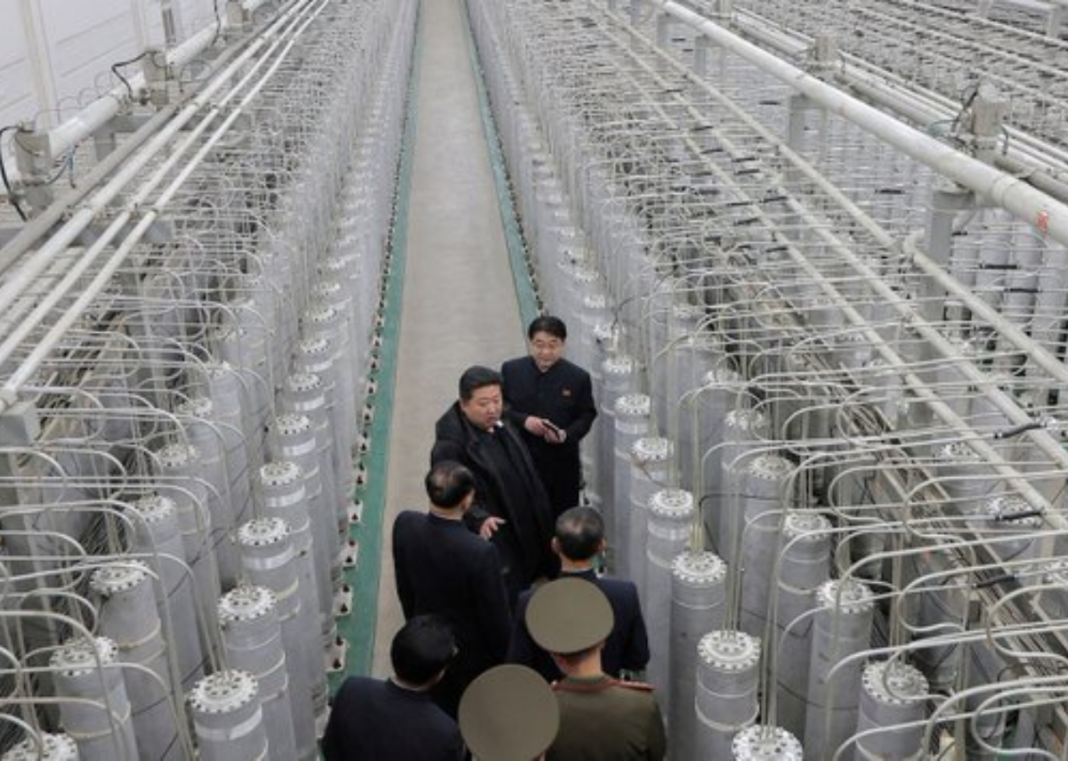
North Korean leader Kim Jong Un visited a newly operational nuclear material production facility and called for an “exponential” expansion of the country’s atomic arsenal, state media KCNA said on Thursday. Kim made the visit the previous day, accompanied by key party officials, KCNA reported. The report did not disclose the facility’s location or other details. The announcement marks one of Pyongyang’s most explicit public statements yet on the scale of its weapons-grade nuclear production programme. WikipediaHungarian Conservative
What Kim Said
Kim said production capacity for weapons-grade nuclear material had reached more than double its previous level over the past five years and instructed officials to further increase output to meet long-term strategic goals. During the visit, Kim was briefed on new production processes incorporating more advanced technology and reviewed current output targets and future plans, KCNA reported. Wikipedia
Kim said the expansion was necessary given what he called worsening security threats and long-term confrontation with hostile forces, and reaffirmed the country’s policy of continuously increasing its nuclear deterrent. Wikipedia
“Potential threats and unpredictable long-term crises further highlight the urgency” of expanding the nuclear deterrent “both in quality and quantity and in a sustained and accelerated way,” Kim said, signalling that Pyongyang has no intention of stepping back from its nuclear ambitions. Hungarian Conservative
KCNA said a key consultative meeting on bolstering nuclear forces was held the same day, at which Kim outlined guidelines for accelerating both the qualitative and quantitative expansion of North Korea’s nuclear arsenal. Kim said the country had made “responsible and significant decisions,” including setting out the sequence and safeguards for executing what he described as a vast plan to strengthen nuclear forces “exponentially.” Wikipedia
North Korea had “set a transformative milestone for the advancement of nuclear capabilities,” he said. Wikipedia
The Location Question
The identity and location of the facility Kim inspected remain unknown. North Korea is currently believed to house uranium enrichment facilities at three sites — Yongbyon, Kangson and Kusong. It remains unclear whether the report suggests the existence of a fourth location. Global Banking and Finance
In March 2026, the International Atomic Energy Agency reported “ongoing operation of enrichment facilities” at Kangson and Yongbyon and a new building at Yongbyon. In an April 2026 statement to the House Armed Services Committee, the US Defense Intelligence Agency director said Pyongyang is also building a probable additional uranium enrichment facility at Yongbyon to increase stockpile production. Euronews
South Korean Unification Minister Chung Dong-young told the National Assembly’s Foreign Affairs and Unification Committee in March 2026 that North Korea’s enrichment facilities were producing 90 percent highly enriched uranium, a weapons-grade level. It was the first time a senior South Korean official had publicly identified Kusong as a third enrichment site. Wikipedia
What North Korea’s Arsenal Looks Like
Some non-governmental experts estimate that North Korea has produced enough fissile material for up to 90 warheads and may have assembled approximately 50. The expansion of North Korean nuclear facilities at Yongbyon, Kangson and Kusong will likely increase North Korea’s enriched uranium supply, enabling the production of additional nuclear warheads, according to the American Enterprise Institute’s Korea peninsula update published in April 2026. EuronewsHungarian Conservative
Satellite imagery reviewed by monitoring group 38 North in late 2025 showed what appeared to be a new uranium enrichment plant under construction at the Yongbyon Nuclear Scientific Research Centre, with a large, heavily secured compound whose design and footprint closely resembled the known layout of the Kangson facility. Six possible heat exchangers — typically used to cool centrifuges and maintain stable temperatures for uranium enrichment — had recently appeared on the southeast side of the building. europa
A Pattern of Escalating Announcements
Thursday’s statement is not the first time Kim has used a facility inspection as a platform for nuclear maximalism. In January 2025, Kim visited a nuclear material production base and the Nuclear Weapons Institute, where he said North Korea had achieved “amazing” results in nuclear material production and emphasised the need to exceed that year’s production target in order to fortify “the nuclear shield of the country.” euronews
In December 2025, Kim ordered munitions factories to step up missile and munitions production in 2026, with factories expected to expand capacity and build new plants as Pyongyang intensified weapons development and deepened its ties with Russia. euronews
The language used in Thursday’s KCNA report — “exponential,” “transformative milestone,” “vast plan” — mirrors the escalatory framing Kim has used repeatedly since 2023, when he first ordered exponential expansion of the arsenal alongside development of a more powerful intercontinental ballistic missile.
Regional and Global Impact
The announcement lands at a sensitive moment in the region. South Korea held local elections on June 3, and the political relationship between Seoul’s Democratic Party-controlled parliament and the People Power Party presidency remains contested. US Forces Korea — roughly 28,500 troops stationed in the South — remain in place, and the Pentagon has not confirmed any reduction discussions, The Korea Herald reported separately on Thursday.
A 2025 US Defense Intelligence Agency report stated that North Korea has restored its nuclear test site and is now postured to conduct a seventh nuclear test at a time of its choosing. The last nuclear test conducted by Pyongyang took place in September 2017. No test has taken place since, though IAEA inspectors were expelled from the country in 2009 and have not been permitted to return. Euronews
Background
North Korea is expanding its capacity to produce fissile material — plutonium and highly enriched uranium — for nuclear weapons. North Korea produces plutonium at its Yongbyon site and operates gas centrifuge uranium enrichment plants. Fissile material production largely determines the number and type of nuclear warheads a country can build. North Korea’s constitution was amended in 2022 to enshrine the country’s nuclear status, and Kim has repeatedly declared that denuclearisation is not on the table under any circumstances. Pyongyang has not engaged in formal diplomatic talks with either Washington or Seoul for several years. Euronews
What Happens Next
No immediate response from the United States, South Korea or Japan was issued as of Thursday afternoon following the KCNA report. The IAEA has called for the resumption of dialogue with Pyongyang and for North Korea to comply with UN Security Council resolutions, but has no mechanism to enforce inspections in the country’s absence. The DIA has stated that North Korea aims to continue increasing its stockpile of nuclear warheads and improving their design for multiple delivery systems. With Kim now publicly linking expanded production to both qualitative improvements and quantitative targets, analysts expect further facility announcements and weapons tests in the second half of 2026 as Pyongyang uses the Middle East war’s diversion of US and allied attention to accelerate its programme. Euronews