
Xi Jinping Arrives in North Korea for First State Visit in Seven Years as Both Sides Pledge to Resist Hegemony
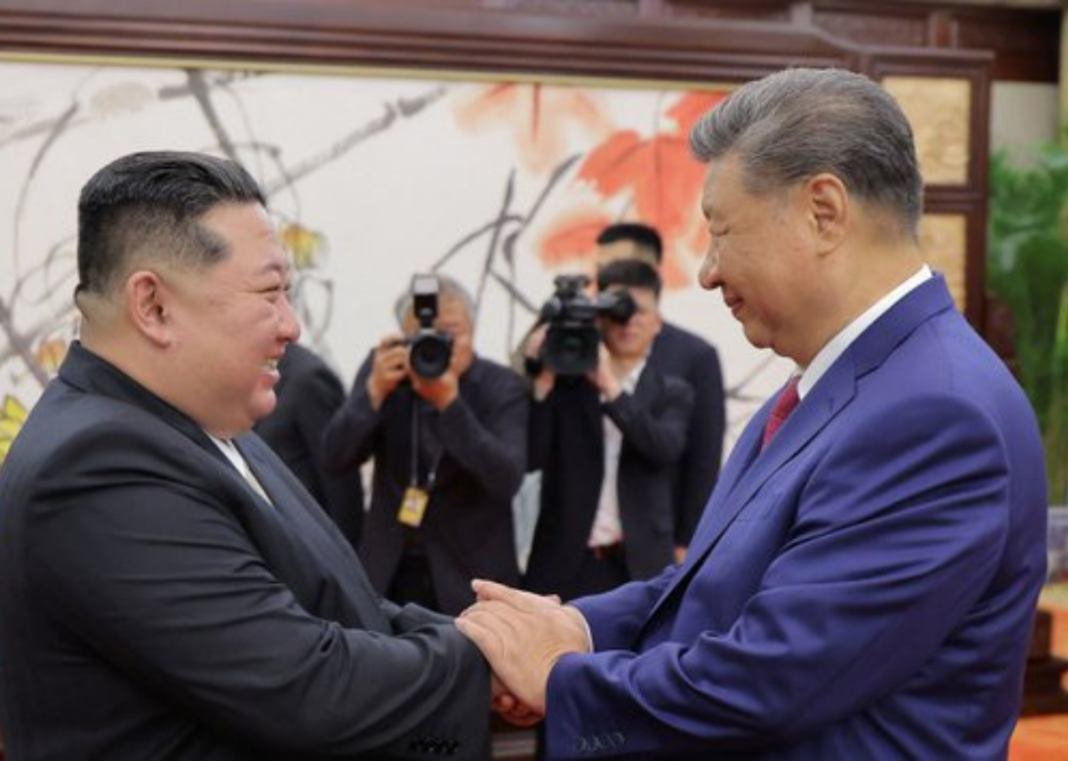
Chinese President Xi Jinping arrived in Pyongyang on Monday for a two-day state visit — his first trip to North Korea since 2019 and his first overseas visit of 2026 — as Beijing moved to consolidate its alliance with Kim Jong Un’s government against a backdrop of deepening geopolitical confrontation with the United States. Xi said it was China’s unwavering policy to upgrade ties with North Korea, and that the two countries would work together to fight hegemony and attempts to revive militarism, according to comments published in North Korea’s state newspaper Rodong Sinmun on Monday. Al Arabiya
Xi said in a commentary that the two neighbours would strengthen exchanges in all areas to inject strong momentum into developing relations and safeguarding a fair and just global order. “We must oppose hegemony, authoritarianism and all attempts and conspiracies to revive militarism that endanger regional security and stability,” Xi said. Yahoo!
Xi also pledged to work with North Korea to promote fair and orderly multilateralism and inclusive economic globalisation that would benefit the world in building a community of shared human destiny. The Local
Xi will be accompanied by a high-level delegation including senior Chinese Communist Party and military officials. The visit coincides with the 65th anniversary of the China-North Korea mutual defence treaty, signed in 1961, which remains Beijing’s only formal military alliance. Euro Weekly News
The visit arrives at a moment when Pyongyang’s relationships with its two main patrons — Beijing and Moscow — are being actively recalibrated. The visit comes at a critical time when China seeks to reaffirm its alliance with North Korea amid Pyongyang’s growing military cooperation with Russia and stalled denuclearisation talks with the United States. North Korea has supplied artillery shells and ballistic missiles to Russia for use in the Ukraine war, a relationship that has grown visibly closer over the past two years and that Beijing has watched with increasing concern over its own strategic position as Pyongyang’s primary external patron. Euro Weekly News
Xi hosted Kim and other leaders last year at a massive military parade in Beijing, where he stood alongside Russian President Vladimir Putin. That gathering — in which Xi, Kim and Putin appeared together publicly — was widely read as a demonstration of trilateral alignment against US-led international order. Monday’s bilateral visit carries a different message: China is investing in a direct, bilateral relationship with Pyongyang rather than relying on the trilateral optics to bind North Korea to Chinese interests. Yahoo!
Pyongyang has since resumed crossings at the Chinese border and increased exchanges, which had been frozen during the COVID-19 pandemic. The restoration of normal economic and people-to-people movement across the border since the pandemic reopening in 2023 has given Beijing leverage that it lacked during the years of closure, and Xi’s visit is designed to embed that leverage in a formal diplomatic framework. Yahoo!
The geopolitical context of the visit extends well beyond the Korean Peninsula. Beijing framing the Xi-Kim summit around opposition to “hegemony” and “militarism” is a direct rhetorical response to the United States, which has expanded military exercises with South Korea and Japan in 2026 as part of its broader Indo-Pacific posture. The language of “attempts to revive militarism” is also a pointed reference to Japan, whose constitutional reinterpretation and significant defence spending increases since 2022 remain a source of deep anxiety in both Beijing and Pyongyang.
Regional and Global Impact
A reinforced China-North Korea alliance complicates the US-led effort to pressure Pyongyang on denuclearisation through economic isolation. Denuclearisation talks with the United States have stalled, leaving North Korea’s nuclear and ballistic missile programme unconstrained by any active diplomatic framework. A strengthened Chinese backstop reduces the bite of UN Security Council sanctions — which China and Russia have increasingly vetoed or circumvented — and reduces Pyongyang’s incentive to return to negotiations with Washington on US terms. Euro Weekly News
For South Korea and Japan, the visit signals that the security environment on the Korean Peninsula is hardening rather than thawing. Both countries have been deepening trilateral security cooperation with the United States throughout 2025 and 2026, but a formal reaffirmation of the China-North Korea mutual defence treaty’s relevance — implicit in the summit’s 65th-anniversary framing — raises the stakes of any future Korean Peninsula contingency for the entire region.
Background
Xi’s last visit to Pyongyang was in June 2019, when he became the first Chinese president to travel to North Korea in 14 years. That visit came at a moment when North Korean-US diplomacy, driven by the Trump-Kim summits of 2018 and 2019, was stalling — a dynamic that resembles the current impasse. The China-North Korea Treaty of Friendship, Co-operation and Mutual Assistance, signed on July 11, 1961, obligates each party to provide military and other assistance if the other is attacked. It is Beijing’s only formal mutual defence commitment and has no direct equivalent in China’s other bilateral relationships. North Korea’s nuclear weapons programme, which has produced multiple successful intercontinental ballistic missile tests, is estimated to have produced enough fissile material for several dozen warheads. No credible denuclearisation negotiation has been underway since the collapse of the Hanoi summit in February 2019. Euro Weekly News
What Happens Next
Xi is scheduled to hold formal talks with Kim Jong Un during the two-day visit, which runs through Tuesday, June 9. No agenda has been publicly disclosed by either Beijing or Pyongyang, though the 65th anniversary of the mutual defence treaty is expected to feature prominently in the summit’s official framing. A joint statement is likely to be issued at the conclusion of the talks. The United States has not yet issued a formal response to the visit. South Korea’s foreign ministry is expected to comment after the summit concludes. Whether the two sides announce specific economic or diplomatic deliverables — beyond the rhetorical commitments to opposing hegemony — will determine how substantive the summit proves to be beyond its symbolic value.