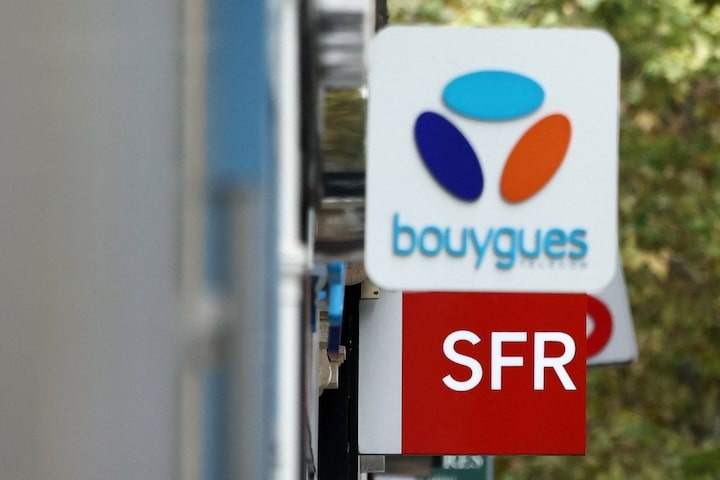

Bouygues Telecom, Orange and Free-iliad Group signed a memorandum of understanding with Altice France on Saturday to buy telecoms operator SFR for €20.35 billion ($23.44 billion), including debt. The deal, one of the largest European telecoms transactions in years, would carve up France’s second-largest mobile operator and distribute its assets among the country’s three remaining players. Regulatory approval — far from guaranteed — now stands as the principal obstacle.
Under the terms, Bouygues would acquire the largest share of SFR’s assets, accounting for about 52% of the carved-out revenue, with Free-iliad taking some 27% and Orange 21%. The financial split between the buyers follows a different formula: the price is divided at around 42% for Bouygues Telecom, 31% for Free-iliad and 27% for Orange. Break-up fees between €100 million and €2 billion have also been agreed upon.
Some assets, including parts of the fixed and mobile networks and IT systems, would be held jointly for a transition period.
Bouygues Telecom Chairman Edward Bouygues framed the acquisition in terms of national strategy. “With this transaction, the Bouygues group confirms its commitment to placing its core businesses on a long-term growth path and to contributing to France’s digital sovereignty,” he said.
Orange Chief Executive Christel Heydemann struck a similarly confident tone. “This agreement is set to reinforce Orange’s leadership position in France and in Europe and will support the ambitions of our ‘Trust the future’ plan,” she said on Saturday.
The deal’s path to completion runs squarely through antitrust regulators. A break-up of SFR would reduce the number of mobile network operators in France to three from four, setting up a key test of antitrust authorities’ willingness to allow consolidation in Europe’s crowded telecoms market. The European Commission, which has not yet been formally notified of the transaction, has 25 working days to complete a first-stage review once a filing is submitted, and may extend that by 35 further working days to consider remedies or handle referrals from member states, according to Reuters.
Heydemann signalled that the buyers are already working to pre-empt regulatory objections. Orange had begun discussions with both the European Commission and France’s Competition Authority as far back as April, and is considering potential behavioural remedies to win approval. Each buyer will face its own separate antitrust assessment, an Orange spokesperson confirmed to Reuters, meaning the deal effectively involves three distinct regulatory processes running in parallel.
The consortium pledged to ensure employment for all staff of the acquired assets until the beginning of 2029, either by allowing them to continue in their present positions or by providing them with other job opportunities. That commitment appears designed in part to address union concerns: French unions including the CFDT have warned that a four-to-three market structure could put jobs and consumer choice under pressure.
A Deal Long in the Making
The agreement did not emerge quickly. A prior €17 billion joint bid from the same three buyers was rejected by Altice France in October 2025, before the parties entered exclusive negotiations in April 2026. Even during those exclusive talks, the deadline shifted repeatedly. Altice France extended the exclusivity period for talks with the consortium until June 5 from a prior deadline of May 16, after the three operators raised their offer in April from around €17 billion. On the day that deadline expired, the consortium announced a further 48-hour extension to finalise terms — before announcing the signed MoU on Saturday.
Altice’s willingness to sell reflects the financial pressure its parent company has faced. Altice France won court approval in August 2025 for a debt restructuring that cut borrowings by about €8.6 billion, from roughly €24.1 billion to €15.5 billion, while leaving billionaire Patrick Drahi with 55% ownership and creditors with 45%. The SFR sale represents a major deleveraging move for Drahi, whose broader Altice empire has been under sustained financial strain.
SFR itself is a substantial business. The operator has 19 million mobile subscribers and more than 6 million fibre customers. Its absorption into three competing networks — rather than a single buyer — was structured deliberately. Since Orange is the current market leader in France, it was constrained to the smallest share of the acquisition to limit further concentration at the top of the market.
Wider Stakes for European Telecoms
The regulatory question extends well beyond France. EU antitrust regulators have historically imposed tough remedies and outright blocks on telecoms deals that proposed reducing the number of mobile network operators from four to three in a single country market, with a view to safeguarding competition and avoiding price increases.
But that posture has come under pressure. A 2024 EU report on the bloc’s competitiveness urged regulators to ease a stance that had resulted in a highly fragmented sector, and instead focus on helping businesses gain scale and compete with U.S. and Chinese rivals. Sector chief executives have pushed for mergers to be assessed at a regional rather than national level, and for investment plans to be factored into approval decisions.
If approved by regulators, the acquisition would rank among the biggest European telecoms deals in recent years. It would also reshape a French market that has been defined by exceptionally fierce price competition. Operators in France have been locked in price wars for years, pressuring margins and revenue growth. Proponents of the deal argue that consolidation is necessary to fund the infrastructure spending required to compete in 5G and fibre — an argument the EU’s own reports have increasingly validated.
What Happens Next
The deal is expected to be completed in the second half of 2027, after regulatory clearance has been obtained. Definitive agreements between the parties are expected to be signed in the second half of 2026, according to reporting by Reuters. Each of the three acquiring operators will file separately for antitrust review, as confirmed by Orange. The acquisition would trigger rigorous scrutiny by ARCEP, France’s telecommunications regulator, and possibly the European Commission. Should regulators demand remedies — such as divestitures of spectrum or infrastructure — the structure of the deal could still shift before a final transaction closes.