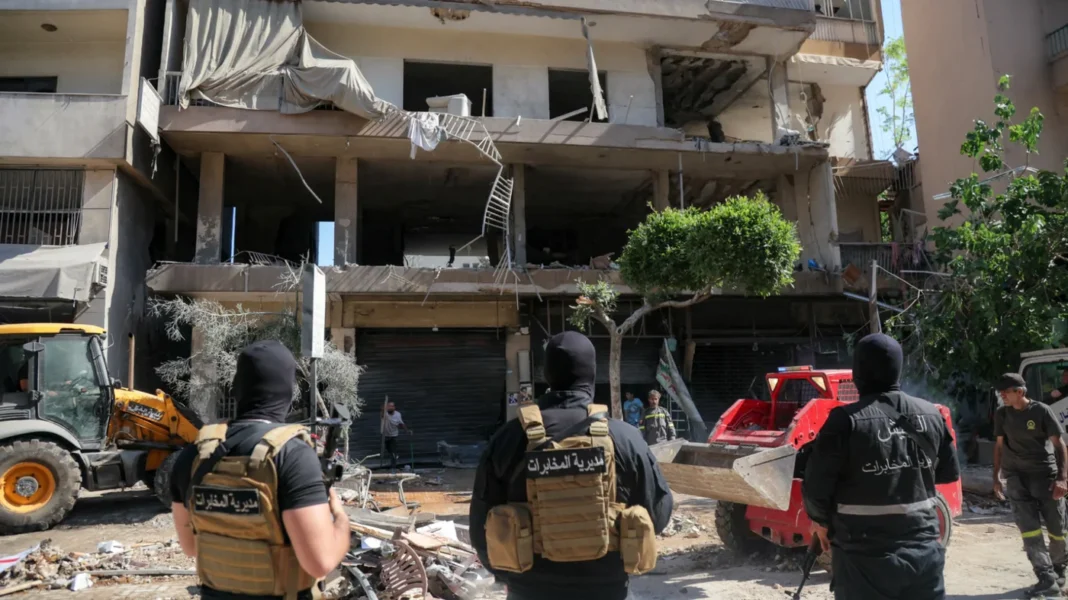

An Israeli strike on Beirut’s southern suburbs killed at least three people and wounded 15 others on Sunday, prompting condemnation and threats of retaliation from senior Iranian officials at the moment Washington and Tehran appeared close to signing an agreement aimed at ending the wider regional war. The attack targeted an apartment building in Dahieh’s Ghobeiry neighbourhood that belongs to Beirut’s municipality, according to Lebanese media reports.
On Sunday morning, three drones launched from Lebanon hit northern Israel, prompting Israeli ministers to call for “aggressive” strikes on the Lebanese capital.
In a joint statement with Defence Minister Israel Katz, Prime Minister Benjamin Netanyahu said the military had targeted Hezbollah in Dahieh in response to fire on Israeli territory.
The strike is part of a pattern of continued Israeli military activity in Lebanon despite a formal ceasefire. Israel has carried out daily bombardments in southern Lebanon since a ceasefire took effect on April 16. Israeli forces have also continued to expand their occupation and demolitions of villages in the south.
The Israeli military had issued a wide-scale evacuation warning earlier on Sunday for residents of at least 30 towns and villages in the districts of Nabatieh and Sidon, north of the Litani River.
Sunday’s strike echoed a similar episode the previous week that nearly derailed the broader diplomatic process. Last week, an Israeli strike on Dahieh triggered an exchange of fire between Israel and Iran that threatened to derail a US-Iran deal aimed at ending the wider war.
The timing placed the strike directly inside the window of an expected agreement. Sunday’s attack came as Tehran and Washington appeared to be nearing an agreement, with US and Pakistani leaders predicting it could be signed on Sunday.
Iran’s response was immediate and pointed at Washington’s role rather than only at Israel. Iran’s chief negotiator, Mohammad Baqer Ghalibaf, said Israel’s strike on Beirut showed either that the US lacked the will to fulfil its commitments or the ability to do so. In a post on X, he said continuing on the current path would be impossible if commitments could not be fulfilled.
A senior Iranian military commander added a more direct threat. Brigadier General Mohammad Jafar Asadi, deputy commander of Iran’s highest military command, said Israeli “crimes” in Lebanon would not go unanswered, according to Iranian state media.
The dispute over Lebanon strikes directly at one of Iran’s core demands in the broader negotiation. Iran has long made the cessation of fighting in Lebanon a condition for any wider agreement with the United States. On Friday, Iran’s Foreign Minister Abbas Araghchi said that an imminent agreement with the US would include an end to hostilities in Lebanon and the withdrawal of Israeli troops from all southern Lebanese territories.
Israel’s position remains directly at odds with that condition. Israel’s Defence Minister Israel Katz said there was no intention to withdraw from the areas held by the Israeli army.
Regional and Global Impact
The strike’s timing — hours before a deal that US and Pakistani officials had predicted could be signed on Sunday — places the broader Hormuz ceasefire and nuclear negotiations directly at risk over an issue, Lebanon, that has remained a parallel front throughout the talks. Iran’s demand for an Israeli withdrawal from southern Lebanon and Israel’s explicit refusal represent an unresolved core disagreement that the diplomatic process has not yet bridged, even as both sides signalled optimism about signing an overall agreement.
For Lebanon, the continuation of daily Israeli bombardments and the expansion of ground occupation in the south since the April 16 ceasefire illustrate the gap between the formal ceasefire’s terms and conditions on the ground. The evacuation order covering 30 towns and villages north of the Litani River — issued the same day as the Beirut strike — indicates that Israeli military operations in southern Lebanon are continuing at a scale that affects a substantial civilian population, independent of whatever is agreed in Washington or Tehran.
Background
Beirut’s southern suburbs, known as Dahieh, are a Hezbollah stronghold and have been a recurring target of Israeli strikes throughout the conflict that began with the wider war in late February 2026. The Lebanon ceasefire took effect on April 16, more than six weeks after the Iran war’s outbreak, but has not translated into an end to Israeli military operations in southern Lebanon. The Litani River has historically served as a reference line in agreements governing the area of southern Lebanon from which Hezbollah forces and weapons are meant to be excluded under UN Security Council Resolution 1701, the framework underlying successive ceasefire arrangements since 2006. The current negotiations between the US and Iran, which Pakistani officials have helped mediate, have addressed the Strait of Hormuz blockade, Iran’s nuclear programme, and — according to Araghchi’s Friday statement — the situation in Lebanon as linked elements of a single prospective agreement.
What Happens Next
US and Pakistani officials had predicted a deal could be signed on Sunday, the same day as the Beirut strike, though Iranian negotiator Ghalibaf’s comments suggest the strike has introduced new doubt about whether that signing will proceed on schedule. Iran’s deputy military commander Asadi’s statement that Israeli actions “would not go unanswered” raises the prospect of an Iranian or Hezbollah response that could further complicate the negotiating timeline. Israel’s Defence Minister Katz has stated there is no intention to withdraw troops from areas of southern Lebanon currently held by Israeli forces, leaving Iran’s stated condition for an agreement unmet as of Sunday. The evacuation order for the 30 towns and villages in Nabatieh and Sidon districts remains in effect, with no timeline given for its lifting.