
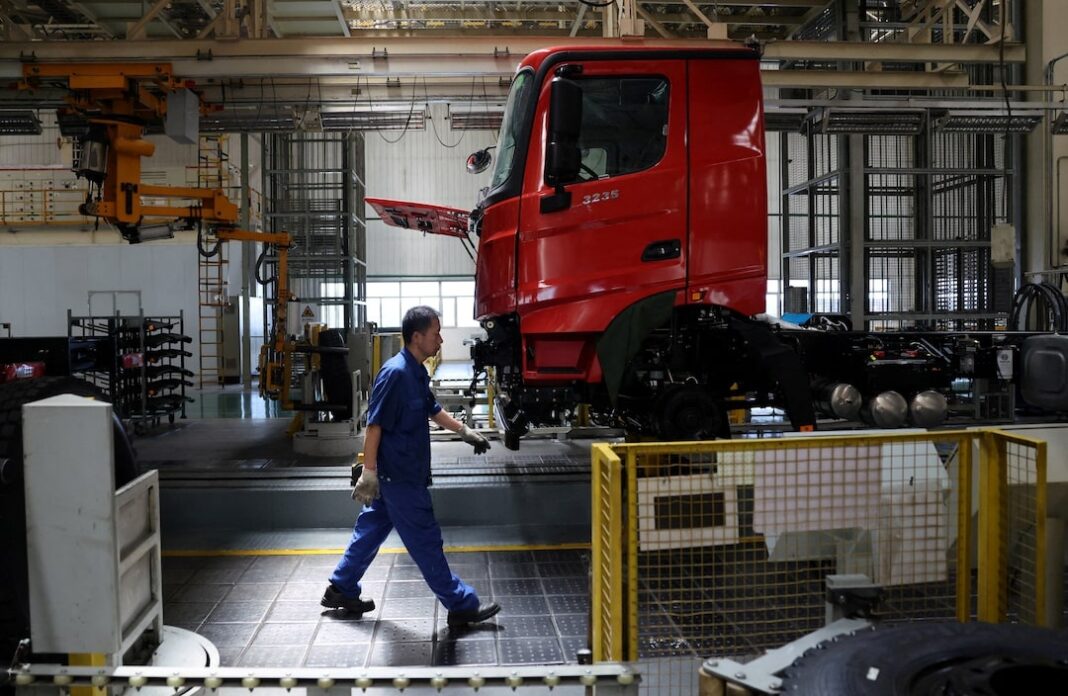

China has launched a sweeping national plan to electrify its heavy-duty trucking sector, setting a target of 40% market penetration for new-energy vehicles in the heavy truck segment by 2030. The roadmap, issued on June 13 by eleven Chinese government agencies including the Ministry of Transport, covers all heavy-duty trucks weighing over 12 tonnes. It arrives as China’s electric truck sales have already reached levels that are reshaping global diesel demand forecasts.
The plan aims for the electric heavy truck fleet to exceed 1.6 million vehicles by 2030, representing roughly 20% of all heavy-duty trucks operating in the country. Authorities also want new-energy heavy trucks to carry 18% of highway freight volumes by that year — a target that would mark a structural break from China’s near-total reliance on diesel in road freight just five years ago.
The scale of China’s ambition becomes clearer when set against where the market stands right now. Sales of heavy-duty new-energy trucks over 12 tonnes in China reached 231,100 units in 2025, a 182% increase compared to the previous year, with a penetration rate of about 29%. In December 2025, the single-month penetration rate surged to a record 53.89% before dropping significantly in the new year, partly driven by fleet operators rushing to take advantage of subsidies before a year-end cutoff.
For comparison, a total of 6,372 externally chargeable trucks over 16 tonnes were registered in all of Europe in 2025, representing just a 2% share of the market — a figure that shows how far ahead China’s transition has moved relative to the rest of the world.
Infrastructure at the Core
The plan is built around a large-scale infrastructure push. To support the transition, the government plans to build 30,000 kilometres of zero-carbon freight corridors along key sections of the national expressway network, with approximately 3,000 heavy-truck charging and battery-swapping stations to be deployed. New and upgraded highway service areas will be required to either install such infrastructure or reserve space for it.
The government envisages an electrification rate of 80% for all regular, short-haul truck shuttle routes in regions with high air pollution, such as the northern megacity cluster of Beijing-Tianjin-Hebei and the Fenwei Plain.
On the financing side, local governments are being encouraged to provide funding through dedicated bonds and green loans, with the plan also promoting new business models such as the separation of vehicle and battery ownership and battery leasing. A full-lifecycle traceability system for batteries at swap stations will be set up to manage safety.
The Diesel Demand Equation
The policy push matters well beyond China’s borders because of what it means for global oil markets. China is the world’s largest crude oil importer, and the transport sector consumes a significant share of its diesel. The Rhodium Group estimates that China’s electric trucks are already cutting oil demand by the equivalent of more than one million barrels per day.
The transport sector, which burns about two-thirds of all diesel in China, is forecast by energy consultancy Rystad to use 40% less diesel by 2030, cutting overall consumption by roughly a quarter compared to 2024 levels. Rystad Energy projects a 5% decline in diesel demand in 2026, compared with earlier estimates of 4%, while GL Consulting forecasts a 4.3% decrease.
SCI analyst Xu Lei told Reuters that the firm has cut its forecast for China’s diesel demand by 1%–2%, with diesel consumption now forecast to fall by 6.3% this year — a projection that is tracking at a similar pace to last year’s decline.
Industry Players and Cost Dynamics
Battery maker CATL sits at the centre of the electrification push. Zeng Yuqun, chairman of CATL, said that half of China’s sales of heavy trucks could be electric vehicles by 2028, up from 10% in 2024, according to a report by the Shanghai government-affiliated news site Jiemian. Sany Heavy Industry, China’s top-selling electric heavy truck manufacturer, has made an even bolder call, anticipating a 70% to 80% penetration rate over the same period.
The economic argument for fleet operators is hardening. According to Xia Nan, sales director of commercial vehicles at CATL, new-energy heavy trucks can save approximately $176,792 in costs over a 10-year operating cycle compared to traditional fuel vehicles, as reported by Caijing. While electric heavy trucks can cost more than ¥500,000 (approximately $73,500) compared with around ¥300,000 for diesel equivalents, incentives and trade-in programmes help narrow the upfront cost gap.
Chinese manufacturers are also beginning to look outward. Sany Heavy Industry plans to export electric trucks to Europe starting in 2026 and has already shipped models to the United States, Thailand, India, and the United Arab Emirates. In June this year, BYD broke ground in Hungary on a factory to produce electric trucks and buses, targeting Europe’s requirement to cut emissions from new trucks by 90% by 2040 compared with 2019 levels.
What This Means for Global Energy Markets
The speed of China’s trucking shift has caught many energy analysts off guard. In 2020, nearly all new trucks in China ran on diesel. By the first half of 2025, battery-powered trucks accounted for 22% of new heavy truck sales, up from 9.2% in the same period in 2024, according to Commercial Vehicle World, a Beijing-based trucking data provider.
China’s total electric vehicle fleet is already displacing over one million barrels per day in implied oil demand — equivalent to roughly the daily oil production of Oman — and that level is likely to rise by around 600,000 barrels per day over the next 12 months, according to the Rhodium Group.
For oil-producing nations and commodity markets, those numbers carry real weight. If Beijing’s 2030 targets are met, the structural decline in Chinese diesel demand will accelerate, pressuring refinery margins and potentially dampening crude prices globally.
Background
China’s heavy truck sector was almost entirely diesel-powered at the start of this decade. The shift began with generous government incentives — a 2024 scheme offered truck owners up to approximately $19,000 to replace older diesel models with newer or electric ones — combined with a rapid buildout of charging infrastructure. The electrification of passenger vehicles came first, with Chinese EV brands now exporting globally. Heavy trucks followed, aided by falling battery costs and the entry of CATL into the commercial vehicle sector with dedicated battery-swap technology. Cities like Beijing and Shanghai have built heavy-duty charging hubs along highways capable of charging trucks in minutes. China accounted for more than 80% of global electric truck sales in 2024, according to Business Standard.
What Happens Next
The government has set a 2030 deadline for the 40% penetration target and the build-out of 30,000 kilometres of zero-carbon freight corridors. Local governments are expected to begin issuing special-purpose bonds and green credit facilities to fund vehicle purchases and charging infrastructure in the near term. CATL aims to deploy 300 battery swap stations for heavy trucks along China’s freight corridors and expand the service into 16 city clusters nationwide by 2030. On the manufacturing side, BYD’s electric truck and bus factory in Hungary is expected to begin production targeting European markets as Chinese manufacturers execute their overseas expansion strategies. Analysts will be watching monthly penetration data through 2026 to judge whether the post-December correction represents a temporary dip or a genuine slowdown in adoption.