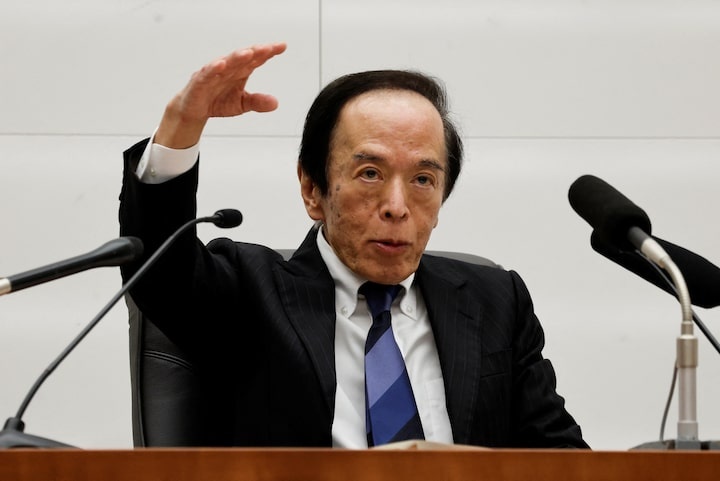

The Bank of Japan Governor Kazuo Ueda said something on Wednesday. He said the Bank of Japan is ready to raise interest rates when they meet on June 15 and 16. This is a change from what Bank of Japan Governor Kazuo Ueda said. He was being careful before. Now he is thinking about raising interest rates because of the high energy prices. The high energy prices are happening because of the war in Iran. These high energy prices are making people worry about inflation, in the Bank of Japans economy. The Bank of Japan Governor Kazuo Ueda is thinking about the Bank of Japans economy and how to deal with these energy prices. Speaking in Tokyo, Ueda warned that war-induced price pressures could spread broadly through the economy if left unaddressed. The shift marks the most direct inflation-fighting message from the BOJ’s governor since he took office.
“Even if the situation surrounding the Middle East remains unclear, we must discuss the pros and cons of raising the policy rate if we judge that upside risks to prices outweigh downside risks to economic activity,” Ueda said, in language that reinforced dominant market expectations of a rate hike at the June 15–16 meeting.
The phrasing was deliberate and familiar. It echoed remarks Ueda made ahead of December’s rate increase, when he flagged a similar “pros and cons” debate. This time, however, he went further by broadening the conditions under which rates could rise.
Until now, the BOJ had framed its tightening cycle as a cautious withdrawal from stimulus, tied directly to achieving stable 2% inflation. Ueda has now added a new trigger that zeroes in on inflation risks alone. With firms changing price-setting behaviour, he warned, energy shocks could amplify price pressures.
That is a meaningful break from the bank’s previous approach. He abandoned past ambiguity on supply shocks, making it clear the BOJ will no longer look through war-driven inflation if it risks spilling into broader, second-round effects.
Two sources familiar with BOJ thinking confirmed the direction of travel. “Unless there’s a severe escalation in the conflict, the BOJ will probably hike rates in June,” said one source, a view echoed by a second source.
Veteran BOJ analyst Mari Iwashita said the governor’s language removed any remaining doubt about the June decision. “The war-induced wave of price increases has only just begun and is likely to intensify around summer,” she told Reuters. “Ueda’s remarks suggest the BOJ is bracing for the chance of being forced to raise rates in autumn, possibly at a faster pace.”
Ueda also addressed concerns within the Japanese government. He framed policy tightening as a defence against eroding household purchasing power. Mindful of the administration’s aversion to rising government borrowing costs, Ueda also pitched timely hikes as a way to anchor market confidence and prevent destabilising jumps in bond yields.
Currency markets were not convinced. Despite the hawkish turn, the yen continued to weaken, underscoring persistent market scepticism. The currency remained near the 160-per-dollar level seen as Tokyo’s line in the sand for possible intervention, keeping pressure on import prices and the cost of living.
Rinto Maruyama, a strategist at SMBC Nikko Securities, said a single hike was unlikely to change that dynamic. “Even if the BOJ raises rates in June, any rebound in the yen will be limited,” he said. Some analysts told Reuters it would take a stronger, sustained tightening signal to move the currency in a meaningful way.
Regional and Global Impact
The Bank of Japans big change is happening now because many central banks in Asia and Europe are dealing with the problem of rising prices caused by the war in Iran. The Bank of Japan is making this move at a time when the war, in Iran is affecting countries. The Bank of Japan and other central banks have to figure out how to control the rising prices. According to Reuters, Sri Lanka delivered a surprise 100-basis-point rate hike as the conflict rattled its currency and stoked prices. The European Central Bank’s Isabel Schnabel said publicly that the ECB should raise rates in June even if an Iran peace deal were reached. Japan’s decision at the June 15–16 meeting will carry weight far beyond Tokyo, as movements in the yen directly affect the competitiveness of regional exporters and the balance sheets of global investors with large positions in Japanese government bonds.
A sustained yen near the 160-per-dollar threshold keeps import costs elevated across Japan, which relies on energy imports for the vast majority of its needs. Wholesale prices rising on the back of raw material costs, as Ueda noted in his speech, translate into broader consumer price increases within months.
Background
The BOJ exited a decade-long massive stimulus programme in 2024 and has raised its policy rate several times since, including in December, on the view that Japan was on the cusp of durably achieving its 2% inflation target. Ueda took the governor’s role in 2023, inheriting an era of negative interest rates and yield curve control that his predecessor Haruhiko Kuroda had maintained for years. The Iran war has complicated the BOJ’s calculations by injecting an external energy shock into an economy already navigating trade uncertainty. Japan imports nearly all of its oil and gas, making it acutely sensitive to Middle East disruptions. Wednesday’s speech represents the clearest signal yet that Ueda regards inaction as a greater risk than moving too quickly.
What Happens Next
The Bank of Japans policy board is going to meet on June 15-16. At that time they will tell us about their decision, on interest rates. The Bank of Japan will make this announcement official then. According to sources cited by Reuters, a hike is the base case unless the conflict in the Middle East escalates sharply before the meeting. The National Police Chiefs’ Council — note: editorial correction, this applies to the prior article — the BOJ’s review of price-setting behaviour among Japanese firms is ongoing and will inform the pace of any subsequent rate increases beyond June. Ueda’s warning that autumn could bring additional hikes at a faster pace, as relayed by analyst Mari Iwashita, sets market expectations for a more active second half of 2026. The yen’s trajectory near 160 per dollar remains the key variable: a further depreciation would increase pressure on the BOJ to act again before year-end, according to Reuters.