
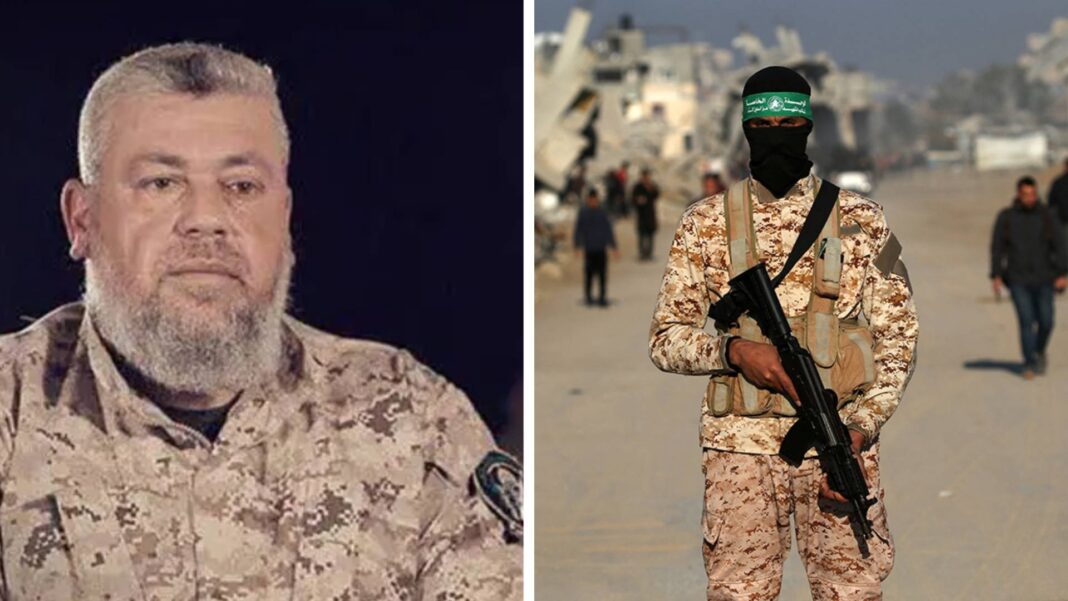

Hamas’s internal security apparatus in Gaza executed a Palestinian man on Wednesday, July 2, 2026, on charges of collaborating with Israeli intelligence, accusing him of providing information that enabled a series of Israeli strikes — including the May airstrike that killed Izz al-Din al-Haddad, the head of the Izz al-Din al-Qassam Brigades. The man, identified only by the initials “M.M.” and reported to be 47 years old, was convicted after what the group described as “all revolutionary procedures” had been completed. Israel has not commented on the claims.
The execution was announced by the Hamas-affiliated Resistance Security apparatus, which said M.M. had worked directly with Israeli military intelligence and played a role in directing multiple lethal strikes throughout the war in Gaza. The allegations against him could not be independently verified.
Al-Haddad, also known as Abu Suhaib, headed the Qassam Brigades’ military staff and was killed alongside his wife and daughter in an Israeli airstrike on an apartment in central Gaza City’s Rimal neighbourhood on May 15. Israeli Prime Minister Benjamin Netanyahu and Defence Minister Israel Katz confirmed the strike, calling al-Haddad one of “the architects” of the October 7, 2023 attacks, Al Jazeera reported. Seven people were killed in the attack, including other Palestinian civilians.
Hamas sources told the London-based Arabic newspaper Asharq Al-Awsat that M.M. was first arrested shortly after al-Haddad’s assassination in May, after he was observed communicating with Israeli intelligence. The sources said he was also witnessed at Gaza’s Al-Shifa Hospital verifying the identities of those killed in the airstrike on al-Haddad. According to the same sources, M.M. confessed to the charges immediately following his arrest and admitted to being present at the scene of the strike. Hamas sources further alleged he was found in possession of surveillance equipment at the time of his arrest and confessed to passing intelligence that contributed to the deaths of approximately 30 individuals.
The Resistance Security apparatus issued a direct warning in its statement. “This is the fate awaiting those who cooperate with Israel in operations aimed at undermining Palestinian steadfastness and internal unity,” the statement read, calling on anyone cooperating with Israeli intelligence to “return to the national ranks and surrender themselves to resistance security before it is too late.”
While Hamas did not formally claim top-level responsibility for the execution, attributing it to the Resistance Security apparatus, local indicators suggested the sentence was carried out by members of the Qassam Brigades.
The execution is part of a wider security campaign Hamas has been conducting inside Gaza. On June 14, Resistance Security announced the dismantling of a cell it said had coordinated directly with Israeli intelligence to lure Palestinian police personnel into Israeli strikes and create internal instability. The Palestine Chronicle reported that the Independent Commission for Human Rights, Palestine’s official national human rights institution, separately documented kidnappings, unlawful detention, torture, and extrajudicial killings in Gaza, and called for independent investigations.
Hamas regularly carries out executions in Gaza, even though all execution orders must technically be approved by Palestinian Authority Chairman Mahmoud Abbas, who is based in Ramallah and imposed a moratorium on executions several years ago. Hamas no longer recognises Abbas’s legitimacy and has declared that the death penalty in Gaza can be carried out without his consent.
Al-Haddad’s killing in May had already drawn significant regional attention. Born in the early 1970s, al-Haddad joined Hamas upon its inception in 1987 and rose to become commander of the group’s Gaza City Brigade, overseeing six battalions. He played a foundational role in establishing al-Majd — Hamas’s internal security apparatus designed to track down Israeli intelligence collaborators — and survived at least six Israeli assassination attempts, earning him the nickname “the Ghost.”
Palestinian political analyst Saeed Ziad told Al Jazeera that al-Haddad’s death represented “a massive symbolic and moral blow” to Palestinians, though he assessed that the immediate operational impact on Hamas’s armed wing would be limited. “The Qassam Brigades are not built on a hierarchical, sequential structure, but a parallel one,” Ziad said. “Over the past two decades, Hamas has transitioned into a decentralised guerrilla force. Units operate as isolated, self-sufficient groups with their own logistical supply lines and combat doctrines.”
Iran’s Ministry of Foreign Affairs described al-Haddad’s killing as a “terrorist assassination” and reaffirmed its support for the Palestinian cause. Hezbollah condemned the strike as a “heinous crime” and “treacherous aggression.”
Background
Al-Haddad was a primary architect of the October 7, 2023 attacks, personally overseeing the breach of the eastern fence and directing elite units that stormed the Re’im military base and the Fajja outpost. He assumed command of the Qassam Brigades following the assassination of Mohammed Sinwar and had become Israel’s highest-priority remaining target in Gaza. His eldest son and grandson were killed in an airstrike in Gaza City on January 17, 2025, and his second son was killed in a separate airstrike in April of the same year. The October 2025 ceasefire agreement formally paused major hostilities, though Israeli strikes have continued. According to the Gaza Health Ministry, since the ceasefire began in October 2025, the death toll from Israeli attacks reached 870, with the number of injured climbing to 2,543. Israel has long relied on networks of Palestinian informants to gather intelligence in Gaza, while Palestinian armed groups have historically executed those accused of collaborating with Israeli security services.
What Happens Next
The Resistance Security apparatus has signalled that its anti-collaborator operations in Gaza will continue, having announced the dismantling of multiple cells in recent weeks. Hamas has not named a confirmed successor to al-Haddad as head of the Qassam Brigades, and analysts told Al Jazeera that the group’s decentralised command structure means individual units will continue operating independently regardless of leadership vacancies at the top. Israel has not commented on the execution or on the specific intelligence claims made by Hamas regarding M.M.’s alleged role. The execution adds further strain to the October 2025 ceasefire, which Hamas has already accused Israel of violating through continued airstrikes, including the May 15 strike that killed al-Haddad.