
The Trump administration has formally reoriented United States policy toward the Western Balkans away from democratic institution-building and toward energy commerce, signing multi-billion-dollar liquefied natural gas agreements with Albania, Bosnia and Herzegovina, and Croatia in late April 2026. The shift, formalized in a seven-page State Department report released in May, marks the most significant strategic realignment in the region since Washington’s post-war engagement in the 1990s. At its core, the new approach treats American LNG exports as the primary instrument of US influence across Southeastern Europe.
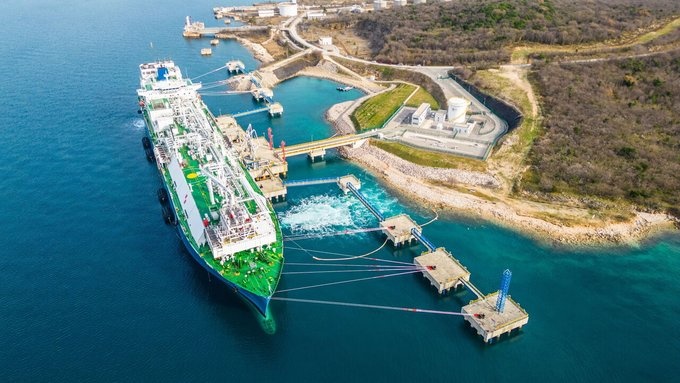
The centerpiece of the new framework is the Southern Interconnection Gas Pipeline, a $1.5 billion project that will link Bosnia and Herzegovina to Croatia’s gas infrastructure and to the LNG terminal on the Adriatic island of Krk. The US Department of Energy announced the deal on April 28, 2026, with Bosnia selecting AAFS Infrastructure and Energy, a US-based firm, as the investor and developer. Bosnia currently relies almost entirely on Russia for its gas imports, delivered through pipelines via neighboring Serbia and Bulgaria along the TurkStream corridor.
In Tirana, a separate agreement was signed the same week. Albania concluded a 20-year framework agreement for American LNG imports worth $6 billion, connecting the local energy supplier Albgaz with the American firm Venture Global and the Greek company Aktor. The plan envisions turning the southern Albanian port of Vlore into a future import hub and hosting a new gas-based thermal plant.
“President Trump is opening a new era of cooperation with Southern, and Central and Eastern Europe,” US Energy Secretary Chris Wright told reporters at the Three Seas Initiative business forum in Dubrovnik, Croatia.
The deals are part of a broader architecture known as the Vertical Gas Corridor. The project aims to turn Greek ports and LNG terminals and the Trans-Balkan Pipeline into a hub for regassifying US LNG and distributing it northward to at least seven countries, with the eventual goal of reaching Ukraine. US energy firms ExxonMobil and Chevron have also signed agreements with Greece to explore new natural gas deposits near the Ionian Sea and Crete.
The State Department report accompanying the deals is blunt about what is driving Washington’s re-engagement. “The US-led nation-building era has passed,” it states. “US policy in the Western Balkans is not about rescue or reconstruction, but stability and mutually beneficial partnerships.” The report describes the Western Balkans as a region of “economic opportunity” with a population of around 18 million, and prioritises “deal facilitation, market access, and investment climate reforms” over institution-building.
David J. Kostelancik, a nonresident Senior Fellow at the Center for European Policy Analysis, said the shift reflects a hard security logic. “Energy security in Southeastern Europe is no longer a peripheral economic issue — it is a core US national security concern,” he said, adding that focused diplomatic engagement and financing can boost investment in a way that increases both competitiveness and security.
Serbia, though not party to the April deals, is also in Washington’s sights. Serbia, North Macedonia, and Kosovo are largely expected to be integrated into the US energy corridors. Serbia’s Minister of Mining and Energy Dubravka Đedović Handanović said her country is building gas interconnections toward North Macedonia and Romania, which will give it the capacity to carry around four billion cubic metres of gas per year, opening access to new gas markets and supply routes.
The policy is generating friction with the European Union. Brussels has warned Bosnia that legislation adopted specifically for the AAFS pipeline project — bypassing an open tender process — could jeopardize the country’s EU accession path. Transparency International has warned of a “dangerous precedent,” and the EU ambassador to Sarajevo, Luigi Soreca, wrote to Bosnian authorities on April 13 cautioning that the lex specialis legislation risks undermining Bosnia’s obligations as an EU candidate.
Major investments in gas contradict the EU’s broader green agenda to phase out fossil fuels, leaving Western Balkan candidates — which must meet specific criteria to join the EU — caught in the crossfire of US-EU divisions on energy policy. Several EU member states, including Greece and Croatia, are part of US LNG corridors and have attempted to push Brussels to soften limitations on gas projects, though the outcome of that effort remains undetermined.
The tension between Washington and Brussels over the Balkans reflects a wider contest for influence in a region that both sides regard as strategically exposed. The new US report addresses local issues such as organised crime while also outlining a larger geopolitical vision involving Russia and China, warning that “malign actors can exploit regional instability to the detriment of US interests.”
The strategy is also entangled in questions of political transparency. AAFS Infrastructure and Energy, the firm selected to develop the Bosnia pipeline, was awarded the contract following talks between the US and Bosnian governments without an open competitive bidding process. According to company disclosures reported by RFE/RL and European Western Balkans, Jesse Binnall — a former member of Trump’s legal team — is listed as director of AAFS Infrastructure and Energy, and Joseph Flynn, brother of former National Security Adviser Michael Flynn, serves as vice president.
One US Congressional aide familiar with the discussions told RFE/RL that Washington is deliberately moving at speed. “The strategy is to move capital and projects faster than the politics can react. If you frame everything as a geopolitical contest, you slow it down,” the aide said.
Background
For decades under both Democratic and Republican administrations, US strategy in the Western Balkans centred on support for the region’s eventual EU and NATO accession, as well as investments to strengthen democratic governance, energy independence, and regional market integration. When Trump returned to office in January 2025, one of his first moves was to shut down USAID, which had been central to funding those programmes — leading to the cancellation or suspension of an estimated 83 percent of aid contracts active in the region. Washington has no Senate-confirmed ambassadors in the Western Balkans, a vacancy that has reinforced perceptions of reduced engagement even as energy deals accelerate. In February 2026, 12 countries and the United States signed a Joint Statement on Enhancing Security of Natural Gas Supply to Central and Eastern Europe at the Transatlantic Gas Security Summit, organised by the US National Energy Dominance Council.
What Happens Next
Anonymous officials familiar with the discussions said further deal announcements are expected, with Serbia, North Macedonia, and Montenegro seen as the logical next steps if the initial projects proceed. The State Department report outlines plans for structured 2026 dialogues with North Macedonia and Serbia. The EU is expected to continue pressing Sarajevo over the pipeline’s procurement process, with Bosnia’s accession trajectory potentially affected by the outcome. The Vertical Gas Corridor is envisaged to expand gas flows from Greece northward through Bulgaria, Romania, Moldova, and Ukraine, though its commercial viability depends on the conclusion of long-term supply contracts that are still being negotiated.