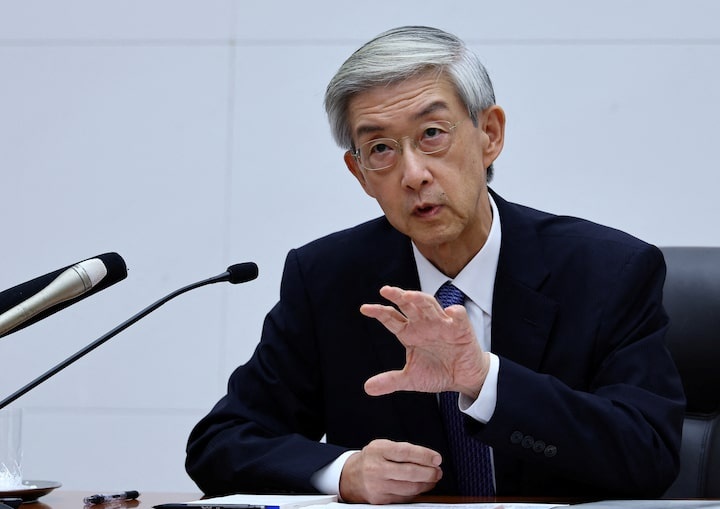

Bank of Japan policy board member Kazuyuki Masu on Thursday called for an interest rate increase at the earliest opportunity, warning that energy price pressures stemming from the war in Iran risk becoming a lasting driver of inflation in Japan. Masu delivered the remarks at a business conference in Kagoshima prefecture in western Japan on May 14.
“I myself judge that the situation did not warrant a hasty hike,” Masu said in a speech. “That said, if data do not indicate clear signs of an economic downturn, I believe it is desirable to raise rates at the earliest stage possible.”
The BOJ kept its policy rate steady at 0.75% at its April meeting, but three of the nine board members dissented and called instead for a hike to 1.0%. Masu voted with the majority in April to hold rates, but his remarks Thursday place him closer to those dissenters ahead of the central bank’s next meeting in June.
The Bank of Japan raised its inflation forecasts at the April meeting to reflect rising oil prices, while holding its benchmark rate steady. A summary of opinions from that meeting, released May 11, showed the board had grown more concerned about inflation risks tied to the Middle East conflict.
“It is quite possible that the bank will raise the policy interest rate from the next monetary policy meeting onward, even if the future course of the situation in the Middle East remains unclear,” one board member said, according to the April meeting summary.
Masu, a former executive at Japanese trading company Mitsubishi, warned that the economic consequences of surging energy costs could prove more severe than historical precedents suggest. An oil shock now will likely have a more significant impact on consumers’ everyday life than it did during the 1970s, he said, because people depend on plastic products far more than they did 50 years ago.
“What is vital from now on is to ensure that, through timely and appropriate policy rate hikes, the underlying inflation rate does not exceed 2%,” Masu said.
Rising prices of fuel and chemical goods caused by the Iran war could prove a temporary shock, Masu said, though he expressed concern they could push up already rising distribution costs and lead to enduring price pressures. He also warned that a weaker yen could compound those pressures by raising inflation expectations, according to reporting by investingLive.
“As the behaviour that took root during the period of deflation is now being unentrenched, Japan has clearly entered an inflationary phase,” Masu added.
Market and Policy Impact
A slew of recent hawkish signals from the BOJ have led markets to price in roughly a 70% chance of a rate hike at the June meeting. Nearly two-thirds of economists polled by Reuters before last month’s meeting had also predicted a rate hike by June.
Soaring energy costs from the Middle East conflict have complicated the BOJ’s rate decisions. They push up prices, but also weigh on an economy heavily reliant on fuel imports. Japan imports nearly all of its oil and gas, making it acutely exposed to energy shocks triggered by conflict in the region.
Masu also said Japan is no longer in deflation and that negative real interest rates should be addressed promptly, a position that aligns with the more hawkish wing of the board that voted for an immediate hike in April.
Background
The BOJ ended its decades-long ultra-loose monetary policy in 2024 and has since raised its benchmark rate incrementally. The current rate of 0.75% remains among the lowest of any major central economy. Japan’s inflation has been running above the BOJ’s 2% target, driven in recent months by rising energy and food costs. The war in Iran has sent oil prices sharply higher, increasing pressure on fuel-importing nations across Asia. The BOJ’s nine-member policy board votes by majority, and significant dissent — as seen in April — signals a narrowing path to continued rate holds.
What Happens Next
Masu’s hawkish tone turns market attention to a speech on May 21 by fellow board member Junko Koeda, who also voted to keep rates steady in April. Deputy Governor Ryozo Himino is also scheduled to deliver a speech on Saturday. The BOJ’s next monetary policy meeting is set for June, at which markets now assign roughly a 70% probability of a rate increase to 1.0%, according to Reuters polling data. The bank has said it will continue to assess economic, price, and financial developments before making any policy change.