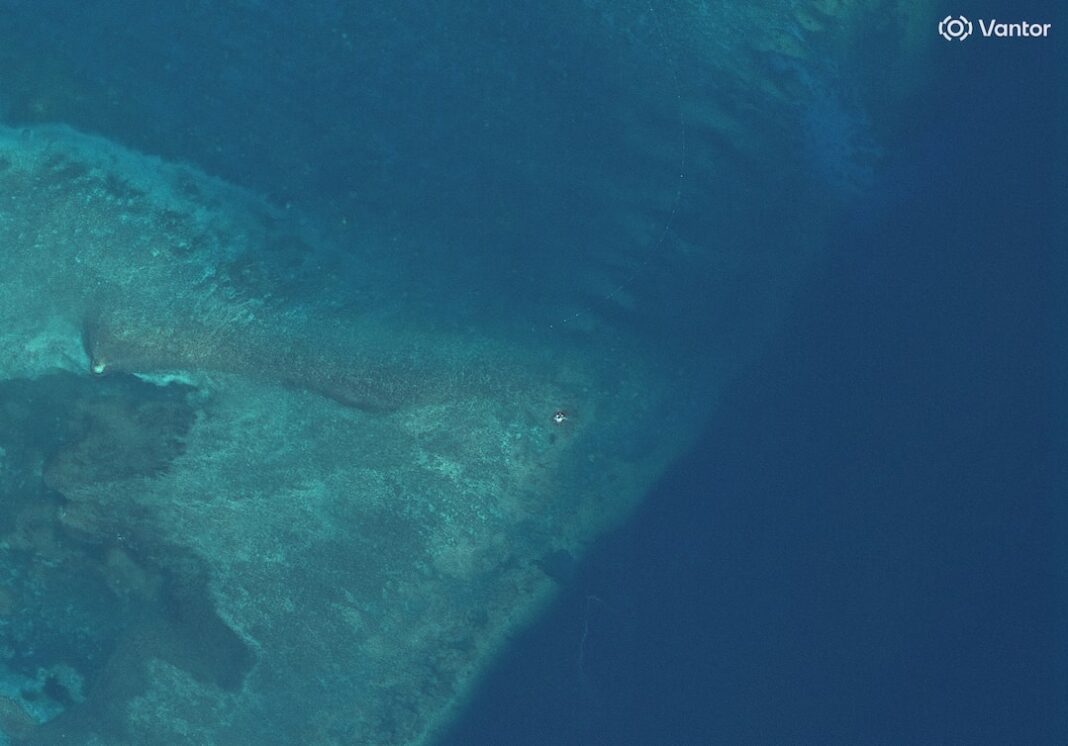

Satellite images obtained by Reuters confirmed the presence of a structure at the entrance of Scarborough Shoal in the South China Sea in late May 2026, though later imagery indicates it is no longer there. The Philippines said on Wednesday it was investigating reports about the presence of a new structure on the shoal, which has been effectively under China’s control since a standoff with Manila in 2012. China’s defence ministry and its embassy in Manila did not respond to requests for comment, Reuters reported.
The images, taken on May 27, 29, and 30, show what commercial satellite imagery provider Vantor described as possibly a floating raft or buoy at the opening of the atoll, along with a barrier stretching across it in the May 27 and May 29 photographs. On Tuesday, U.S.-based maritime monitoring group SeaLight posted on X satellite imagery taken on May 28 showing what it described as a “small, reflective object clearly distinguishable on the reef flat near the lagoon entrance.” “Evidence suggests it is a persistent feature rather than a transient optical artifact,” SeaLight said, citing its review of additional satellite images.
The object had disappeared by the following week. A June 1 image taken by Vantor was the first reported evidence that the suspected structure was no longer present at the location.
The object appears to be less than 10 meters (32 feet) in diameter, Stanford-affiliated maritime analysis group SeaLight assessed, adding it was unclear whether the structure was fixed to the reef or floating like a buoy.
SeaLight Director Ray Powell said the nature of the object carried direct legal implications. “If this object is confirmed to be a fixed installation, it would raise questions about compliance with the 2002 Declaration on the Conduct of Parties in the South China Sea, which calls for self-restraint and avoiding actions that complicate disputes or alter the status quo on contested, uninhabited features,” Powell said, referring to an agreement signed by China and members of the Association of Southeast Asian Nations.
Philippine Defence Secretary Gilberto Teodoro Jr. said the government was still working to establish basic facts. “I still don’t know what it is, that’s why it’s still considered raw information,” Teodoro told reporters on the sidelines of the Shangri-La Dialogue in Singapore. “Once in a while, they put a buoy and other things there. Might be something from outside drifted inside the shoal.”
The Philippine government’s National Task Force for the West Philippine Sea said it takes “seriously any development that may affect the country’s sovereignty, sovereign rights, and jurisdiction” in those waters, according to Reuters. Teodoro confirmed the country’s National Security Council has been tasked with leading the investigation.
The satellite findings came during a period of elevated Chinese naval activity. The Philippine military said Tuesday it tracked 82 Chinese coast guard and navy vessels within the country’s exclusive economic zone in May, including 39 around Scarborough Shoal alone. Rear Admiral Roy Vincent Trinidad, a spokesperson for the Armed Forces of the Philippines, said the numbers reflected what GMA News quoted as “illegal, coercive, aggressive and deceptive activities that undermine the rules-based international order.”
The vessel numbers were particularly high in the final days of May. Between May 26 and June 1, the United States joined the Philippines for the first known joint patrol near Scarborough Shoal, according to USNI News, marking a visible escalation in Washington’s support for its treaty ally.
Regional and Geopolitical Impact
Tensions continue to simmer in the South China Sea, which China claims sovereignty over nearly in its entirety — a conduit for more than $3 trillion in annual maritime trade — putting it at odds with several neighbours, including the Philippines. Any confirmed fixed structure at Scarborough Shoal would represent a significant step beyond China’s existing posture there, where it has exercised de facto control without physically building on the feature. Philippine Armed Forces Chief General Romeo Brawner Jr. previously said his country “will not allow” what happened at Mischief Reef — occupied in the 1990s by China, which later built a military base on it — to happen at Scarborough Shoal.
Background
China took control of Scarborough Shoal in 2012 after a standoff and has since stationed its coast guard and fishing vessels there. Both China and the Philippines claim the shoal, but sovereignty remains unresolved. A 2016 ruling by the Permanent Court of Arbitration in The Hague invalidated China’s sweeping claims and declared its blockade illegal, affirming the shoal as a traditional fishing ground for countries including the Philippines and Vietnam. China rejected the ruling. Scarborough Shoal — known as Bajo de Masinloc in the Philippines and Huangyan Island in China — sits 200 kilometres (124 miles) off the western coast of the Philippines, within its exclusive economic zone.
What Happens Next
The Armed Forces of the Philippines are actively monitoring the shoal, according to USNI News. The Philippine National Security Council’s investigation is ongoing, with Teodoro confirming it has been formally tasked with determining the nature of the object. Teodoro told Newsweek the Philippines will maintain a “constant presence” near the shoal, whether through the coast guard or navy, acting alone or with partners. Reuters reported that China’s defence ministry had not responded to requests for comment as of June 4.