
Venezuela Earthquake Death Toll Reaches 2,645 as UN Estimates $37 Billion in Damage and Questions Grow Over True Count
The official death toll from the twin earthquakes that struck northern Venezuela on June 24 climbed to 2,645 on Friday, July 3, with 12,666 injured and roughly 50,000 people still unaccounted for, according to government figures and United Nations estimates — while a forensic pathologist working at the disaster’s epicentre told CNN the official count amounts to “not even a third of what is actually there.” A UN-backed engineering assessment released this week placed direct physical damage from the magnitude 7.2 and 7.5 doublet at at least $37 billion, equivalent to approximately 3.4 percent of the exposed physical assets in the affected region and several times Venezuela’s annual state budget.
Acting President Delcy Rodríguez, who gave the updated figures, also announced that Venezuela was establishing a $200 million reconstruction fund with the International Monetary Fund, with disbursements to go to audited contractors for home rebuilding — the first time in years Venezuela has engaged with the IMF on a financial arrangement of this scale.
A Death Toll Under Scrutiny
The gap between official figures and the reality visible on the ground in La Guaira has become one of the most contested dimensions of the disaster. A forensic pathologist working in the port city, who asked not to be identified out of fear of retaliation, told CNN that the makeshift morgue at her facility was processing around 400 bodies a day, many battered beyond recognition or in advanced states of decay. Refrigerated trucks had run out of space, forcing staff to place body bags outside in the sun. “La Guaira is indescribable,” she said. “There are so many cases, so many families. The earthquakes hit the lower-income families the hardest — they are the most affected.”
Volunteer-run missing persons registries have recorded more than 43,000 reports submitted by relatives searching for loved ones, concentrated primarily in La Guaira state and Caracas. Authorities caution that not every report represents someone trapped under rubble, given the scale of communication failures, population displacement, and family separation. But the International Organization for Migration and other aid organisations have separately estimated that roughly 50,000 people remain unaccounted for, and the International Rescue Committee said the scale of humanitarian response “does not meet the scale of humanitarian need.”
David Smilde, a sociologist at Tulane University and Venezuela specialist, cautioned against assuming deliberate misrepresentation. “We’re going to need more studies and more actual research and understanding to really know before speculating that the government is withholding a number of deaths,” he told CNN. For comparison, after major landslides and flooding devastated La Guaira in 1999, the government of then-President Hugo Chávez never produced an official death toll at all.
Rodríguez Defends the Response
Rodríguez held a press conference on Thursday, July 2, to push back against sustained criticism of the official response, describing reporting on shortcomings as the work of “media laboratories” motivated by politics. “The first media narrative developed in these media labs was: ‘Everyone head to La Guaira’ to create chaos and impede search-and-rescue operations,” she said, without providing further detail.
Venezuelan state television has regularly broadcast footage of Rodríguez meeting with military and security officials and of soldiers patrolling roads. Reuters witnesses and the Associated Press have described a response led substantially by civilians rather than the state — volunteers, motorcycle couriers, student doctors, teachers, and veterinarians working alongside foreign rescue teams, while state cranes sat idle and soldiers were seen in spotless uniforms without engaging in debris clearance.
Still Alive After Eight Days
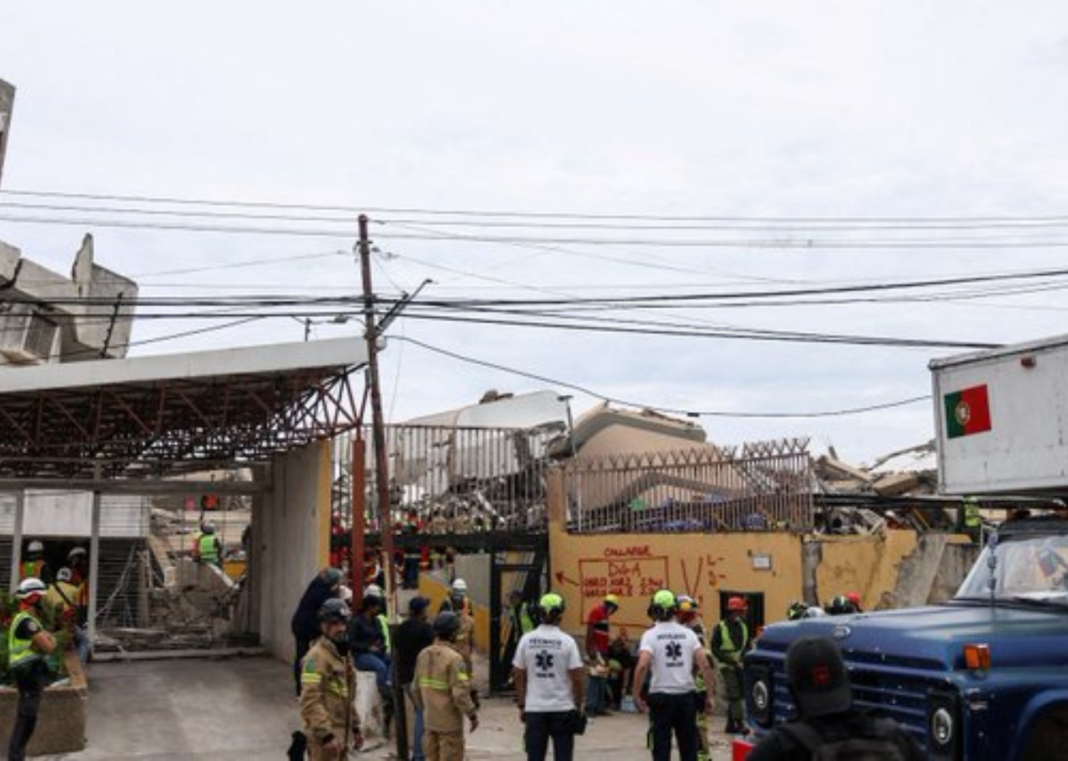
Amid the grim progression of the toll, moments of survival have provided counterpoints. On Thursday, a security guard named Hernán Alberto Gil was pulled alive from the basement of the nine-story Galerias Playa Grande shopping centre after eight days of work by rescue teams from El Salvador, Chile, the United States, Portugal, Mexico, Costa Rica, and Venezuela. “I’m grateful to God for keeping him alive for so many days,” said his wife, Gusbimar González.
Doctors converted a McDonald’s restaurant in La Guaira into a makeshift health centre, treating around 200 patients a day since opening on Friday, June 27, with emergency care, donated medicines, a pharmacy, and a veterinary unit operating from the former ice cream section of the restaurant.
The Scale of Destruction
The UN-backed engineering study, produced with support from firms Ingeniar CAD/CAE Ltda. and ERN, found that approximately $24 billion in losses occurred in residential, commercial, industrial, educational, healthcare, and government buildings. A further $13 billion in damage affected infrastructure, with telecommunications sustaining the heaviest infrastructure losses at around $5 billion, followed by energy infrastructure at $3.1 billion. The Venezuelan Guild of Engineers announced an emergency training programme for engineers and architects to carry out structural assessments of thousands of damaged buildings before residents can safely return.
Researchers concluded Venezuela experienced what seismologists term an “earthquake doublet” — a relatively uncommon sequence in which the initial magnitude 7.2 rupture along the Boconó fault system triggered a neighbouring fault that was already close to rupture, unleashing the larger magnitude 7.5 event on the San Sebastián fault just 39 seconds later. The two earthquakes were the strongest to strike Venezuela since a magnitude 7.7 event in 1900, and researchers estimated that an event of similar combined magnitude has an average return period of approximately 180 years based on Venezuela’s seismic hazard profile. More than 890 aftershocks had been recorded by Friday.
Regional and Global Impact
The IMF and World Bank have both offered credit and assistance, with Rodríguez’s announcement of the $200 million reconstruction fund representing a notable shift in the transitional government’s relationship with multilateral financial institutions after years of hostility under Nicolás Maduro. More than 3,300 international rescue workers are deployed across the disaster zone, drawn from dozens of countries. The United States has committed $300 million in assistance, with around 900 military personnel engaged in the relief effort, including teams that repaired the earthquake-damaged runway at Caracas’s main international airport to facilitate incoming humanitarian flights.
The disaster’s economic dimensions are severe even by the standards of a country already carrying one of the world’s deepest humanitarian crises. Estimated damage of $37 billion represents a sum several times the size of Venezuela’s annual state revenues, making any meaningful reconstruction dependent on sustained international financing rather than domestic public resources. The $200 million IMF reconstruction fund, while significant as a political signal of re-engagement with multilateral institutions, is a fraction of the scale of financing that independent assessments suggest will ultimately be required.
Background
The twin earthquakes struck northern Venezuela at 6:04 and 6:05 p.m. local time on June 24, with epicentres near the city of San Felipe in Yaracuy state. La Guaira, the coastal state north of Caracas that serves as the gateway to Venezuela’s main international airport, bore the heaviest losses, with more than 250 structures damaged or destroyed in that state alone. Venezuela had already been host to one of the Western Hemisphere’s largest humanitarian crises before the disaster, with seven million people requiring assistance and more than eight million having emigrated over the past decade. Rodríguez has led the country in a transitional capacity since the US-led removal of Maduro in January 2026.
What Happens Next
The response is transitioning from active search-and-rescue operations toward longer-term medical care, debris clearance, identification of the dead, and housing reconstruction. The Venezuelan government’s presidential commission is expected to release building safety assessments using a traffic-light system, determining which structures are safe to reoccupy. The $200 million IMF reconstruction fund is expected to begin disbursing to audited contractors for home rebuilding, with the full scale and terms of the arrangement still under negotiation. Forensic pathologists and engineers have warned that the true death toll may not be known for weeks or months, as rubble clearance continues and the capacity to process and identify remains remains severely strained.