
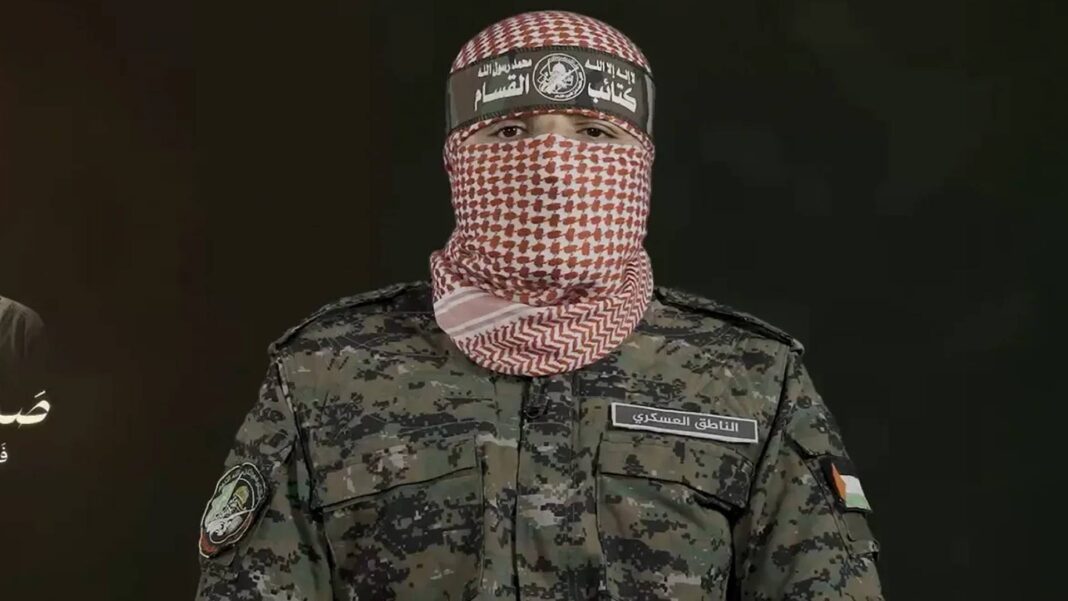

Abu Obaida, the spokesperson for Hamas’s military wing the Al-Qassam Brigades, delivered a televised address on Tuesday in which he accused Israel of failing to honor agreements and declared that Hamas intended to continue its armed confrontation. The statement, shared via a video posted to Telegram, came as Israeli military operations in Gaza persisted into the twenty-first month of the conflict.
In the address, Abu Obaida said the movement had found itself facing “an enemy that does not abide by agreements” and had “misread the reality of the conflict,” according to Roya News. He did not specify which agreements he was referring to, but the remarks came against the backdrop of repeated rounds of ceasefire negotiations mediated by Qatar, Egypt, and the United States — talks that have stalled multiple times since early 2024.
Abu Obaida added that “the bill of reckoning for the enemy will remain open until it is paid in full and heavily,” signaling the group’s intention to press on with its armed campaign, Roya News reported.
The statement addressed Israeli assassinations of Hamas commanders directly. Abu Obaida said Israel mistakenly believed that killing Hamas leaders could weaken the movement. “Our cowardly enemy imagines it can weaken us by assassinating our leaders, but their blood is the fuel that drives our ship through hardships,” he said, according to Roya News.
Abu Obaida also paid tribute during the speech to Izz al-Din al-Haddad, whom he described as the chief of staff of the Al-Qassam Brigades. He said al-Haddad played a central role in planning, preparing, and overseeing the October 7, 2023 operation, according to Roya News. Al-Haddad had been killed in an Israeli strike, and Tuesday’s statement marked a formal acknowledgment of his senior command role and the circumstances of his death.
The tribute to al-Haddad reflects a broader pattern in Hamas’s public communications. Since October 2023, Israel has killed several senior Al-Qassam commanders through targeted strikes, including Mohammed Deif, Yahya Sinwar, and Marwan Issa. Hamas has consistently responded to each killing with public statements framing the deaths as martyrdom and pledging organizational continuity.
Regional and Global Impact
The statement carries significance for ongoing ceasefire diplomacy. Each time Hamas issues defiant public declarations rejecting the premise that Israeli military pressure is degrading its capacity, it complicates the negotiating positions of mediating states. Qatar and Egypt have invested considerable diplomatic effort in bridging the gap between Israeli and Hamas positions; public messaging of this nature from the Al-Qassam Brigades tends to harden Israeli government resistance to any agreement that does not include the complete dismantling of Hamas’s military infrastructure.
For Palestinian civilians in Gaza, the intractability signaled in Tuesday’s statement suggests that a durable ceasefire remains distant. International humanitarian organizations, including the United Nations Office for the Coordination of Humanitarian Affairs, have repeatedly warned that the civilian population faces acute shortages of food, medicine, and shelter.
Background
Hamas launched a cross-border attack on southern Israel on October 7, 2023, killing approximately 1,200 people and taking around 250 hostages, according to Israeli government figures. Israel launched a military campaign in Gaza in response. Gaza’s Health Ministry has reported that more than 54,000 Palestinians have been killed since then, though Israeli authorities dispute some of those figures. Multiple rounds of ceasefire and hostage-release negotiations have taken place, including a partial deal in January 2025 that released some hostages in exchange for Palestinian prisoners. That agreement broke down before its second phase was implemented, and fighting resumed. The Al-Qassam Brigades, Hamas’s armed wing, has continued to carry out rocket fire and engage Israeli ground forces throughout the conflict.
What Happens Next
Mediators from Qatar, Egypt, and the United States have not publicly announced a new round of talks in the immediate aftermath of Tuesday’s statement. Israeli Prime Minister Benjamin Netanyahu has said publicly that Israel’s war aims remain the destruction of Hamas’s governing and military capacity in Gaza, a position his government has not formally revised. Hamas has indicated through prior statements that it will not accept any agreement requiring it to disarm as a precondition. A formal response from the Israeli government or military to Tuesday’s address had not been issued at the time of publication.