
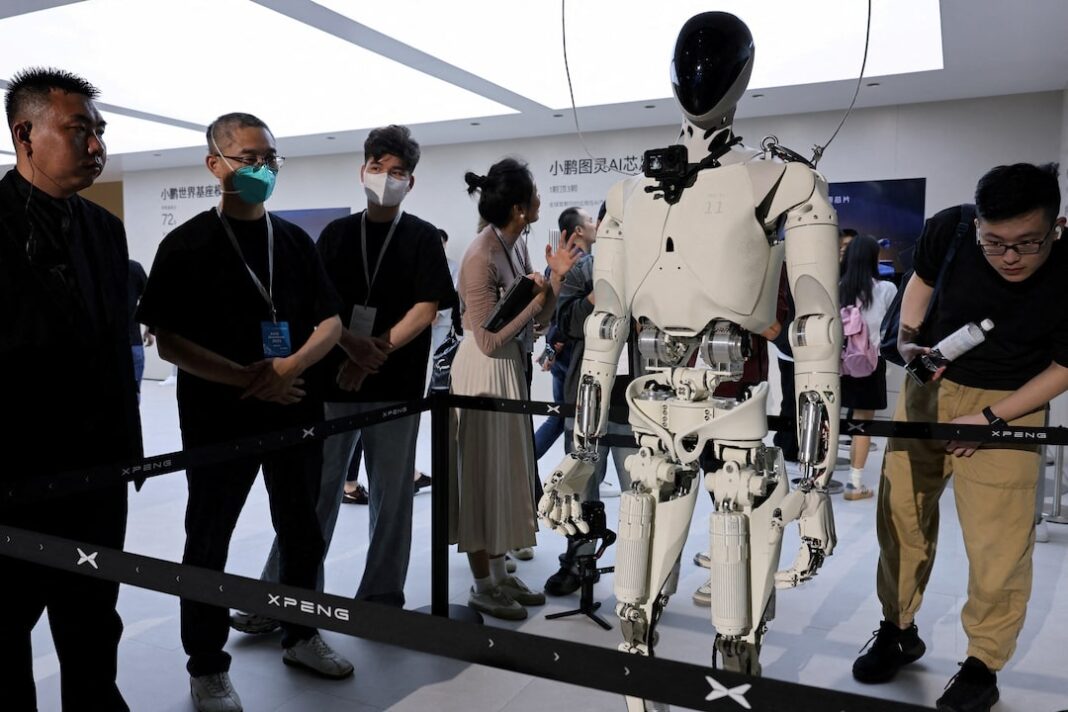

He Xiaopeng assumes direct leadership of the division days after a key executive’s resignation, as the Chinese automaker targets humanoid robot mass production by the end of 2026.
Xpeng Chief Executive Officer He Xiaopeng announced on Wednesday, June 10, that he would personally assume the role of chief executive of the company’s robotics business unit, effective immediately. The announcement, made through an internal letter reviewed by Reuters, comes as the Beijing-based electric vehicle maker prepares to launch mass production of its IRON humanoid robot by the end of the year. The move follows the resignation of Shi Xiaoxin, the senior director of robotics product planning and a central figure in the IRON project.
“The (robot) industry is becoming increasingly hot and competitive, and we have clearly seen the direction and timing of victory, but it still requires more arduous implementation and extremely high decision-making ability,” He said in the letter.
He placed the word “CEO” in quotation marks in his letter. According to CnEVPost, which obtained the full text, this is likely because the robotics unit has not been formally spun off as a separate legal entity. The decision, he wrote, comes on the eve of mass production and commercialisation of the IRON robot line.
Xpeng confirmed on Wednesday that Shi Xiaoxin had resigned as senior director of robotics product planning. The company offered no further explanation. Market speculation about Shi’s departure had circulated earlier in June, and Wednesday’s confirmation settled the question, though it also raised fresh ones about leadership continuity at a pivotal moment for the division.
According to CnEVPost, He said in the internal letter that over the past year, he has spent at least one full day a week on the robotics business, engaging in in-depth thinking, discussions, and decision-making. He described the current moment as a historic opportunity he did not want to miss.
A Tightly Scheduled Commercialisation Roadmap
According to Xpeng’s latest plan, the company will achieve mass production and initial delivery of its advanced humanoid robots in the fourth quarter of 2026. The company then plans to introduce humanoid robots into its offline stores nationwide in the first quarter of 2027 to take on shopping guide duties. By the second quarter of 2027, these robots will be pushed to broader overseas markets, with entry into ordinary households targeted for 2028.
He said on an earnings call in late May that robotics hardware and related AI models are set to become one of the main drivers of revenue and gross margins from 2027 onward.
The IRON robot first debuted at the Auto Shanghai show in April 2025. The company completed the first unit of its ET1 humanoid robot prototype earlier this year, with He announcing the milestone on Chinese social media platform Weibo. “This marks a critical step toward the large-scale mass production of advanced humanoid robots this year,” he wrote at the time.
Xpeng has stated it is prioritising development of its robots entirely in-house rather than relying on third-party suppliers for critical systems. He has said the company builds everything internally, including chips, operating systems, robotic joints, and dexterous robotic hands, describing Xpeng as the only robotics company in China with a fully self-developed full-stack architecture.
Financial Pressure Mounts
Xpeng’s push into robotics comes against a backdrop of strained finances. The company’s first-quarter revenue fell 17.6% year on year, with net losses widening from the previous year — reversing its first-ever quarterly break-even recorded in the fourth quarter of 2025. The robotics and physical AI pivot is, in part, a bet that new revenue streams can compensate for pressure in the core EV business, where domestic competition in China remains intense.
He has described the company’s broader strategic direction as a shift from a “smart car company” to a “physical AI company,” encompassing humanoid robots, robotaxis, and flying cars.
What It Means for China’s Robotics Race
Xpeng’s move to place its CEO directly over the robotics division reflects the accelerating competition among Chinese technology and automotive firms to establish early dominance in humanoid robotics. Several Chinese companies, including state-backed players and private startups, have announced competing timelines and products. Xpeng gathered nearly 1,000 employees from departments spanning automotive engineering, powertrain systems, manufacturing, testing, and general AI at a large-scale mobilisation rally focused on robot manufacturing earlier this year, according to industry outlet Gasgoo, pointing to the scale of internal resources being directed toward the effort.
If Xpeng meets its fourth-quarter 2026 production deadline, it would be among the first automakers globally to commercially deploy humanoid robots at scale — a milestone that would carry significant weight in China’s ongoing technology competition with the United States.
Background
Xpeng was founded in 2014 and listed on the New York Stock Exchange. The company built its reputation on smart electric vehicles with advanced driver-assistance systems. He Xiaopeng co-founded the company and has served as chairman and CEO. The IRON humanoid robot was unveiled publicly in April 2025. China has made robotics a national industrial priority, with government guidance documents calling for globally competitive humanoid robot products by the late 2020s. Multiple Chinese automakers, including BYD and Chery, have separately announced robotics projects.
What Happens Next
Xpeng has set the fourth quarter of 2026 as its target for mass production and initial delivery of the IRON robot. Retail store deployments across China are planned for the first quarter of 2027, followed by overseas market entry in the second quarter of 2027. He told investors in late May that robotics would become a primary revenue driver from 2027. The company has not yet announced a replacement for Shi Xiaoxin in the product planning role. No timeline has been confirmed for a formal spin-off of the robotics unit as an independent entity.