
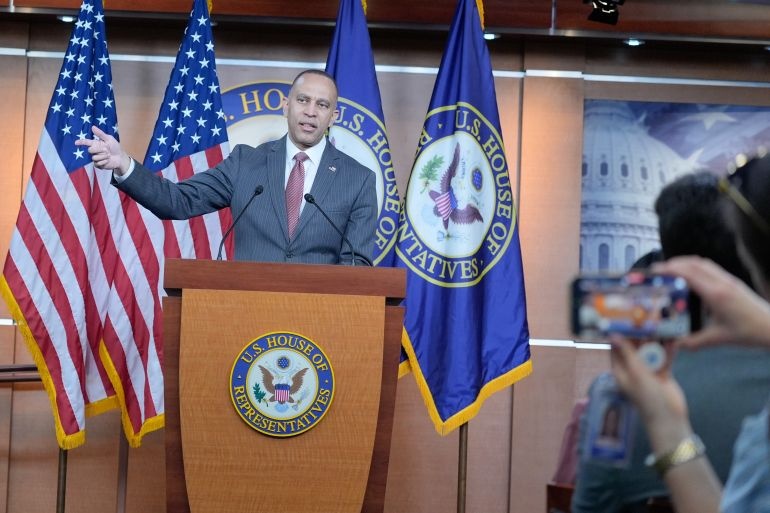

The United States House of Representatives voted on Wednesday, June 4 to use the War Powers Act to stop President Donald Trumps action, against Iran. This happened four months after the US and Israel started the conflict. The resolution passed 215 to 208, with four Republican lawmakers breaking with their party to support it. The vote marks the first time the House has successfully passed such a measure since the war began on February 28.
The result came after three previous Democratic attempts to invoke the 1973 War Powers Act all failed. Democrats have argued from the outset that Congress — not the president — holds the constitutional authority to declare war, and that Trump’s military operations in Iran were launched without the required congressional authorisation.
Four Republicans voted in favour: Representatives Tom Barrett of Michigan, Warren Davidson of Ohio, Thomas Massie of Kentucky, and Brian Fitzpatrick of Pennsylvania. Barrett, Davidson, and Massie had already broken party lines two weeks earlier during the previous failed vote. Fitzpatrick joined them on Wednesday, according to Al Jazeera.
House Democratic Leader Hakeem Jeffries has publicly described the Trump administration as wasting taxpayer money on what he called a “reckless war of choice,” according to Al Jazeera.
The Republican defections reflect a broader shift in mood within the party. Al Jazeera reported that while Republicans overwhelmingly backed the conflict at its launch, domestic economic pressures and the failure to secure a lasting peace deal with Tehran have eroded support. Trump’s approval ratings have dropped sharply since the war began.
Despite the vote, the resolution faces steep obstacles before it can take effect.
The Senate must also pass the measure. Republicans hold a slim majority in the upper chamber and have so far blocked Democratic efforts to advance similar legislation. The most recent Senate vote — held two weeks ago — resulted in a 50-to-47 tally in favour of advancing exit procedures, with four Republicans joining Democrats. That fell short of the threshold needed to proceed. Democratic Senator John Fetterman of Pennsylvania was the only member of his party to vote against the measure.
Even if the Senate passes the resolution, Trump retains the power to veto it. Overriding a presidential veto would require a two-thirds majority in both chambers — a threshold that is widely seen as unattainable given current Republican support for the president, Al Jazeera reported.
The Trump administration has also challenged the legal premise of the vote. Secretary of State Marco Rubio, testifying before Senate committees on Tuesday and Wednesday, declared flatly: “The Iran war is over.” The administration argues that a ceasefire between the US and Iran — in effect since April 8 — means the country is not currently engaged in active hostilities, and that the War Powers Act therefore does not apply.
Senator Jeanne Shaheen, a Democrat on the Senate Foreign Relations Committee, disputed that account directly. “You sent Congress a war powers notification, saying we are not in active hostilities with Iran while the US was conducting strikes against Iran and Iran was bombing US embassies and bases throughout the Middle East,” she told Rubio. “That was not consultation; it was an attempt to avoid answering to this committee and this Congress about this war.”
The administration has gone further in asserting its authority to restart operations. Defense Secretary Pete Hegseth, testifying before the Senate Appropriations Committee on May 12, argued that the April 8 ceasefire effectively reset the 60-day War Powers Act clock. “Should the president make the decision to recommence [the war on Iran], we would have all of the authorities necessary to do so,” Hegseth said.
Regional and Global Impact
Al Jazeera said there have been thousands of deaths in the conflict since February. The fighting has also caused problems for global trade.is still blocking the Strait of Hormuz which’s part of the reason, for the disruption. The US has maintained a blockade of Iranian ports and has struck Iranian vessels, even following the April 8 ceasefire declaration. On May 1, Trump declared the ceasefire marked a “termination” of hostilities, though military actions have continued on both sides.
Background
The US and Israel launched military strikes against Iran on February 28. Under the 1973 War Powers Act, a president may deploy troops in response to imminent threats to the United States without prior congressional approval, but must notify Congress within 48 hours and withdraw forces within 60 days if Congress does not declare war. Critics argued that neither the US nor Israel faced an imminent threat when the strikes began. Trump did not withdraw US forces at the 60-day mark, which fell around April 29. Democrats made three unsuccessful attempts to invoke the act before Wednesday’s vote succeeded.
What Happens Next
The resolution is going to the Senate now. This is where the Republicans have the seats. They have stopped things like this before. The Republicans have a majority, in the Senate. Secretary of State Rubio was asked by lawmakers to submit additional written information detailing the administration’s plans to exit the Iran conflict and address related operations in Venezuela. The Senate Foreign Relations Committee has indicated it will continue oversight hearings on the war. If the Senate does pass the resolution and Trump vetoes it, Congress would need a two-thirds majority in both chambers to override — a vote count that has not yet materialised, according to Al Jazeera.